2024 marked a milestone in marine biology with the first video capture of the Promachoteuthis squid on the Nazca Ridge. Its alien-like appearance, with twisted tentacles and a bulbous head, has fascinated the scientific community. Now, 3D visualization allows for the digital dissection of this deep-sea creature, offering an unprecedented window into its anatomy and behavior in an extreme ecosystem.
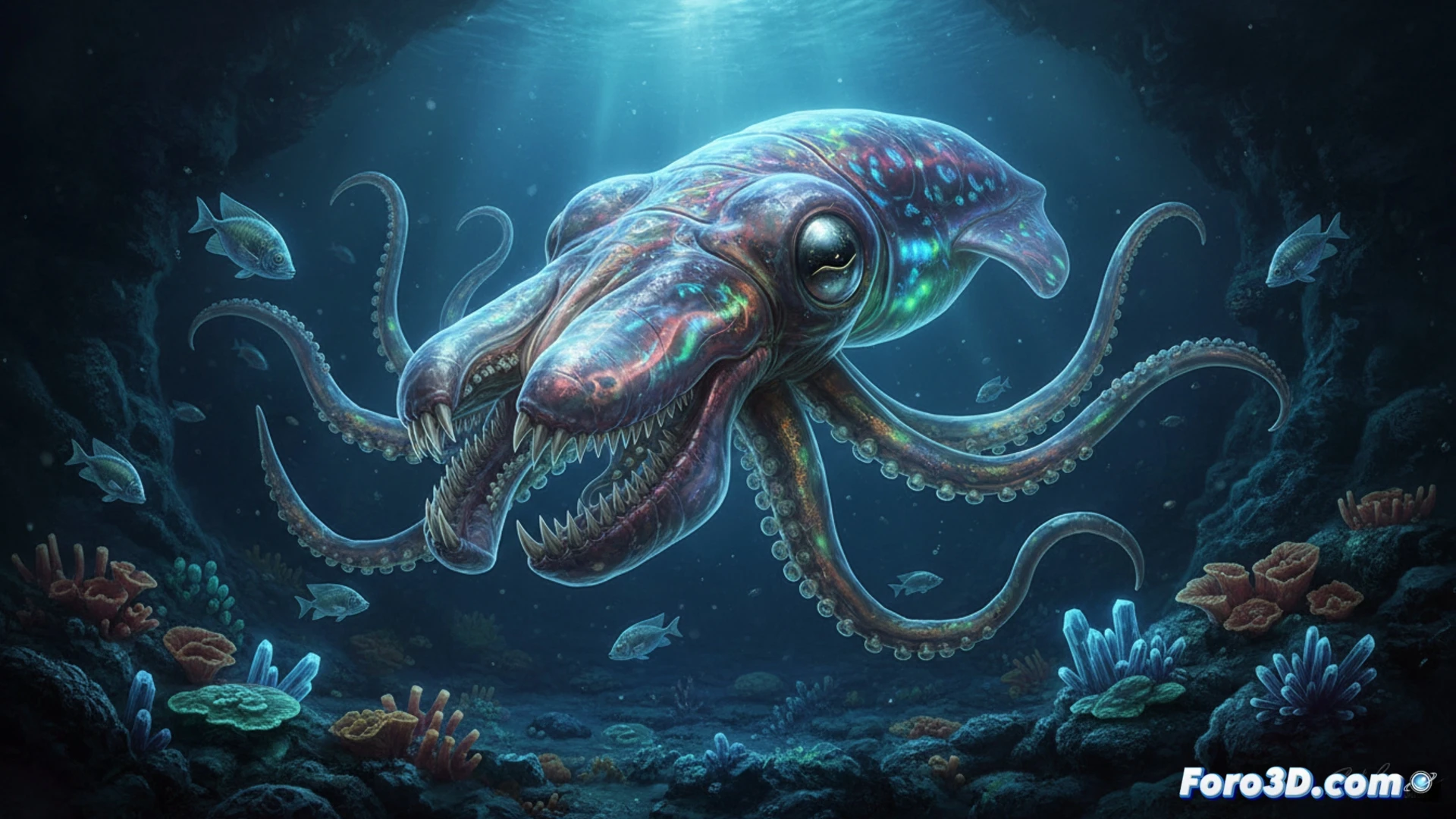
From 2D video to detailed volumetric model 🐙
The documentation process began with a frame-by-frame analysis of the underwater footage. Using photogrammetry and volumetric reconstruction techniques, researchers transformed the flat images into a three-dimensional polygonal mesh. This anatomical model allowed for the study of the structure of its suckers and the arrangement of its photophores, responsible for its bioluminescence. The simulation of its habitat, at depths of over 4,000 meters, was recreated in rendering environments like Blender, adjusting pressure and lighting to reflect the real conditions of the Nazca Ridge. The result is a digital twin that serves both for outreach and biological research without the need to capture specimens.
Implications for scientific visualization 🔬
This case demonstrates how 3D technology is revolutionizing the study of cryptic species. By modeling the Promachoteuthis, scientists can simulate its locomotion and reactions to stimuli, hypotheses that were previously impossible to verify. For the Foro3D community, it represents a fascinating technical challenge: replicating the gelatinous texture and partial transparency of its skin. Beyond visual amazement, these reconstructions become key educational tools for understanding the biodiversity of ocean trenches.
What was the greatest technical challenge in the 3D reconstruction process of Promachoteuthis from the video footage captured on the Nazca Ridge?
(PS: at Foro3D we know that even manta rays have better social connections than our polygons)