Escalator entrapment accidents represent a silent catastrophe in public transportation. Although they are rare events, the consequences are devastating, often resulting in amputations or severe injuries. This technical analysis focuses on the virtual reconstruction of the mechanism, specifically in the critical zone between the step and the exit comb, to understand the dynamics of the incident and propose design solutions.
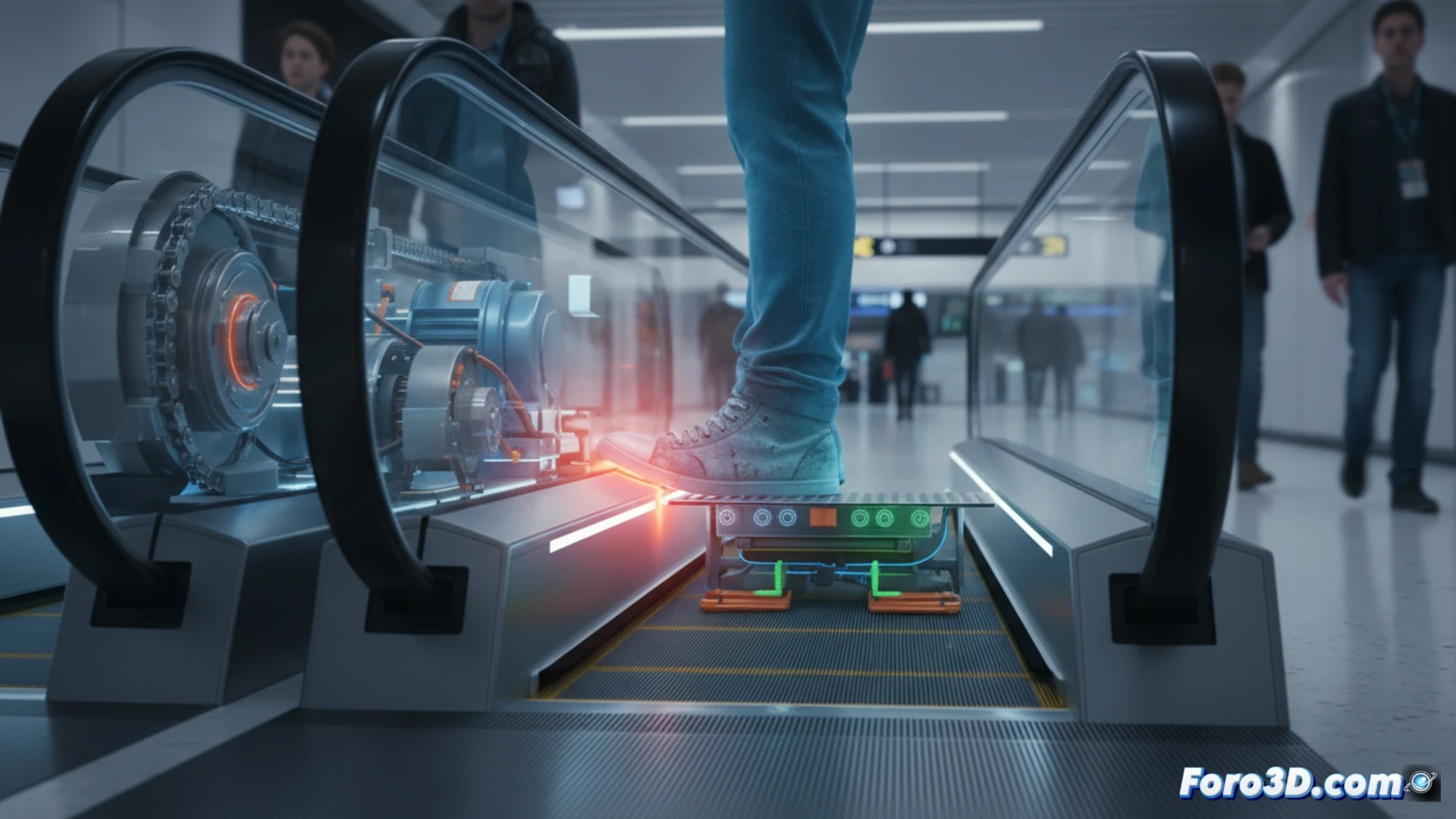
Simulation of forces and mechanism dynamics ⚙️
The 3D simulation reveals that the entrapment point is not a single gear, but a sequence of events. When a soft object, such as a rubber sole or a shoelace, enters the side groove, the drive chain continues to exert a shearing force of up to 200 kg. The parametric model allows visualizing how the step, as it passes over the fixed comb, reduces the clearance to less than 4 mm. The finite element animation shows the material deformation and the exact trajectory of the entrapment, allowing calculation of the closing speed and the available reaction time, which is less than 0.3 seconds.
Proposal for improvements based on virtual analysis 🛠️
The virtual model identifies three replicable design flaws in simulations. First, the lack of an obstruction sensor in the exit comb. Second, the excessive rigidity of the side brushes, which do not deflect objects but rather guide them into the mechanism. Third, the absence of a stop system based on anomalous torque detection. The 3D reconstruction proposes implementing a segmented comb with pressure sensors and a progressive braking system. This virtual analysis allows engineers to test safety protocols without physical risk, reducing the probability of catastrophes in public infrastructure.
How can the 3D reconstruction of an escalator entrapment help identify critical safety points that traditional visual inspections overlook in catastrophe prevention?
(PS: Simulating catastrophes is fun until the computer crashes and you are the catastrophe.)