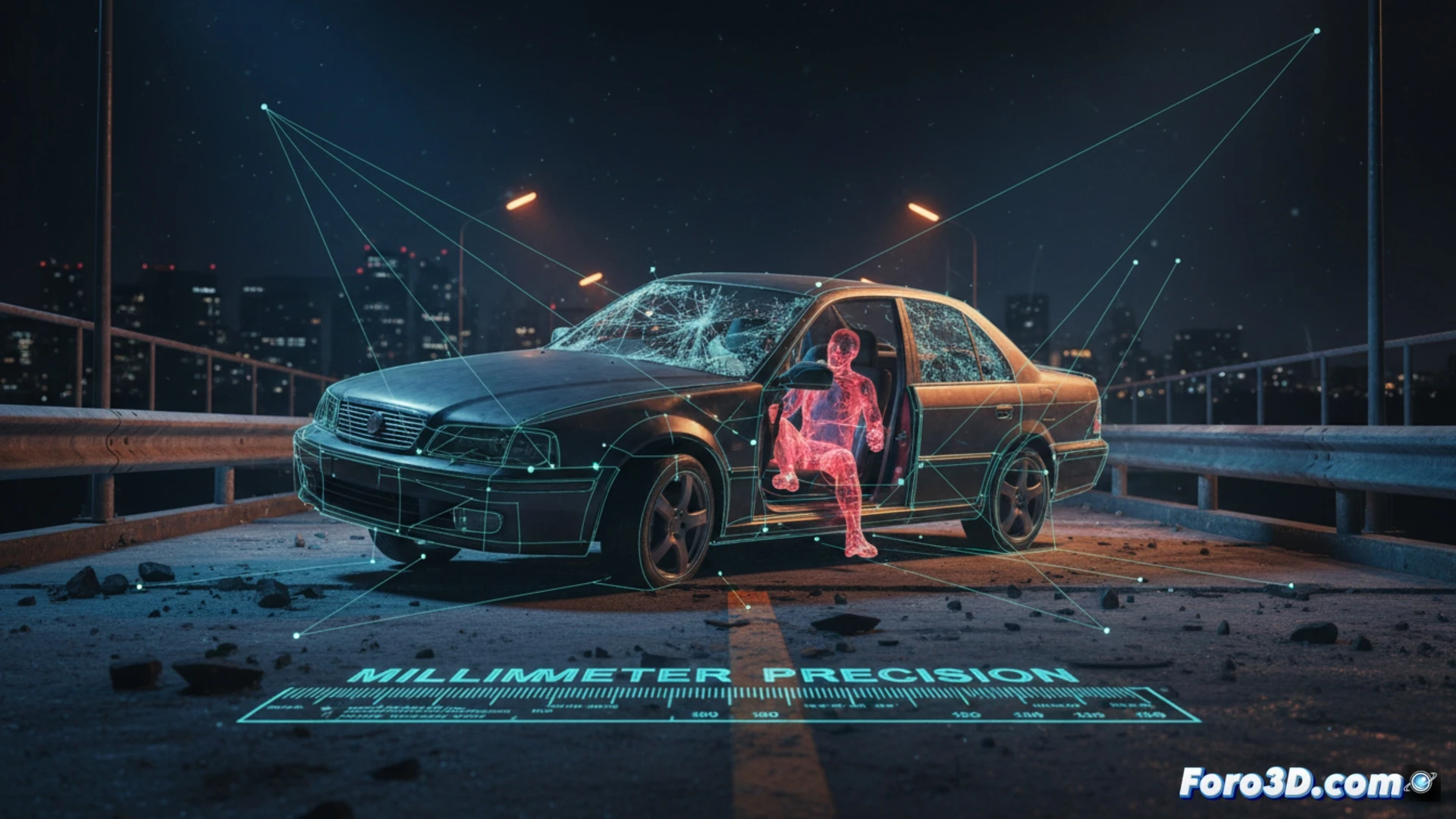
On the night of April 6, on the bridge over the Meguro River in Tokyo, three doctors intervened to save an injured driver after a violent impact. The scene featured a shattered windshield and a victim with severe bleeding. For investigators, this type of incident raises key questions about crash dynamics and responsibility. 3D reconstruction technology allows these to be answered with millimeter precision, transforming visual testimony into a verifiable virtual model.
Photogrammetry and laser scanning: capturing the incident 🛰️
In an accident like the one on Meguro Bridge, the first technical step is documenting the scene using digital photogrammetry. Hundreds of high-resolution images are taken from multiple angles, which specialized software converts into a three-dimensional point cloud. Complementarily, laser scanning (LiDAR) measures exact distances between the vehicle, skid marks, and the impact point. This data allows recreating the exact position of the car, the collision trajectory, and the distribution of glass fragments, essential for calculating the speed and angle of impact. In this case, the reconstruction could confirm whether the driver lost control or if there was an external factor.
Beyond responsibility: data-driven prevention 🚦
3D forensic analysis not only serves to clarify legal responsibilities but also provides critical information for road safety. By simulating the accident in a virtual environment, engineers can evaluate the effectiveness of the bridge barriers, nighttime visibility, and reaction times. The rapid intervention of the doctors was vital, but the digital reconstruction reveals how to improve road design to prevent a similar incident from ending in tragedy. Thus, 3D technology becomes a prevention tool, not just an investigation one.
Would you place scale witnesses before scanning?