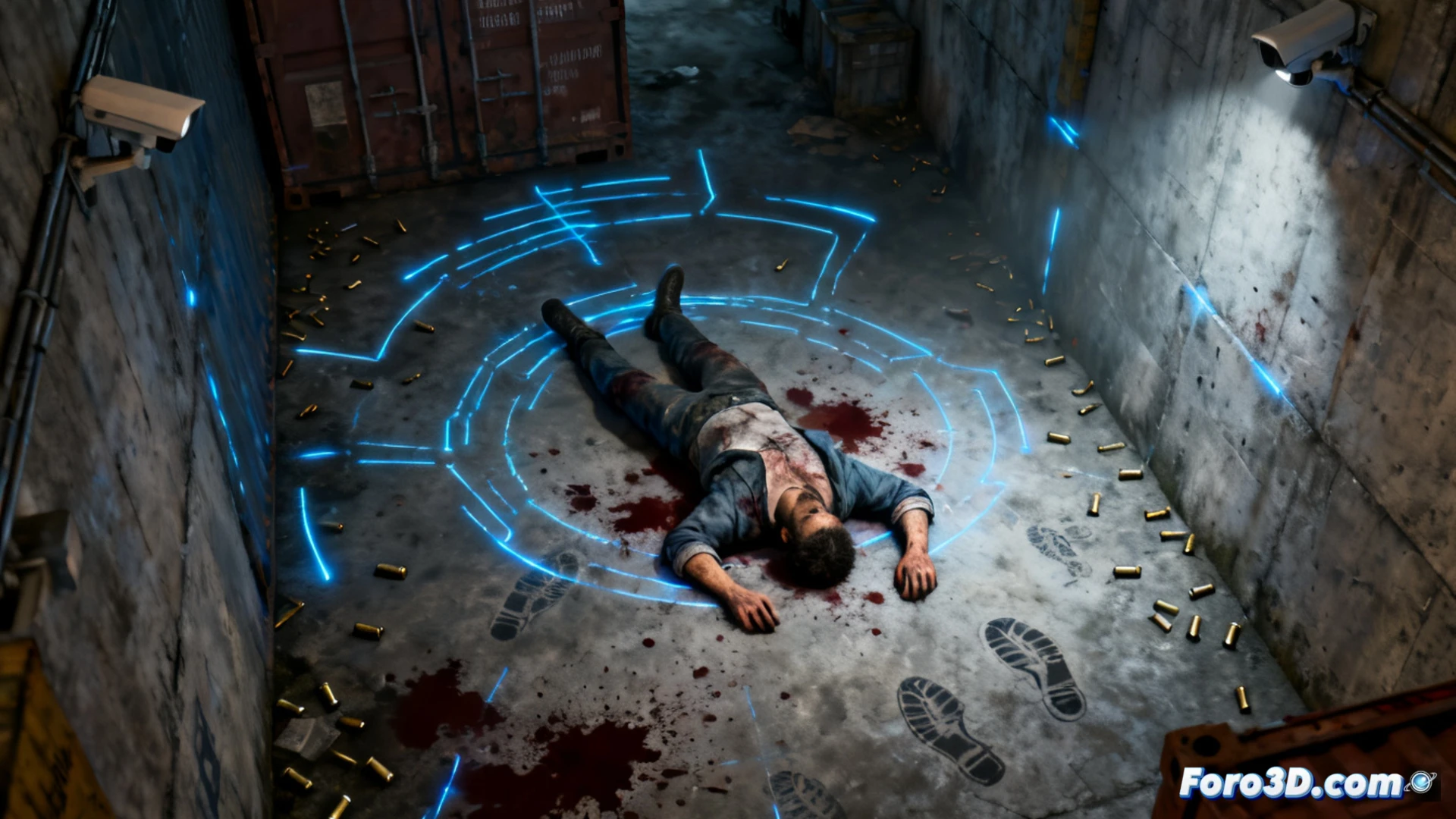
On Saturday afternoon, a man was killed by several gunshots to the head while walking along Minería Street in the Zona Franca of Barcelona. Attacked from behind, neighbors mistook the shots for firecrackers. The scientific police are searching for shell casings and analyzing the scene, considering a settling of scores. This case is a perfect scenario for applying a 3D forensic workflow to document, analyze, and simulate the crime dynamics.
Workflow: LiDAR, photogrammetry, and ballistic simulation 🎯
The first step would be a LiDAR scan of the entire Minería Street, capturing the precise geometry of facades, sidewalks, and street furniture. Simultaneously, a high-resolution photogrammetry of the suspect's escape route towards Gran Vía would be performed, recording possible footprints or residues. At the main scene, the exact position of the victim and each shell casing would be documented using high-precision GPS coordinates. With this data in Unreal Engine, the scene would be recreated to simulate the ballistic trajectory, determining the angle of entry of the shots and the height of the attacker, key to confirming whether it was a professional execution.
The value of virtual reconstruction in real investigations 🔍
This workflow allows investigators to revisit the scene virtually, avoiding evidence contamination. The simulation in Unreal Engine helps visualize the sequence of events from the shooter's perspective, contrasting testimonies from neighbors who heard firecrackers. Additionally, by comparing this crime with the Sants-Montjuïc shooting, the 3D reconstruction could reveal similar execution patterns among Dominican groups. Technology not only documents but becomes an irrefutable digital witness for the trial.
Would you use a laser scanner or photogrammetry to document this case? 🤔