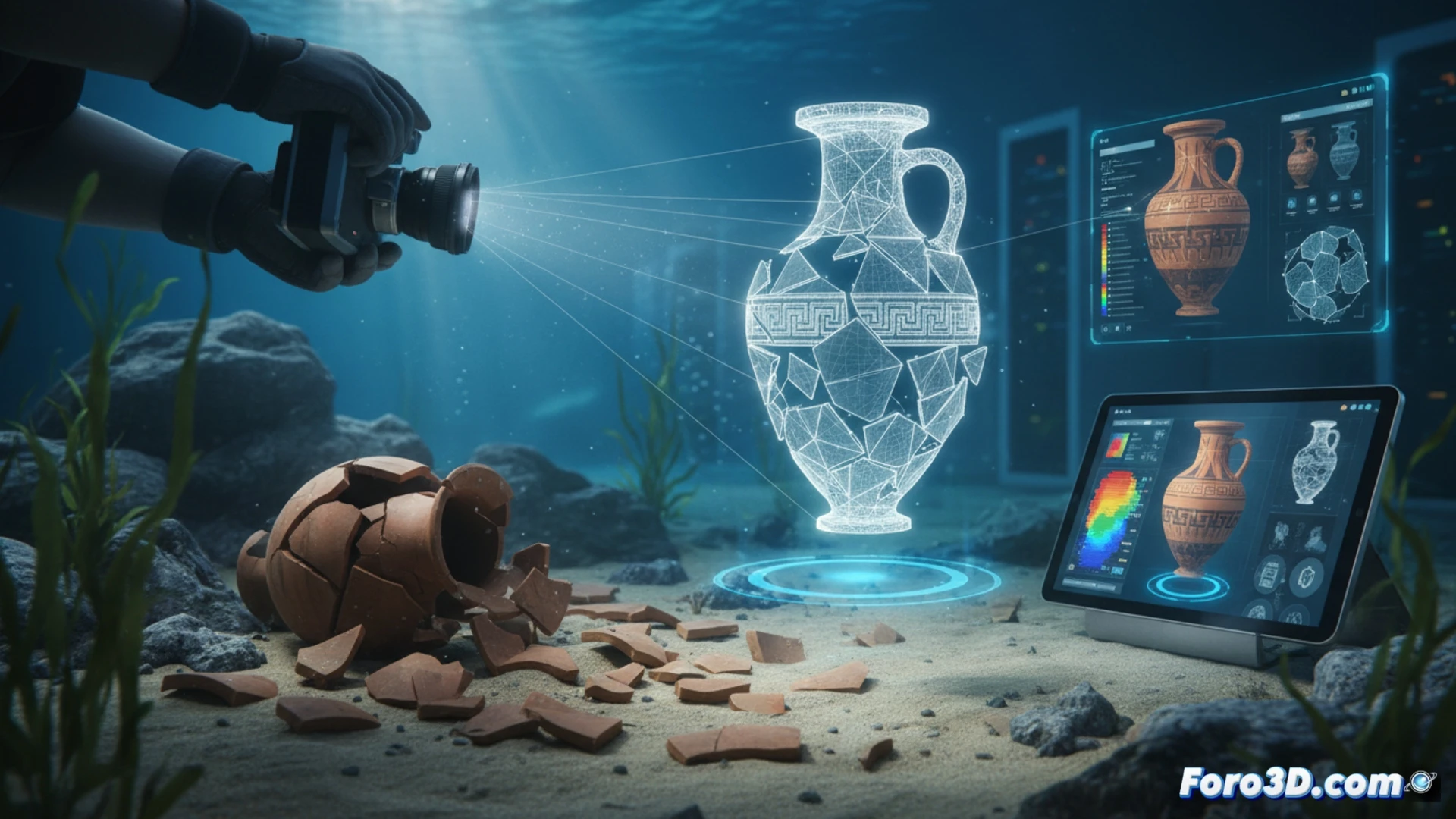
Archaeological restoration has taken a technological leap with 3D digitization. The case of a fragmented amphora found in an underwater context illustrates the complete process. Starting from dozens of scattered fragments, the goal is to digitally assemble the piece without physically touching the remains, allowing its study and dissemination without risk of deterioration. This method has become a standard in modern digital archaeology.
Technical workflow: scanning, alignment, and meshing 🛠️
The process begins with individual scanning of each fragment using photogrammetry with Agisoft Metashape or RealityCapture, obtaining high-resolution meshes. Each piece is exported to Blender, where an alignment algorithm based on differential geometry is applied. The biggest challenge is the lack of matching edges due to erosion. To solve this, manual retopology tools and contour line projection are used. Once aligned, they are merged into a single mesh and gaps are filled using hole filling with smoothing. The final texturing is achieved by projecting the original photos onto the 3D model, preserving the historical patina.
Implications for virtual museums 🏛️
This methodology changes the exhibition narrative. Instead of display cases with disconnected fragments, a virtual museum can show the complete amphora, allowing the model to be rotated and internal details to be observed. Additionally, animations can be generated showing the reverse assembly process, educating the public about the work of the digital archaeologist. The technology does not replace the physical piece, but expands its accessibility and long-term conservation.
What technical and methodological challenges does the 3D reconstruction of a broken amphora from scattered fragments present, and how is historical accuracy guaranteed in the final virtual model?
(PS: If you dig at a site and find a USB drive, don't plug it in: it could be Roman malware.)