The analysis of a wall after a medieval siege is a complex exercise that combines archaeology, engineering, and historical narrative. Every crack, collapse, or impact tells a story about the power of projectiles, the resistance of stone, and the tactics employed. In this article, we will explore how virtual reconstruction through photogrammetry and 3D modeling allows us to unravel these secrets, offering a forensic view of structural damage and a faithful recreation of the post-combat state.
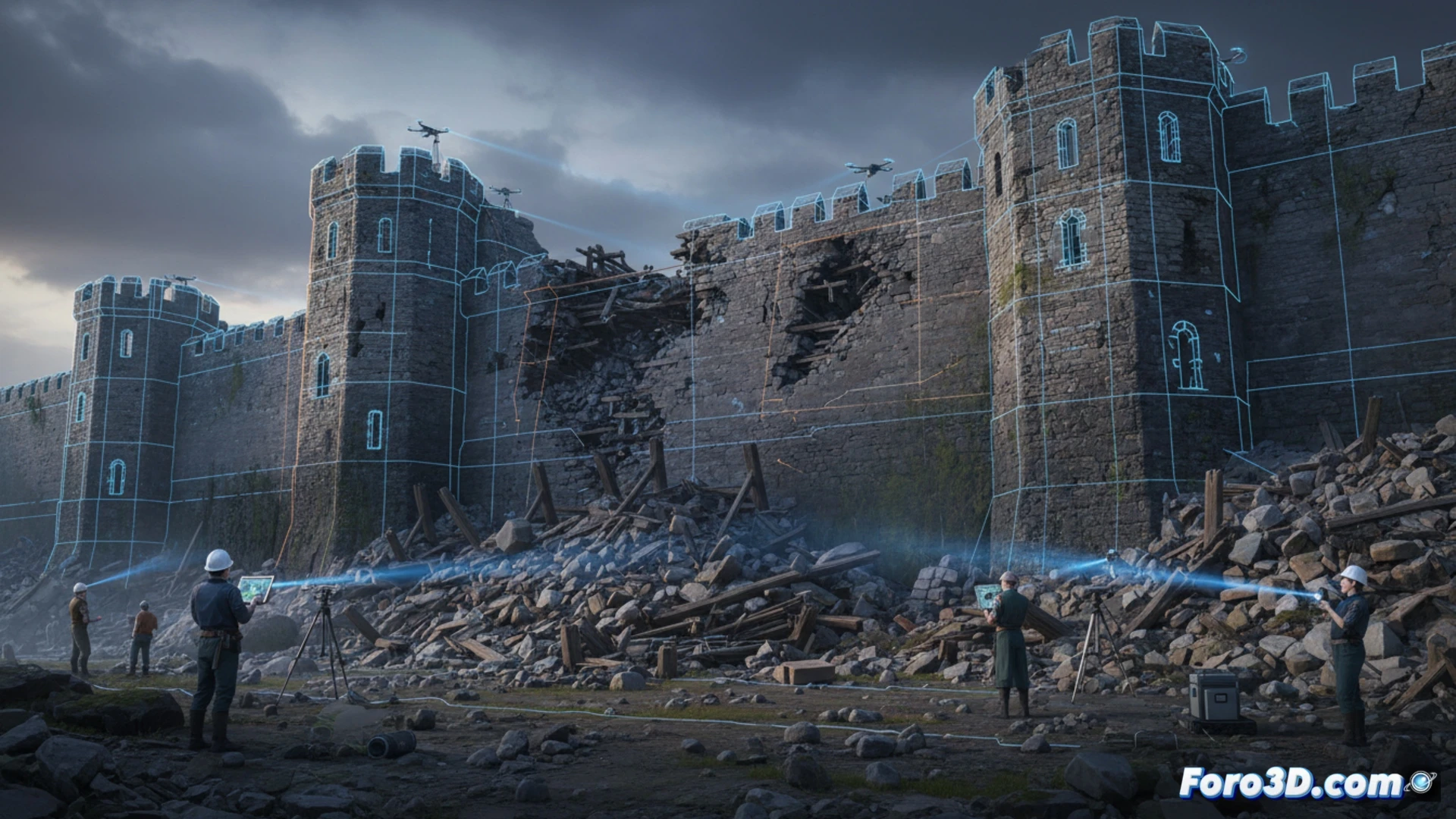
Technical Workflow for Forensic Analysis 🔍
The process begins with photogrammetric capture of the site. Between 200 and 400 high-resolution images are taken, covering every angle of the ruins, paying special attention to fracture zones and impact points from battering rams or trebuchets. The photogrammetry software generates a dense point cloud and a high-fidelity polygonal mesh. Based on this, parametric modeling is carried out in tools such as Blender or 3ds Max to reconstruct the collapsed sections, using historical references from the original quarry and masonry patterns. The key is to isolate siege damage from subsequent natural erosion, differentiating clean fractures (from impact) from irregular ones (from weathering). The result is a 3D model showing the wall at the exact moment of surrender.
The Value of the Virtual Ruin vs. the Physical One 🏰
Comparing the current ruin with the digital reconstruction not only reveals the evolution of deterioration but also humanizes the conflict. By visualizing the trajectory of a projectile or the exact point where a section of wall gave way, we understand the desperation and strategy of the siege. This technique does not seek to beautify the past, but to document the violence of history with millimeter precision. For the reconstructor, each block placed in the model is a testament to the medieval stonemason's craft and the fury of war.
How can structural damage caused by the direct impact of siege projectiles be differentiated in a 3D model from that caused by the progressive collapse of the wall during the medieval assault?
(PS: Reconstructing ruins is like doing a puzzle without knowing how many pieces are missing. But at least you can make up the missing ones.)