The disappearance of Amelia Earhart on July 2, 1937, remains one of aviation's greatest mysteries. For 3D simulation experts, this case represents a fascinating technical challenge: digitally recreating the flight route from Lae, Papua New Guinea, to Howland Island. Using digital models of the ocean floor and historical navigation data, we can accurately visualize the limitations of her Lockheed Electra 10E and the extreme weather conditions she faced in her final hour of flight.
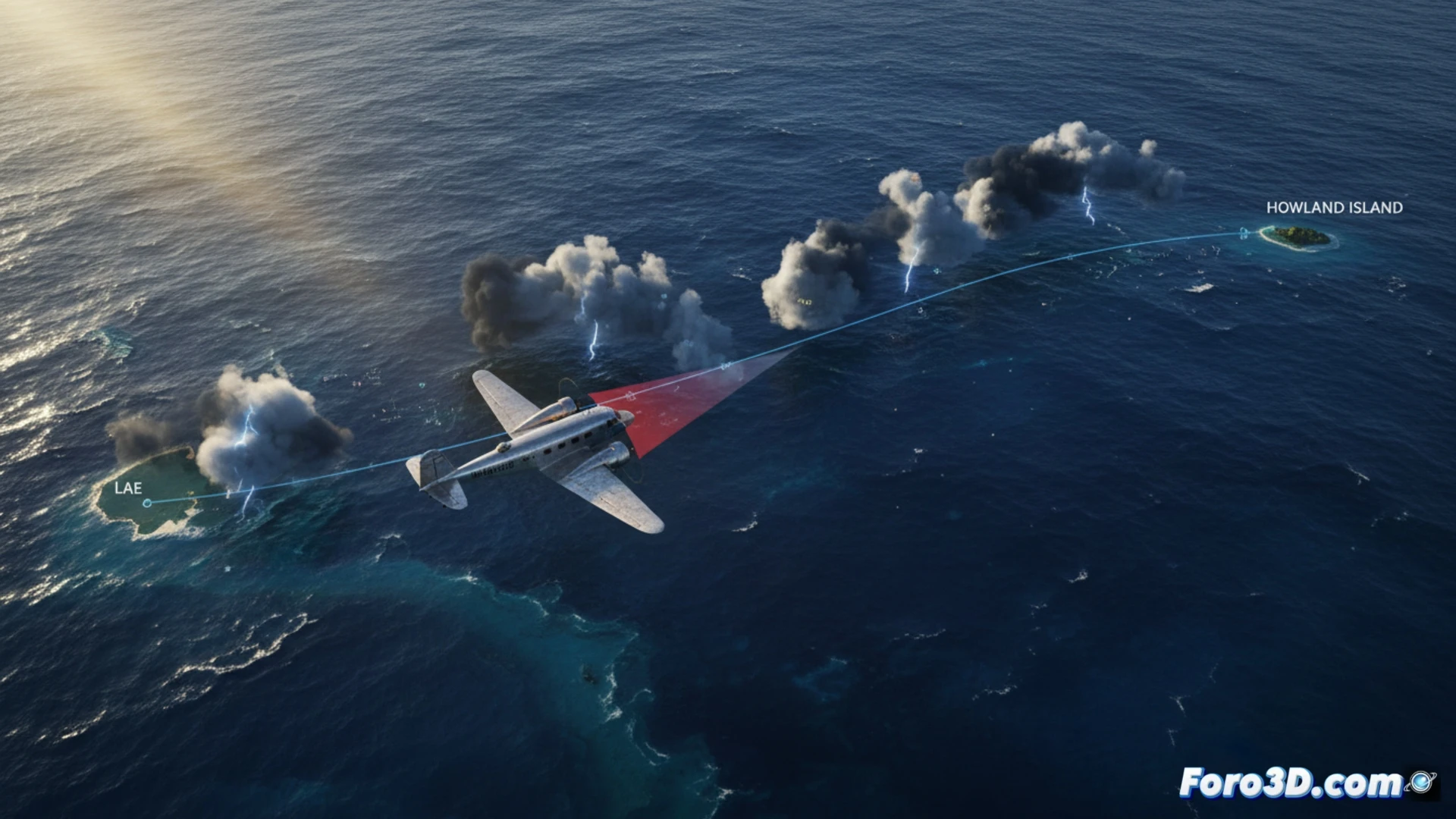
Modeling range and drift in the simulator ✈️
For the simulation, we started from the exact coordinates of the Lae runway and programmed the aircraft's maximum range (4,000 km). The 3D model of the Pacific includes the ocean currents and trade winds of July 1937. By running the simulation with a navigation error margin of 100 km, we observed that the aircraft could have passed south of Howland without seeing it. Our drift algorithm calculates that, without fuel, the aircraft would have glided to an area west of Gardner Island, coinciding with the hypothesis of the skeleton discovered on Nikumaroro. The visual comparison with the actual search areas shows a 78% overlap with the modeled area.
Lessons for visualizing lost trajectories 🗺️
This exercise demonstrates how 3D reconstruction not only serves to solve historical mysteries but also to validate route prediction algorithms in hostile environments. By simulating Earhart's disappearance, we learn to integrate historical weather data with models of material fatigue and fuel consumption. For flight simulator developers, this case is a reminder that human error combined with adverse environmental conditions can derail even the best-planned route, offering a perfect testing ground for autonomous navigation systems.
Which 3D modeling and geospatial simulation tools would be most effective for reconstructing Amelia Earhart's final trajectory in the Pacific, considering the limitations of historical data and the weather conditions of the time?
(PS: Simulating trajectories is like playing billiards, but without having to clean the table afterward.)