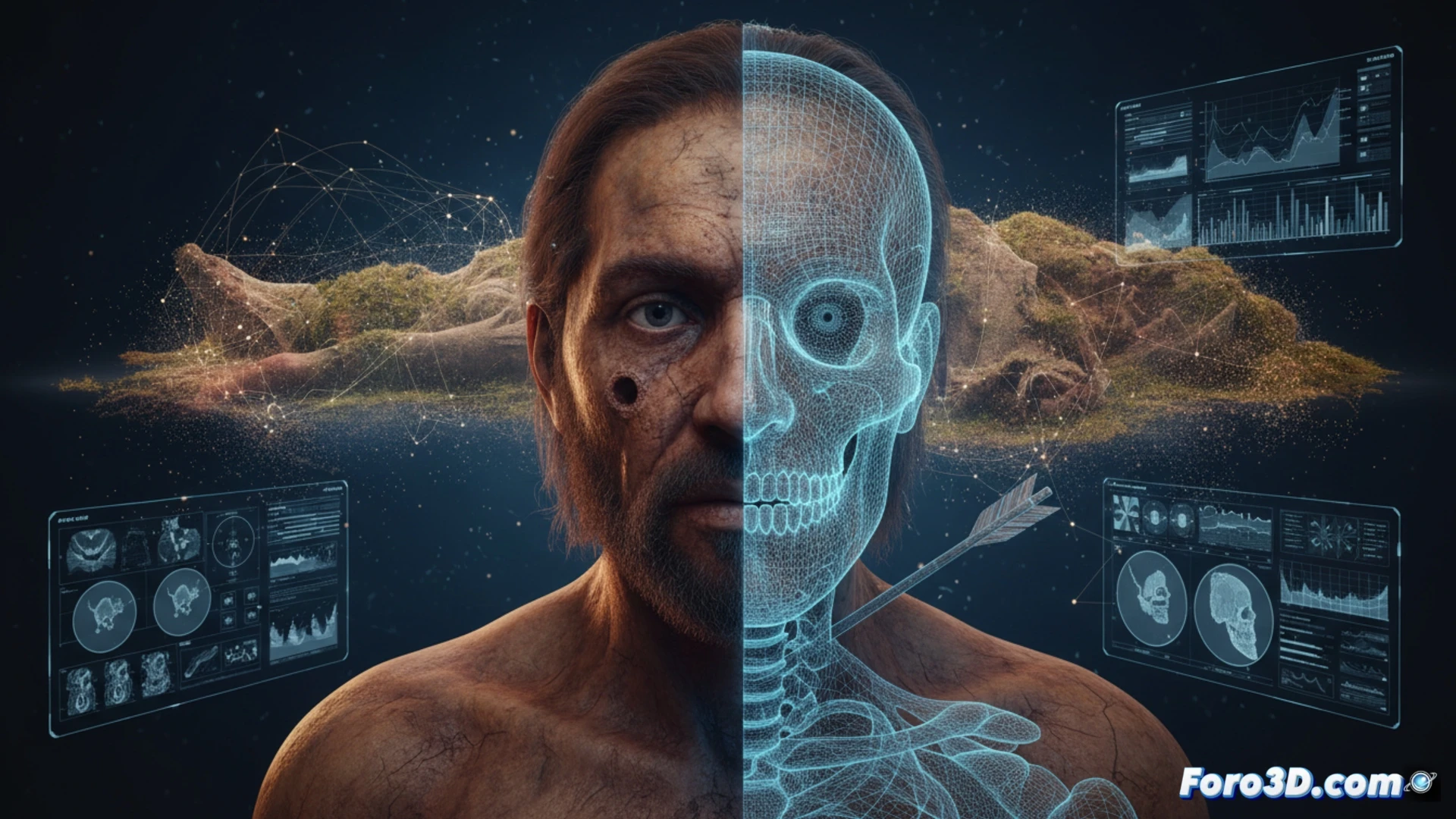
The team of digital archaeologists has managed to restore the face of a prehistoric bog mummy through a craniofacial reconstruction workflow. This process, which combines high-precision photogrammetry with forensic soft tissue thickness data, makes it possible to visualize the appearance of individuals who lived thousands of years ago. The technique not only has educational value but also helps identify potential pathologies and causes of death, turning anonymous remains into a window to the past.
From Laser Scanning to Polygonal Modeling: The Technical Pipeline 🖥️
The process begins with scanning the original skull using a structured light scanner or photogrammetry with Agisoft Metashape, generating a point cloud with submillimeter precision. This base model is imported into Blender, where standard craniometric markers are aligned. On these, soft tissue thickness tables specific to the ethnic group and estimated age are applied, creating a reference mesh. Next, the main facial muscles, such as the masseter and temporalis, are modeled following the bone insertions. The skin is generated using Catmull-Clark subdivision, and final details, such as wrinkles and texture, are painted with Substance Painter based on forensic studies of dental wear and nasal morphology.
Identity and Ethics in Digital Reconstruction ⚖️
Beyond the technical amazement, this reconstruction raises an ethical dilemma about identity. By restoring a face to a mummy, we risk imposing modern features on ancient individuals, biasing historical interpretation. The scientific community demands that these models be presented as hypotheses, not as exact portraits. However, when combined with DNA analysis and isotopic studies, 3D reconstruction becomes a powerful tool to humanize heritage, allowing the public to emotionally connect with a past that would otherwise be just dust.
Is it possible to obtain a reliable forensic facial reconstruction of a bog mummy when the soft tissue is extremely degraded and carbon-14 dating shows an age of over two thousand years?
(PS: If you dig at a site and find a USB stick, don't plug it in: it could be Roman malware.)