On March 15, a catastrophic explosion shook the Santa Cruz Refinery, destroying the pulverized sugar storage section. The accumulation of combustible dust generated a deflagration that turned into a detonation, collapsing steel beams and retaining walls. Now, a forensic team uses integrated simulations of FLACS, FARO Scene, and Abaqus to digitally recreate the incident and determine whether the pressure relief systems worked correctly or failed in a chain reaction.
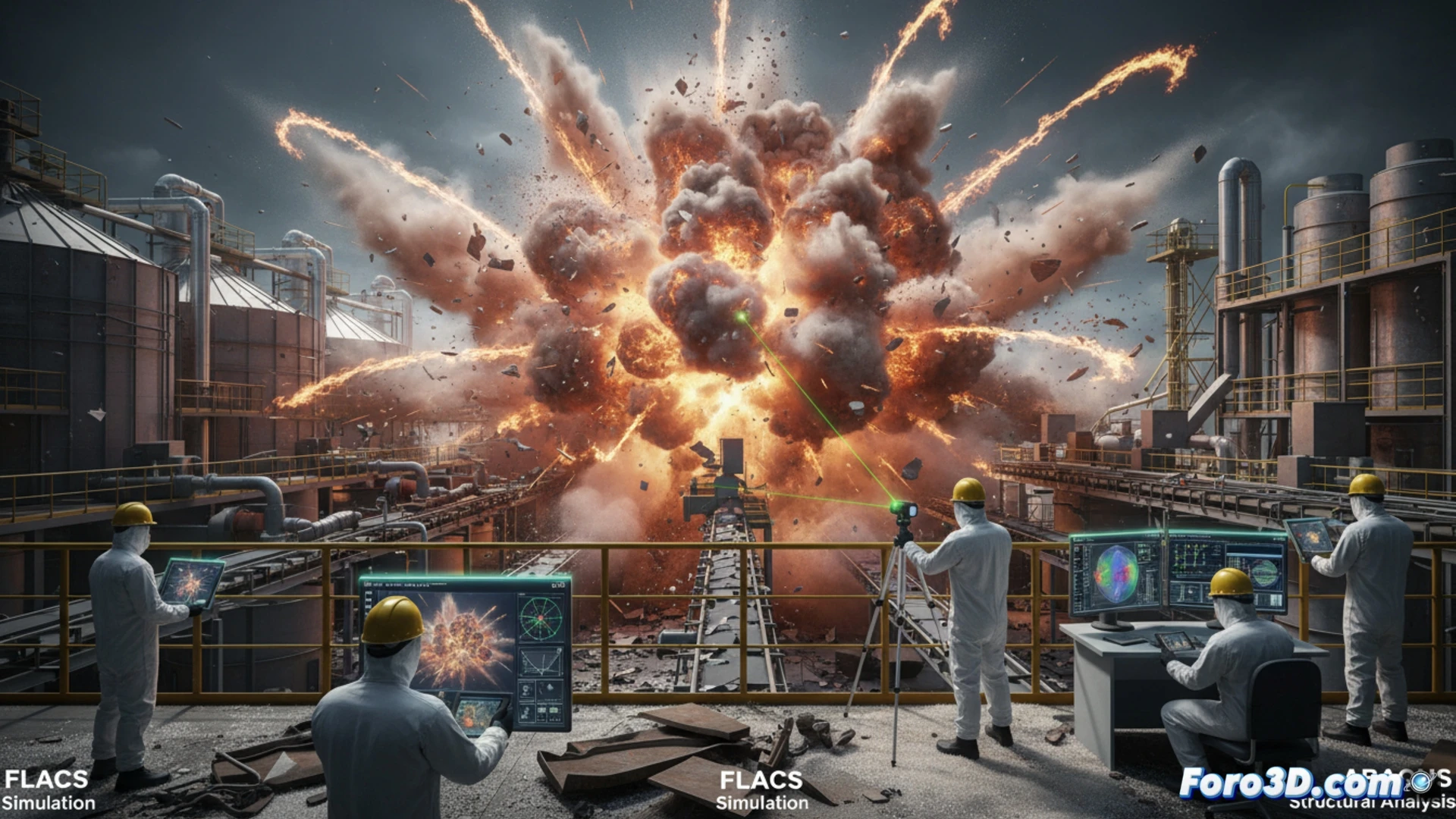
Technical workflow: LiDAR, CFD, and Structural FEA 🔥
The forensic process begins with LiDAR scanning using FARO Scene, capturing the post-explosion geometry with millimeter precision. This point cloud is imported into FLACS, where the dispersion of sugar dust in the silos and ventilation ducts is modeled. Computational fluid dynamics (CFD) simulations calculate the evolution of the shock wave, identifying the initial ignition point near an overheated bucket elevator. Peak pressure and temperature data are then transferred to Abaqus for a finite element analysis (FEA) that evaluates the nonlinear behavior of structural steel, verifying whether the joints and relief panels yielded within design parameters or if the overpressure exceeded critical limits.
Virtual lessons for industrial prevention ⚙️
The 3D reconstruction does not only seek technical culprits but serves as a virtual laboratory to improve regulations. By mapping the chain failure of the relief systems, the model reveals that the flame propagation speed exceeded the response capacity of the passive vents. This digital evidence drives the revision of safety codes in food refineries, demonstrating that the combination of CFD and FEA is today an indispensable tool to prevent a dust cloud from becoming a death sentence for operators.
How could the 3D reconstruction of the sugar dust explosion in Santa Cruz help identify critical ignition points and improve safety protocols in similar industries
(PS: Simulating catastrophes is fun until the computer melts down and you are the catastrophe.)