The fall of a metallic object that pierces a building is no longer just a random event, but a technical case study. The impact of space debris on terrestrial infrastructure demands a precise reconstruction pipeline. This article details the workflow combining 3D scanning, fatigue analysis, and orbital dynamics to trace the projectile's origin, using tools such as STK, Agisoft Metashape, GOM Inspect, and Blender. 🛰️
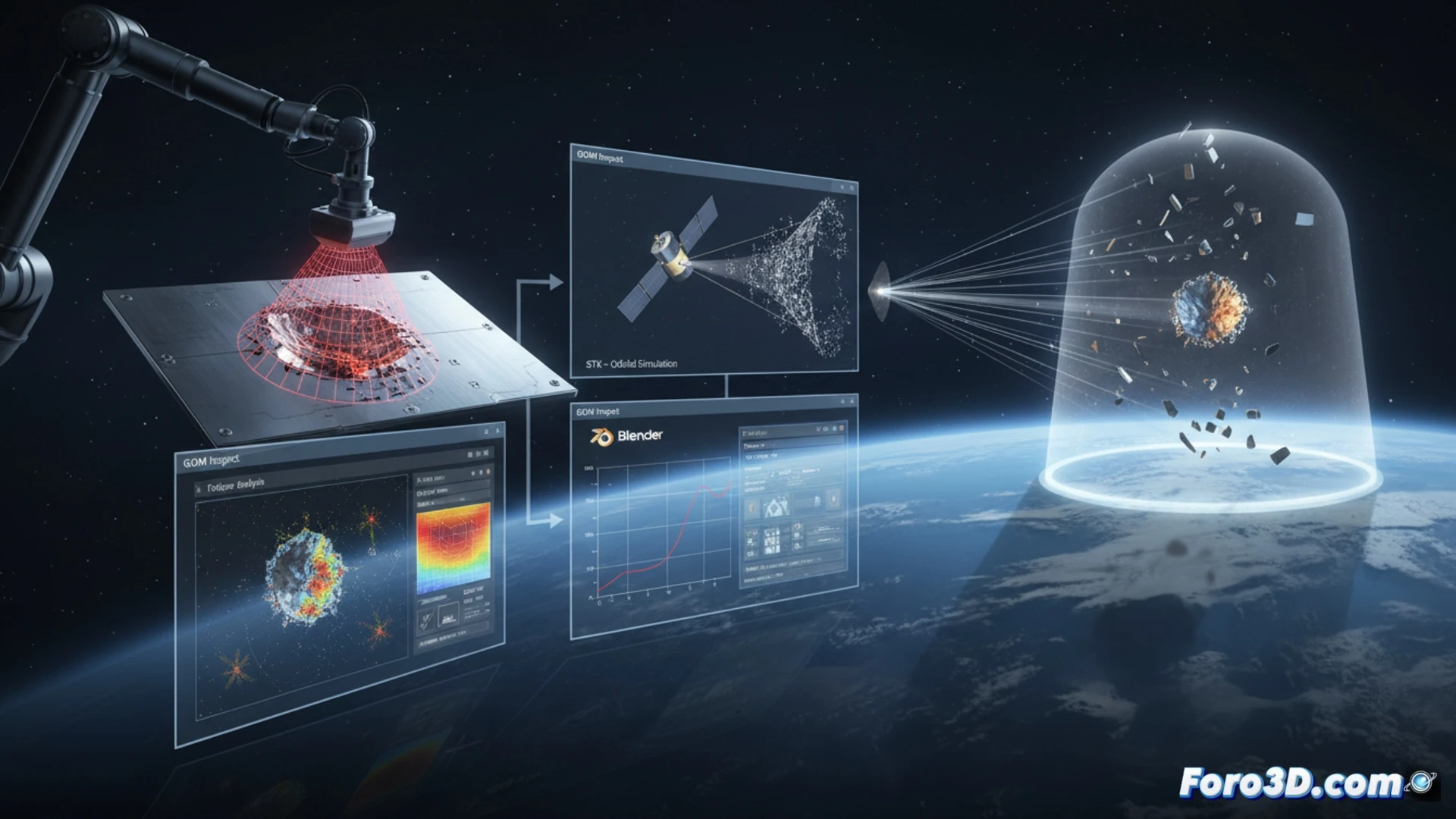
Technical pipeline: scanning, ablation, and orbital dynamics 🔧
The process begins with scanning the crater and fragment using photogrammetry in Agisoft Metashape, generating a high-resolution point cloud. This model is imported into GOM Inspect for dimensional and deformation analysis, quantifying the impact energy. Subsequently, the material ablation on the object's surface is studied, identifying fusion and oxidation patterns that reveal its composition and re-entry velocity. This data is cross-referenced with material fatigue models to estimate orbital wear. Finally, the STK (Systems Tool Kit) software simulates the reverse trajectory, integrating the impact position and atmospheric drag to calculate the object's original orbit.
The value of virtual simulation in orbital safety 🎯
This pipeline demonstrates that the boundary between forensic analysis and virtual simulation is increasingly blurred. By visualizing the ablation and reconstructed trajectory in Blender, engineers can validate hypotheses about the debris's origin, whether it be an inactive satellite or a rocket fragment. The ability to virtually recreate the impact not only allows for tracking the object but also for predicting future risks, reinforcing the need for space debris mitigation protocols from the very design of missions.
How can the deformation and penetration of a metallic object into a reinforced concrete structure during an orbital impact be mathematically modeled to generate a precise virtual trajectory that allows for reconstructing the crater and simulating the event?
(PS: Simulating trajectories is like playing billiards, but without having to clean the table afterwards.)