The release of Resident Evil Village not only solidified the saga's narrative but also established a new technical standard in the industry. Capcom, using its proprietary RE Engine, achieved an almost perfect balance between extreme visual fidelity and optimized performance. This article breaks down the keys to this achievement, analyzing everything from the modeling pipeline to the lighting techniques that define the game's atmosphere.
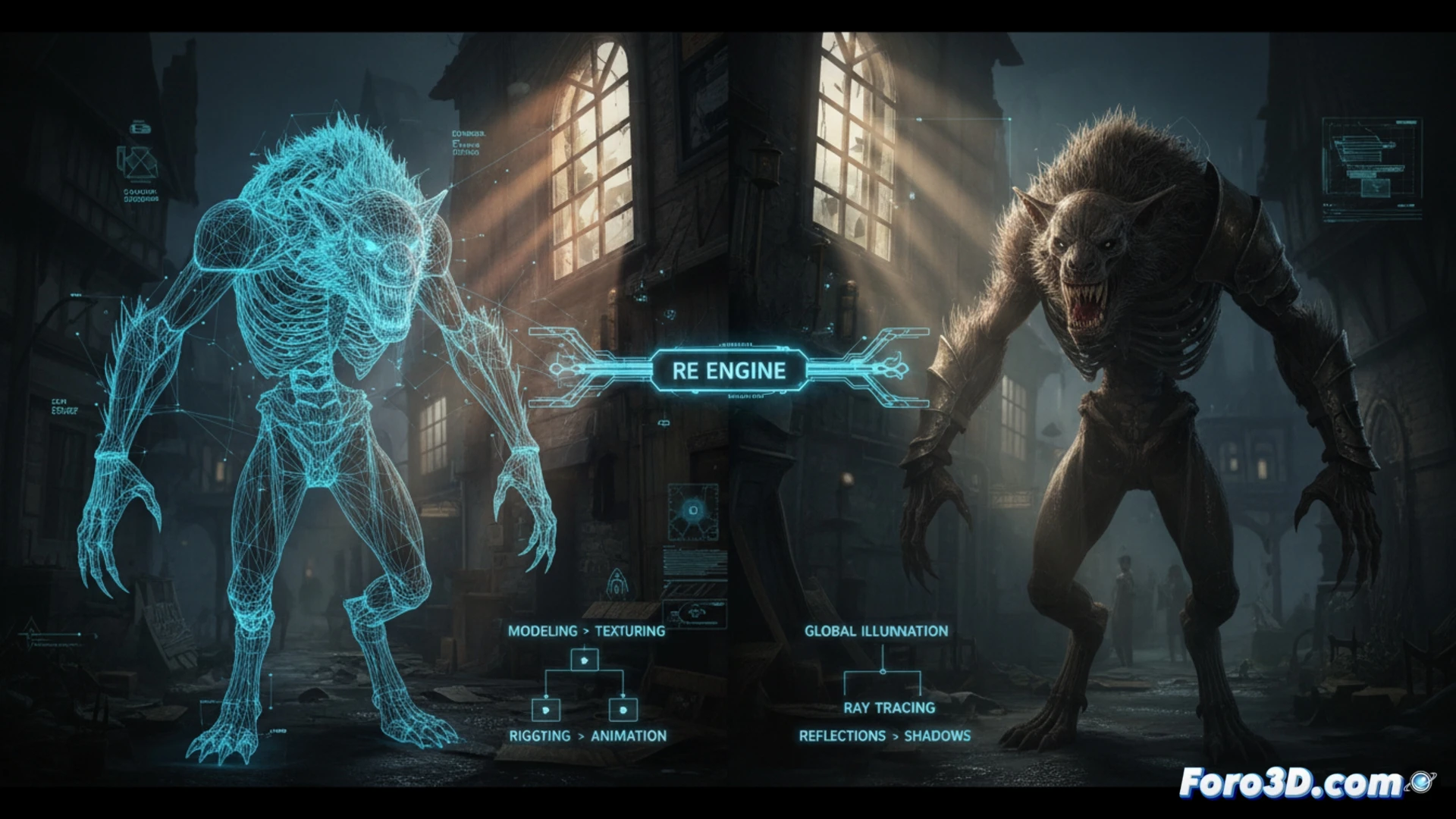
Asset pipeline and dynamic lighting 🎨
The creative process behind the characters and environments begins in Autodesk Maya and ZBrush, where high-resolution models are sculpted with impressive organic detail. Subsequently, texturing is done in Adobe Photoshop, generating diffuse and roughness maps that the RE Engine interprets with precision. However, the true qualitative leap lies in the lighting system. The engine implements ray tracing for reflections in interiors, allowing surfaces like marble or metal to react realistically to light. Added to this is dynamic global illumination that calculates how light bounces off snow and walls, creating soft shadows and an immersive atmosphere without sacrificing frames per second.
The art of optimization without compromise ⚙️
The true merit of the RE Engine is not just its graphical capability, but its efficiency. While other AAA titles struggle to maintain 60 FPS on mid-range hardware, Village achieves solid performance even on last-generation consoles. This is achieved through intelligent resource management: the engine prioritizes the quality of organic textures (skin, clothing, vegetation) and dynamically scales the ray tracing resolution in action scenes. It's a reminder that photorealism is not just about raw power, but about intelligent software engineering.
How does the RE Engine achieve the balance between detailed photorealism of characters and optimized performance in open scenarios of Resident Evil Village, considering the hardware limitations of last-generation consoles?
(PS: game jams are like weddings: everyone is happy, no one sleeps, and you end up crying)