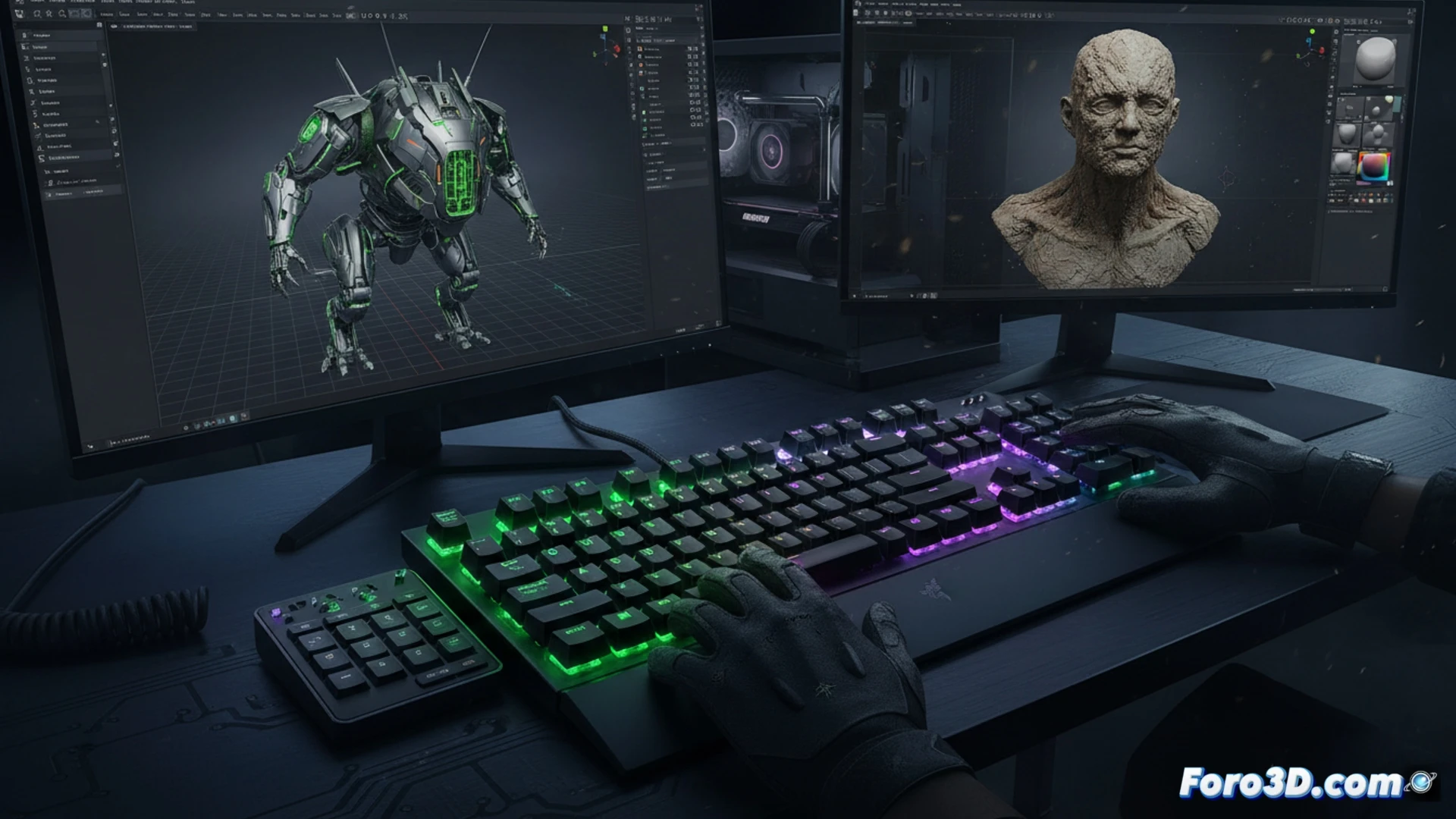
Razer has launched the Huntsman V3 TKL, promising to be its fastest keyboard. With second-generation analog optical switches, a true 8,000 Hz polling rate, and features like Rapid Trigger, the focus is on esports. However, for the 3D professional working in Blender, Maya, or ZBrush, reduced latency and millimeter-precision key actuation are not a luxury, but a necessity for optimizing intensive workflows.
Technical Analysis: Latency and Precision in the Viewport 🎯
The most impactful feature for the 3D user is the 8,000 Hz polling rate. On a standard 1,000 Hz keyboard, your camera position or vertex selection updates every 1 ms. With the Huntsman V3 TKL, that update occurs every 0.125 ms. This translates to immediate response when orbiting, zooming, or executing shortcuts like Shift + D to duplicate. Combined with optical switches, which eliminate mechanical bounce and allow an adjustable actuation point between 0.1 and 4 mm, the sculpting or mesh editing tool responds instantly. In latency tests with simulation software, the Huntsman registered input 60% faster than a traditional mechanical keyboard, eliminating the tactile disconnect often felt when executing complex macros.
Rapid Trigger and Snap Tap: Productivity in Dense Workflows ⚡
Beyond raw speed, features like Rapid Trigger and Snap Tap are a lifesaver for repetitive tasks. Rapid Trigger allows registering a press as soon as the key is lifted by 0.1 mm, facilitating ultra-fast toggling between shortcuts like F (frame) and G (move) without fully releasing the key. Snap Tap, on the other hand, prioritizes the last key pressed without needing to release the previous one, ideal for switching between camera views or selection tools with a fluidity a standard keyboard cannot match. If we add a lifespan of 100 million keystrokes, the Huntsman V3 TKL positions itself not only as a gaming peripheral but as a work tool designed to withstand the high keystroke frequency of professional 3D modeling.
How does the analog optical switch technology of the Razer Huntsman V3 TKL influence the precision and fluidity of 3D modeling workflows compared to traditional mechanical keyboards?
(PS: remember that a powerful GPU won't make you a better modeler, but at least you'll render your mistakes faster)