The discovery of Synapturanus danta, known as the Tapir Frog, represents a fascinating challenge for scientific visualization. This amphibian, found in the Peruvian Amazon, features an elongated snout reminiscent of its namesake mammal and a completely subterranean lifestyle. The absence of accessible living specimens makes 3D modeling based on taxonomic descriptions the ideal tool to study its unique morphology, from its cranial adaptations for digging to the structure of its call emitted underground.
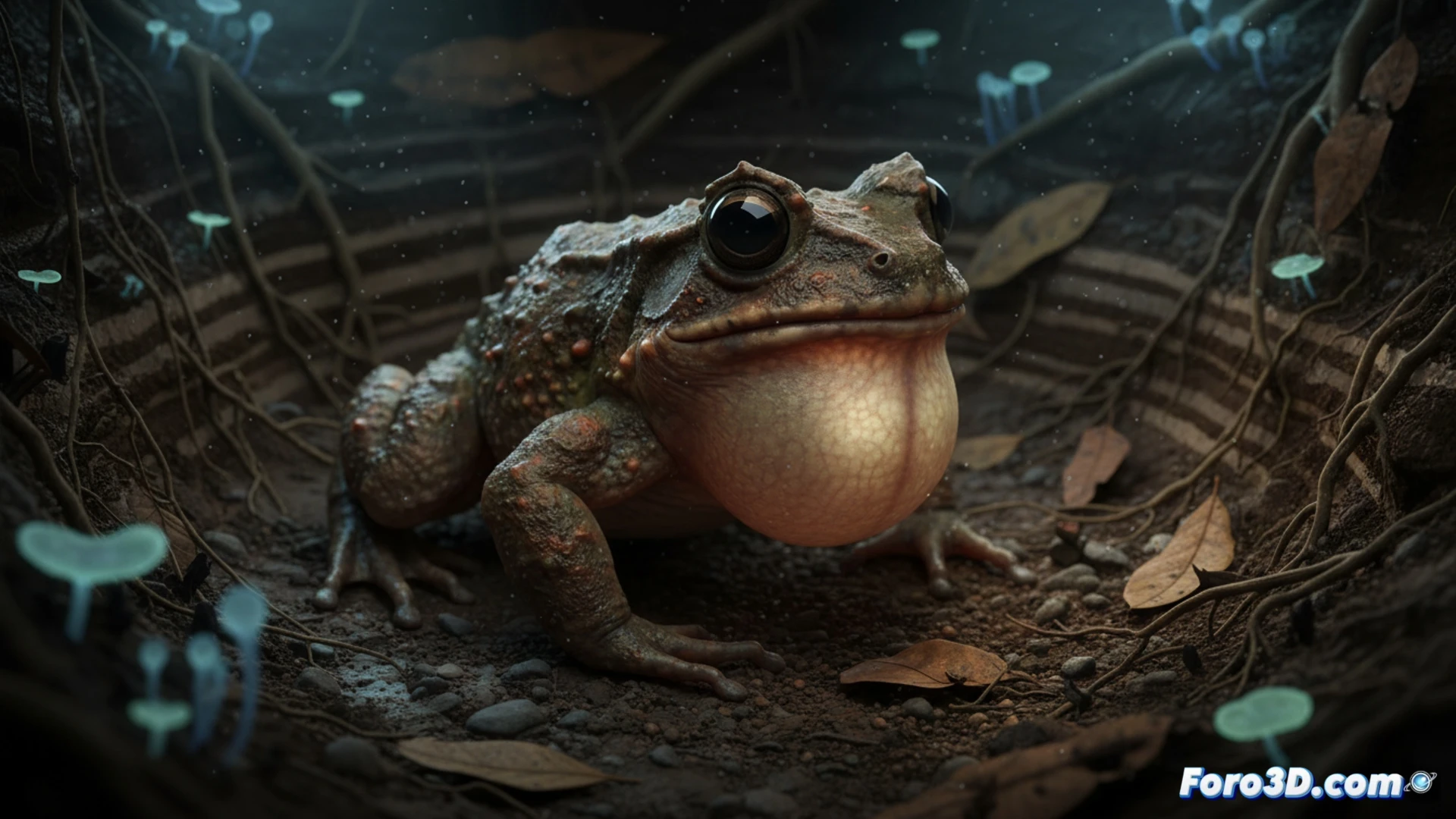
Construction of the anatomical model and bioacoustic simulation 🐸
To digitally recreate Synapturanus danta, one must start from the data published in the original study. The 3D model should prioritize skull morphometry, highlighting the rostral prolongation that gives it its name. At the texturing level, smooth, semi-translucent skin is required, typical of fossorial anurans, with a palette of muted browns and oranges for camouflage in leaf litter. Simulating the call involves modeling the propagation of sound waves through a heterogeneous Amazonian soil substrate, visualizing how the low-frequency call travels through the earth to attract mates, a key behavior that allowed scientists to locate it. Integrating a cross-section of the terrain would show the network of burrows and roots where it lives.
Evolutionary parallel between an amphibian and a mammal 🦏
The educational value of this project lies in the interactive comparison between the frog's snout and that of a South American tapir. Using superimposed 3D models, one can illustrate how convergent evolution shaped similar structures for different functions: the tapir uses its proboscis to grasp leaves, while the frog uses it to probe the soil for prey. This visual resource not only educates about Amazonian biodiversity but also demonstrates how scientific visualization allows connecting distantly related species on the phylogenetic tree through form and function.
How can we accurately model the unique anatomical adaptations of the Tapir Frog for its subterranean life in the Amazon, considering the scarcity of field visual data?
(PS: modeling manta rays is easy, the hard part is making them not look like floating plastic bags)