The recent description of Hyalinobatrachium nura, or the Nura Glass Frog, in the Amazon in 2024, presents a fascinating challenge for scientific visualization. This species has developed a high-frequency call to communicate over the roar of waterfalls. Our project focuses on creating an anatomically accurate 3D model that captures its transparency and allows visualizing this acoustic adaptation in its ecological context.
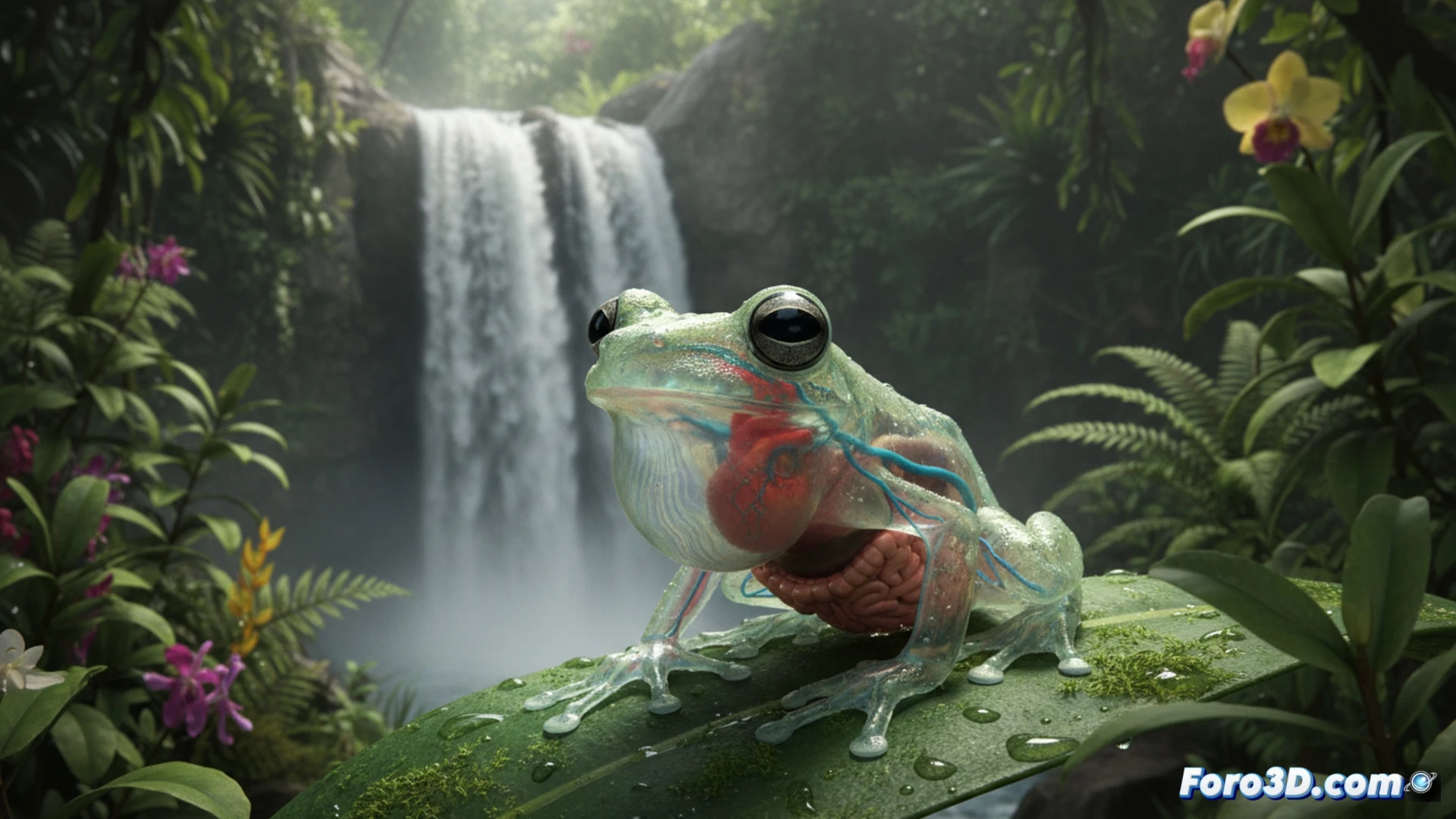
Anatomical Modeling and Acoustic Simulation of the Environment 🐸
The 3D model requires complex rigging to represent dermal transparency and visible internal organs, such as the heart and digestive tract. For the acoustic simulation, a particle shader will be designed to represent the sound waves of the call (frequencies between 6 and 8 kHz). The jungle environment will include a waterfall with a water particle emission system and an ambient noise map. The technical key is to overlay the visualization of the frog's call, showing how its high frequencies propagate above the low-frequency spectrum generated by the waterfall, visually validating the biological hypothesis.
Potential for Interactive Outreach 🌿
Beyond mere representation, this interactive 3D model allows the user to switch between an external view and an X-ray view to study internal anatomy. By activating the sound simulation, one can graphically observe how the frog's call overcomes background noise. This tool is ideal for scientific documentaries and bioacoustics laboratories, offering an immersive way to understand a unique evolutionary adaptation in one of the noisiest ecosystems on the planet.
How can the transparency and visible internal skin structures of the Nura Glass Frog be modeled in 3D to achieve accurate scientific visualization without losing visual realism?
(PS: if your manta ray animation doesn't excite, you can always add some documentary music from channel 2)