The Nymphargus manduriacu, known as the Manduriacu glass frog, is an amphibian endemic to Ecuador facing a critical threat. Its only known population inhabits a jungle area impacted by mining. This article explores how scientific 3D visualization can document its translucent anatomy and habitat, raising awareness about its precarious situation.
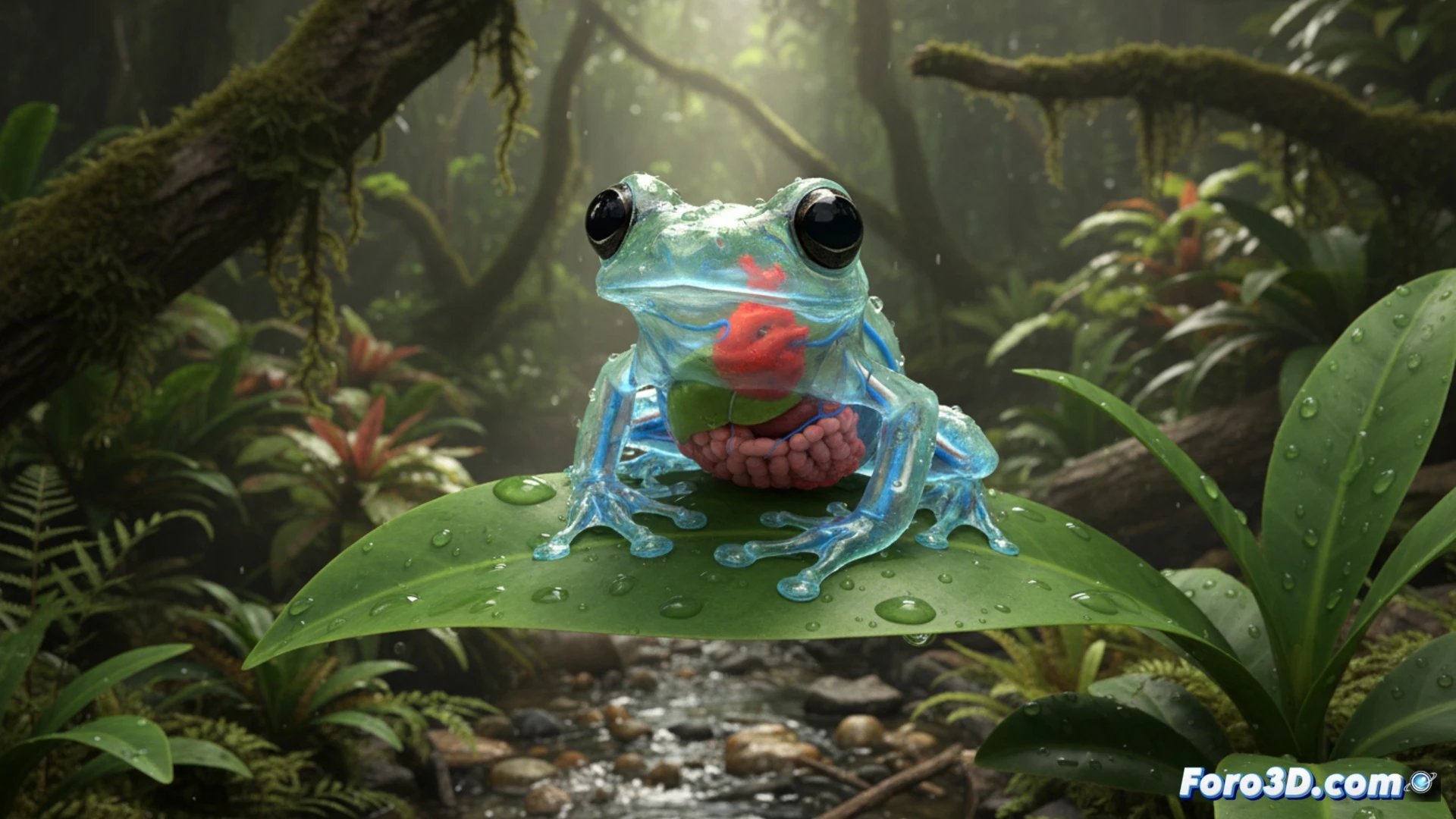
Photorealism and Transparency in 3D Modeling of the Species 🐸
To accurately represent the Nymphargus manduriacu, simulating its semi-transparent skin must be prioritized. The 3D model requires opacity maps and subsurface scattering (SSS) to replicate how light passes through its belly and reveals its internal organs. The yellow speckles on the green background should be generated with procedural textures that allow subtle variations, mimicking the unique patterns of each individual. The scene must include the moist leaf litter and water droplets typical of its microhabitat, using particle systems to simulate the dew and mist of the forest canopy. Global illumination with a tropical rainforest HDRI is key to achieving the realism necessary for scientific dissemination.
Simulating Mining Impact as an Awareness Tool ⛏️
Beyond aesthetics, the 3D model allows visualizing the direct impact of mining. Through keyframe animations, the progressive deforestation and clouding of streams can be simulated, showing how the loss of vegetation cover raises soil temperature and fragments the frog's territory. This digital recreation not only documents the species but translates conservation data into an immersive visual experience, helping researchers and the public understand the urgency of protecting its last refuge.
Since the Manduriacu glass frog is almost transparent and its habitat is difficult to access, what photogrammetry or 3D scanning techniques do you recommend to accurately capture its translucent tissues and generate a digital model useful for conservation studies without harming the specimen?
(PS: if your manta ray animation doesn't excite, you can always add documentary music from channel 2)