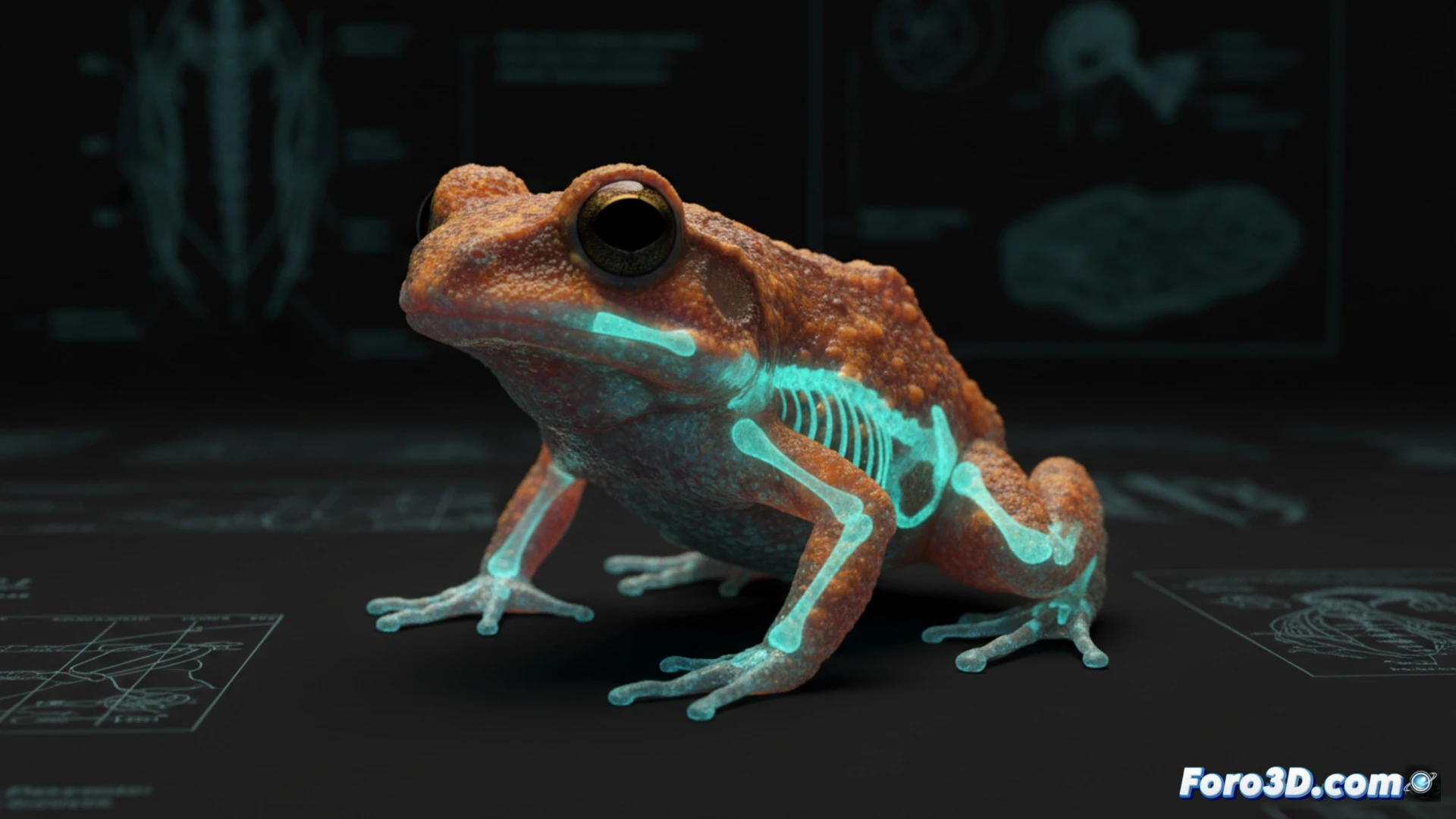
The Brachycephalus rotenbergae, known as the Rotenberg pumpkin toadlet, is an amphibian endemic to the Brazilian Atlantic Forest that does not exceed one centimeter in length. Its most fascinating characteristic is bone biofluorescence: under ultraviolet light, its bones emit a blue-green glow that shines through its translucent skin. This recently discovered phenomenon opens new possibilities for scientific visualization and 3D anatomical modeling.
Building the photorealistic model with a fluorescent skeleton 🐸
To accurately represent this species, the 3D model must integrate two main layers: an external one, with a translucent texture of orange skin and dorsal granulations, and an internal one, which reproduces the skeleton with emissive materials. The key is to assign a subsurface scattering (SSS) shader to the skin, with an opacity value of 30%, and an emissive material with a cyan tone (RGB 0, 255, 255) for the bones. The UV light simulation is achieved by activating a directional light source with a wavelength of 365 nm, which should only excite the fluorescence channel of the skeleton. The habitat is recreated using photogrammetry of real leaf litter from the Atlantic forest floor, with palm leaves and decomposing bark fragments, scaled so that the toadlet occupies a space of 1 cubic cm.
The challenge of the invisible in science communication 🔬
Modeling this toadlet is not just a technical exercise; it is a tool to make visible a biological mechanism that the human eye does not perceive. Partial transparency and bone fluorescence allow the viewer to understand how an internal structure can be functional even in tiny organisms. By including interactive annotations, such as a comparison with a one Brazilian real coin, a bridge is created between anatomical complexity and everyday experience, transforming a scientific fact into a visual revelation.
How are the natural fluorescence properties of the Brachycephalus rotenbergae skeleton transferred to a photorealistic 3D model for scientific visualization, and what volumetric rendering techniques allow for accurately simulating light emission in a digital environment?
(PS: fluid physics for simulating the ocean is like the sea: unpredictable and you always run out of RAM)