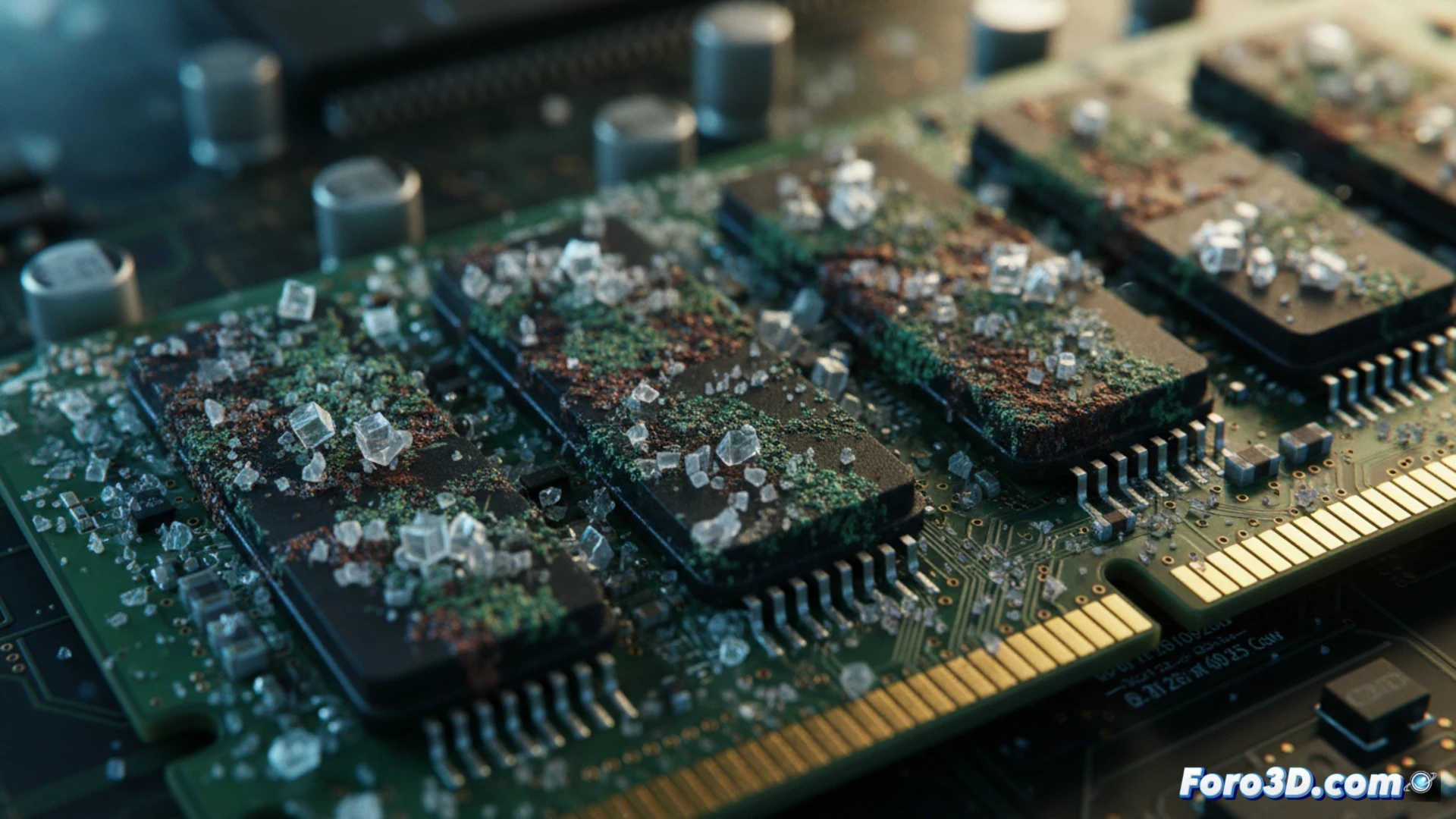
Salt-accelerated corrosion in RAM is not a forum myth, but a real problem affecting equipment in coastal or industrial areas. Air laden with saline particles penetrates gold contacts and PCB traces, initiating an oxidation process that degrades conductivity and causes read errors. You don't have to live by the sea; a humid environment with high salinity is enough to shorten the lifespan of your modules.
Failure mechanisms in traces and connectors 🧂
Salt acts as an electrolyte when moisture is present, facilitating ionic migration between copper and tin traces. This creates unwanted conductive bridges or, conversely, interruptions due to localized corrosion. Modules with low-quality gold plating are more vulnerable, as the protective layer wears down with thermal cycles. Symptoms include random blue screens, boot failures, and corrupted data that are not detected by quick memory tests.
How to tell if your RAM is dissolving 🔍
If your computer starts failing more than a politician on the campaign trail and you live less than ten kilometers from the beach, salt is probably to blame. No, it's not that the modules feel like taking a vacation; it's that chloride is eating away at the contacts like they were french fries. The low-cost solution is to clean with isopropyl alcohol and pray, but the sensible option is to buy RAM with conformal coating or move to the desert.