Radiant Black, the work of Kyle Higgins and Marcelo Costa, bursts onto the comic scene with a visual proposal that fuses the nostalgia of the Sentai genre (Power Rangers) with a narrative rawness suited for an adult audience. The story of Nathan, a frustrated writer who gains cosmic power, explores the duality of the modern hero. Far from youthful fantasy, the series reveals that the neon-lit suit is a prison, and that the price of transformation is a constant struggle against one's own identity and the expectations of others.
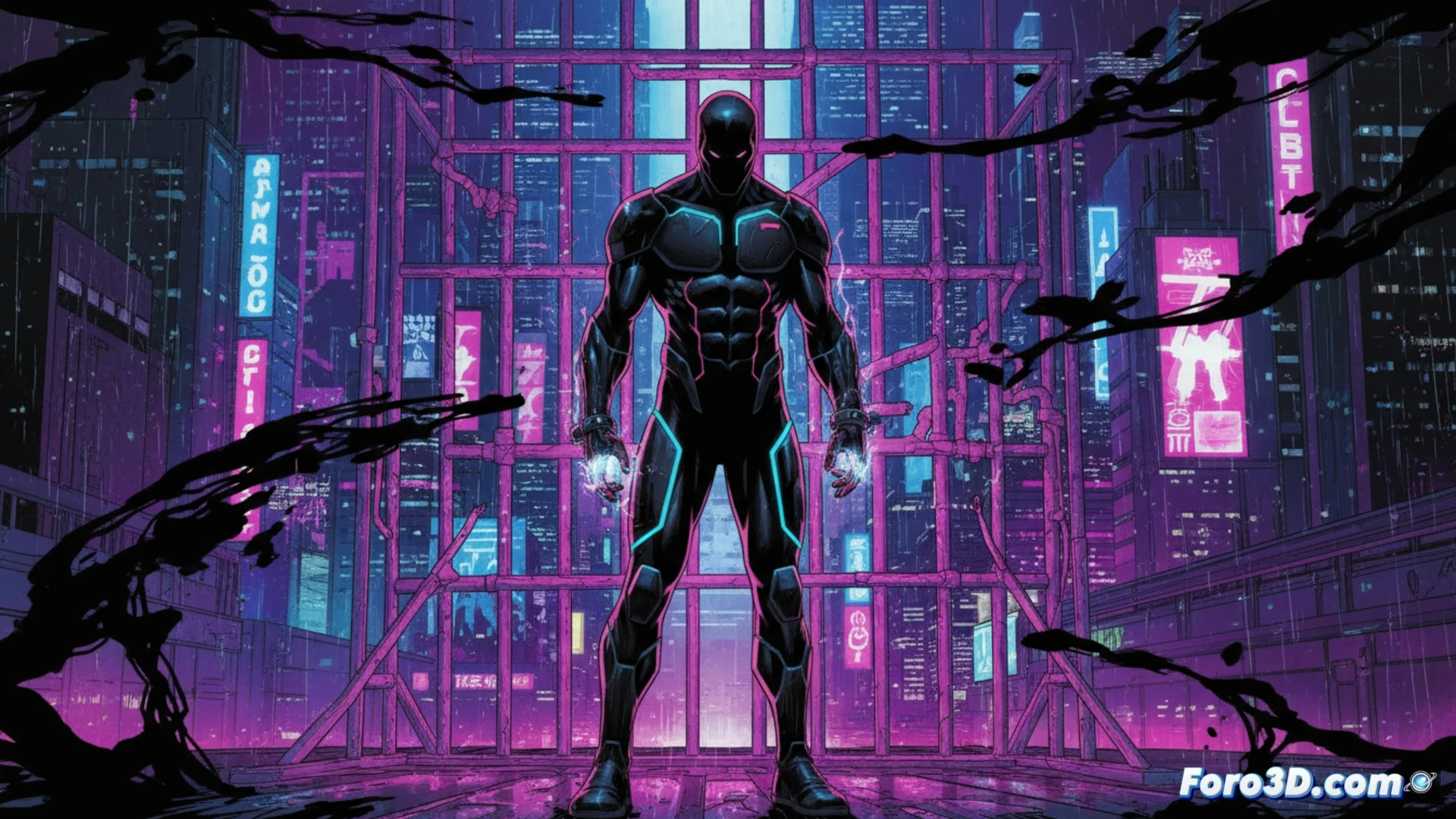
Technical analysis: Neon composition and 3D modeling for visual activism 🎨
From a technical perspective, Radiant Black is a manual on how high-contrast aesthetics and neon colors can be applied to 3D modeling to convey political and social messages. The use of saturated urban backgrounds and dynamic compositions, inherited from Japanese tokusatsu, provides a perfect framework for digital artists. By recreating scenes in software like Blender or Cinema 4D, the symbolism can be enhanced: the brightness of the suit represents superficial power, while the shadows and rough textures of the environment reflect the reality of the activist operating in digital marginality. The Cyan and Magenta palette is not only visually appealing but also functions as a chromatic code to denounce overstimulation and the emptiness of cultural consumption.
The cost of power as a metaphor for digital activism ⚡
The great lesson of Radiant Black for the community of 3D creators is that aesthetics should not hide the message. The fact that there are multiple 'Blacks' suggests that digital activism is not a solitary struggle, but a network of individuals sharing the same symbolic power. Like Nathan, artists who use their skills to create pieces of social criticism must assume that the brilliance of their renders has a cost: creative exhaustion and exposure to public judgment. The work reminds us that true disruptive art not only illuminates the screen but burns upon touch.
How the neon aesthetic and the transformation narrative of Sentai in Radiant Black can be used as tools of digital activism to resignify the identity of the adult superhero in the era of contemporary visual culture
(PS: pixels also have rights... or at least that's what my last render says)