The discovery of the Bounty Quiridium (Cumacea sp.) in the Bounty Trench in 2024 has captured the attention of the marine scientific community. This crustacean, nicknamed the comma shrimp due to its highly specialized body shape, presents a unique morphology that challenges traditional anatomical reconstructions. From Foro3D, we propose a technical analysis for its three-dimensional representation, aimed at marine biologists and scientific content creators.
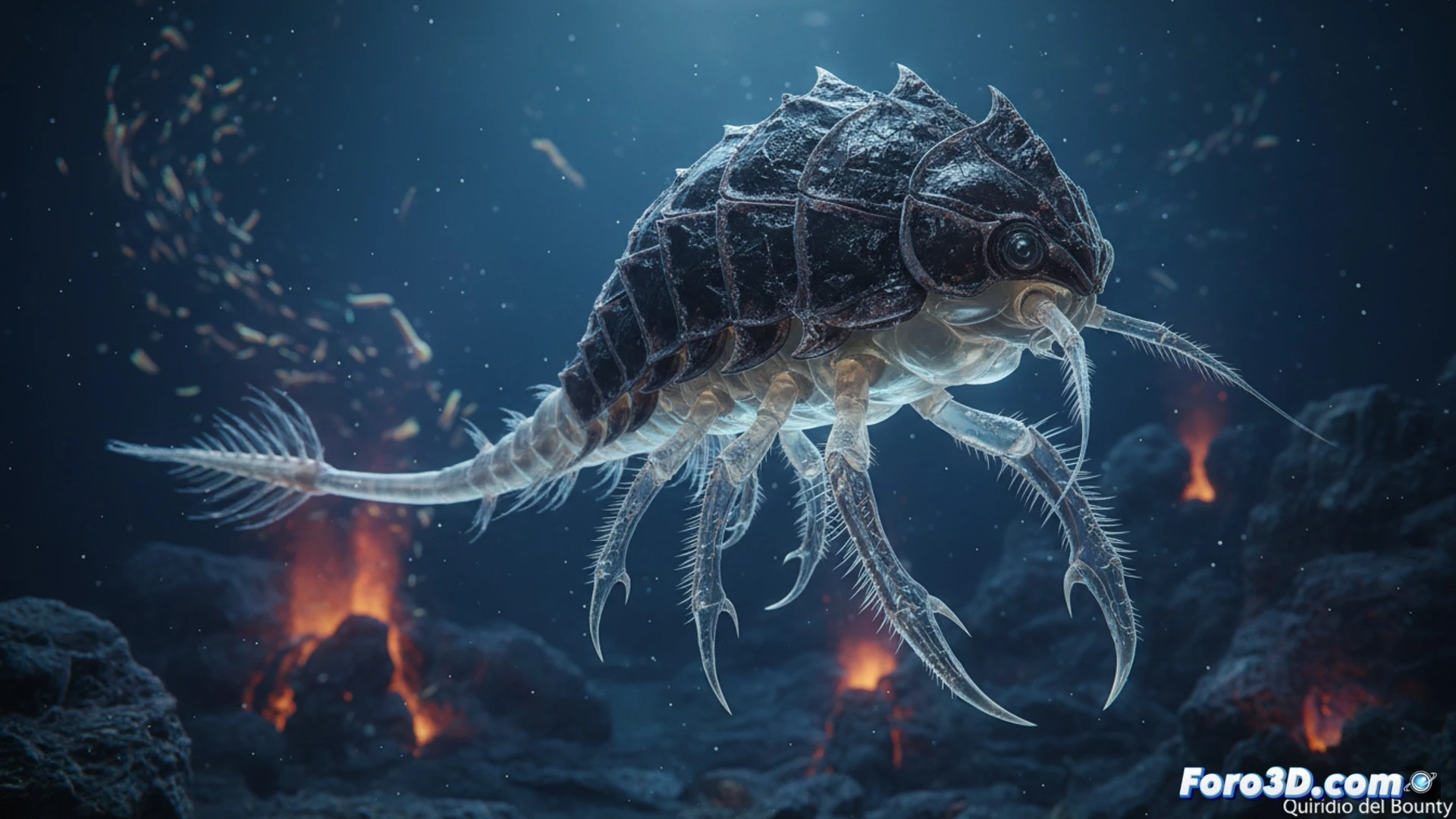
Three-dimensional anatomy and habitat reconstruction 🦐
To model the Bounty Quiridium, it is crucial to capture its laterally compressed carapace and characteristic curved rostrum, elements that define its comma profile. The thoracic appendages, adapted for burrowing in soft sediments, must be detailed with precision in their segmentation. We recommend generating a high-resolution mesh that includes the sensory setae on the antennae. The environment of the Bounty Trench, with its extreme pressure and perpetual darkness, can be recreated using particle simulations for suspended sediment and dim volumetric lighting systems, reflecting the bathyal conditions at depths exceeding 4000 meters.
Implications of modeling for digital taxonomy 🔬
The creation of this model not only serves for outreach but also establishes a precedent in the scientific visualization of cumaceans. By digitally comparing the anatomy of the Quiridium with other peracarid crustaceans, researchers can identify evolutionary adaptations without the need for fragile physical specimens. This approach allows simulating the animal's feeding behavior in its benthic niche, offering an immersive educational tool for future biodiversity studies in ocean trenches.
How was the challenge of 3D modeling the bioluminescent structures and ultra-specialized limbs of the Bounty Quiridium addressed, based on data obtained from over 6,000 meters depth in the abyssal trench?
(PS: if your manta ray animation doesn't excite, you can always add some documentary music from channel 2)