The quench phenomenon in a particle collider represents one of the most critical events for the integrity of superconducting magnets. When a Niobium-Titanium wire abruptly loses its superconducting state, the stored energy dissipates as heat, generating localized thermal expansions that can deform the cryostat. 3D reconstruction using a laser scanner allows detecting millimeter-scale micro-displacements, while electromagnetic simulation with CST Studio Suite seeks to correlate these deformations with the origin of the electric arc.
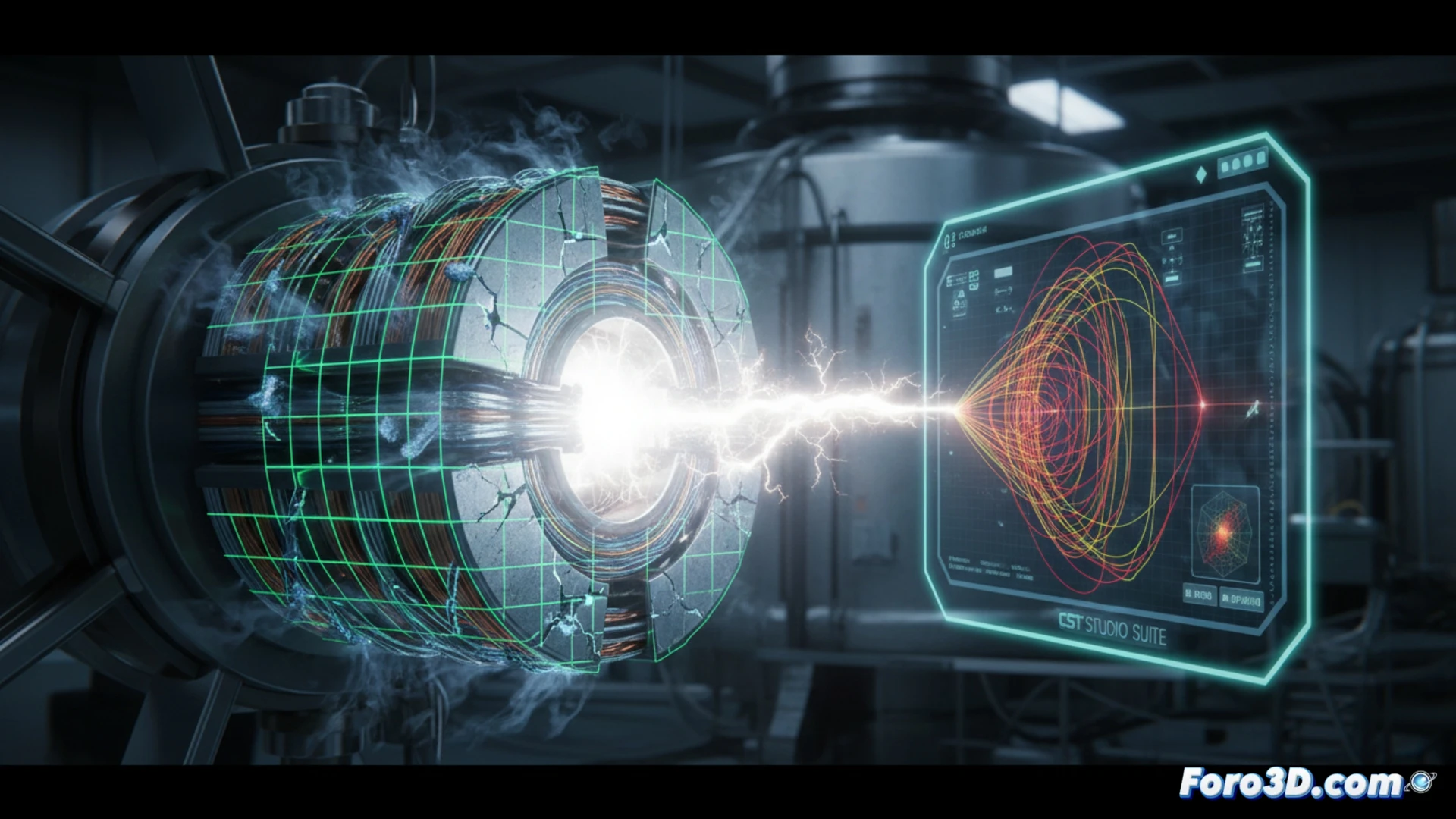
Arc modeling and structural fatigue under cryogenic conditions 🔥
To understand the failure sequence, CST Studio Suite is used for the electromagnetic simulation of the arc generated during the quench. This analysis reveals the distribution of eddy currents and Joule heating in the cable filaments. In parallel, ANSYS Mechanical models material fatigue under extreme thermal stresses, considering the brittleness of Niobium-Titanium at cryogenic temperatures. The synergy between both programs allows establishing whether a prior micro-displacement, detected in the point cloud from the Leica Cyclone scanner, was the mechanical trigger that caused the insulation loss and subsequent arc.
Lessons for failure analysis in cryogenic systems ⚙️
This case demonstrates that material fatigue depends not only on conventional load cycles but also on sudden phase transitions like the quench. The combination of high-precision 3D scanning with multiphysics simulation changes the forensic approach: the goal is no longer solely to find the electrical cause, but the prior mechanical deformation that made it possible. For simulation engineers, this underscores the need to integrate real geometric data into finite element models to predict failures in extreme environments.
How does the thermal propagation rate of the quench influence the accuracy of cryogenic fatigue models for predicting structural failure in superconducting magnets?
(PS: Material fatigue is like yours after 10 hours of simulation.)