Researchers from the Polytechnic University of Turin and Maastricht University have launched PyVoroGen, an open-source software that generates biomimetic structures based on Voronoi diagrams for 3D printing. The tool aims to facilitate the creation of porous and lightweight designs, mimicking natural patterns such as bones or honeycombs, with applications in tissue engineering and prosthetics.
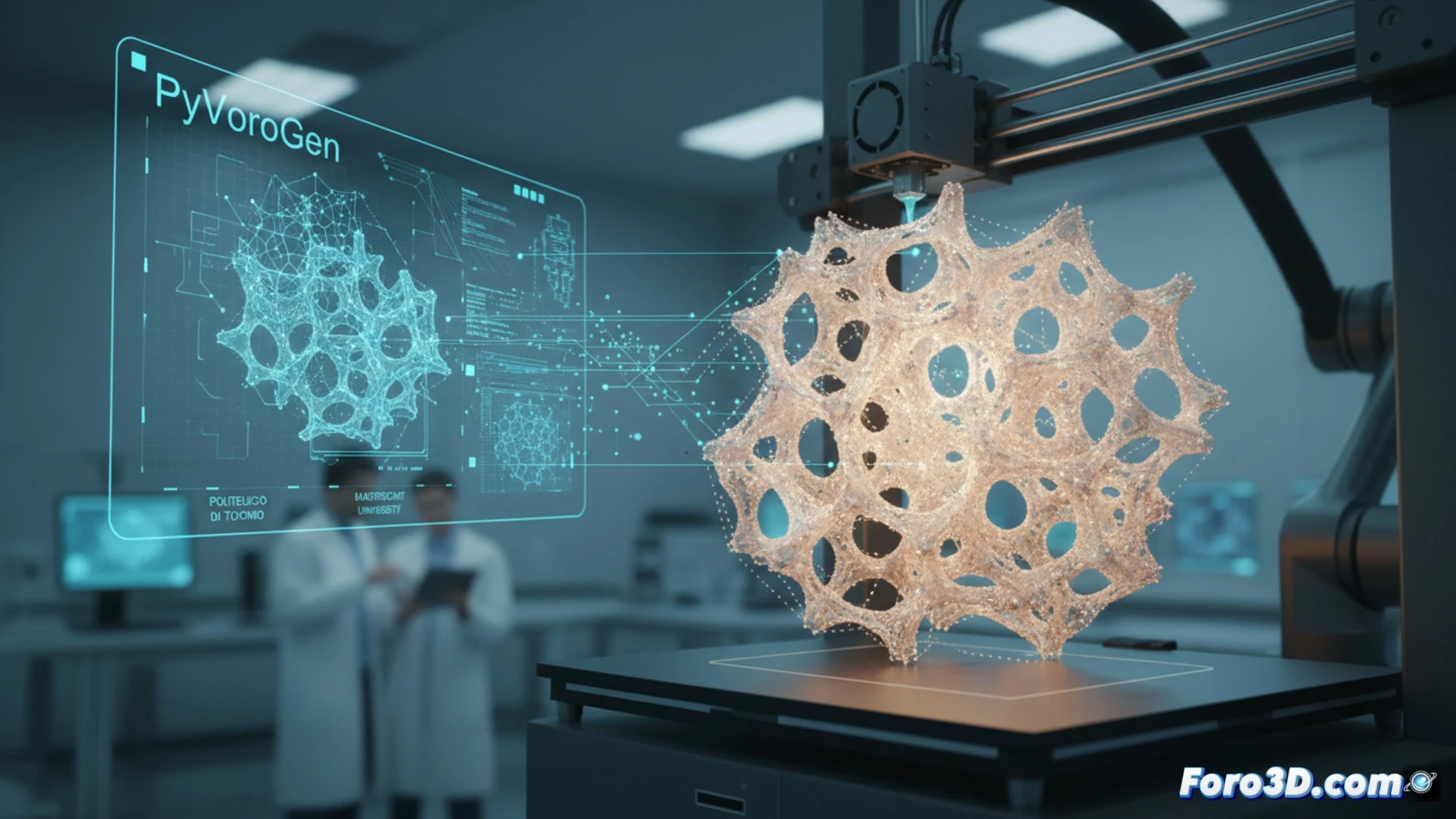
How PyVoroGen simplifies the generation of complex patterns
The software, programmed in Python, automates the process of creating 3D Voronoi tessellations, allowing the user to control parameters such as point density, wall thickness, and pore size. Unlike manual methods in CAD, PyVoroGen generates meshes ready for 3D printing slicers. Its open-source nature allows researchers to modify the code to suit specific needs, such as optimizing mechanical strength or part permeability.
Nature already patented it, but we print it
It turns out that sponges and bones have been using these structures for millions of years without paying royalties. Now, with PyVoroGen, any mortal can replicate the design of a chicken bone on a desktop printer. Of course, if the part fails, don't blame evolution: it's probably due to using generic PLA instead of titanium. Nature offers no money-back guarantee.