Manufacturers promise sterile environments with purifiers that eliminate 99.9% of viruses. However, this figure comes from tests in airtight laboratory chambers, where the air is static and controlled. In a real home, the constant airflow from windows, doors, and HVAC systems disperses viral aerosols, drastically reducing the device's capture capacity. The gap between the advertising myth and physical reality is an abyss worth visualizing.
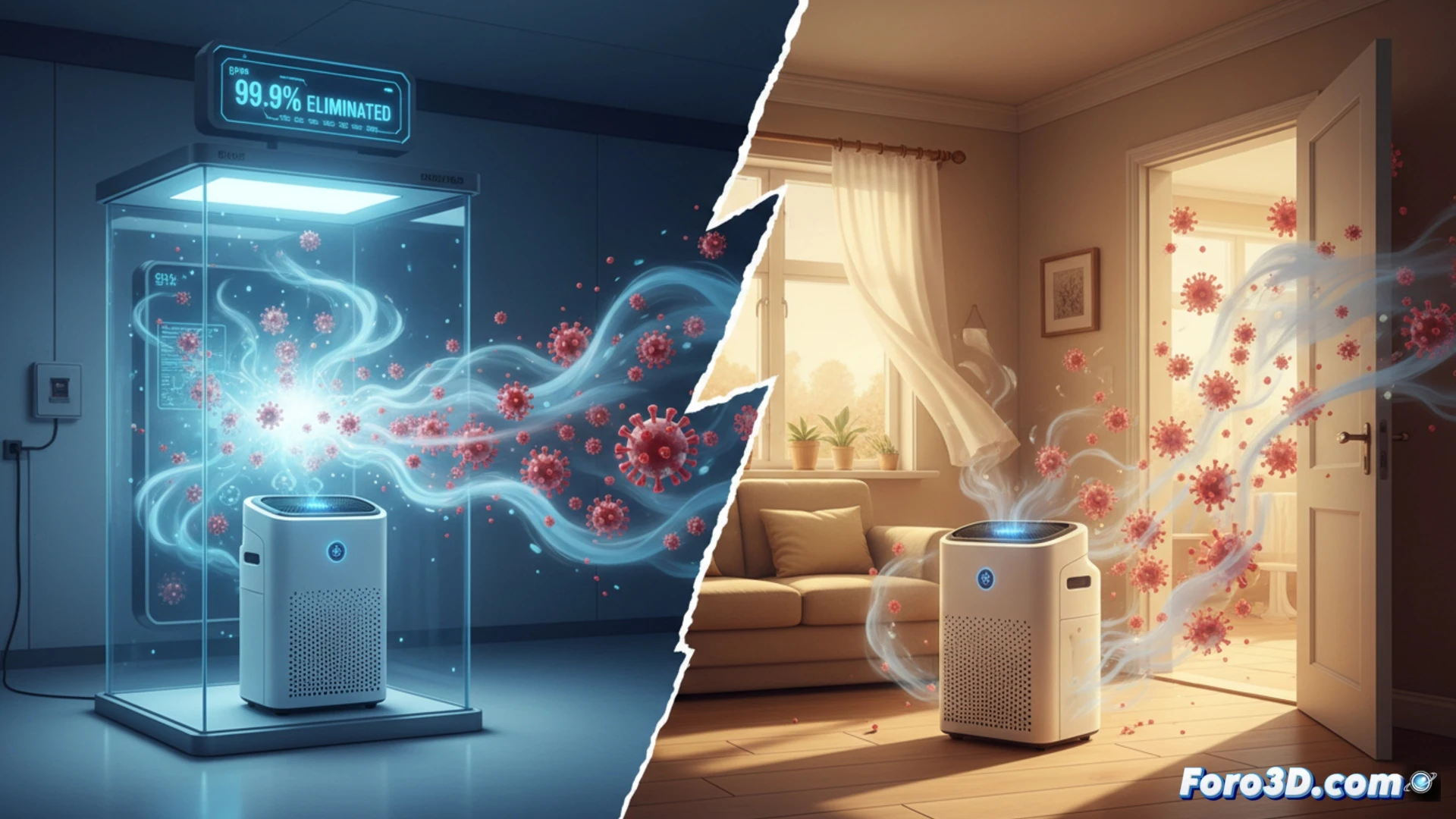
Aerosol dynamics: sealed chamber versus open room 🌀
In the sealed test chamber, the purifier recirculates the same volume of air over and over, trapping particles until the viral load is exhausted. The air change rate (ACH) is practically zero, and efficacy is measured over hours without interference. In a typical domestic room, convection currents and infiltrations generate an ACH between 0.5 and 2.0. This means viral aerosols escape the purifier's suction radius, mix with incoming air, and remain suspended for longer. A 3D infographic would show how tracer particles (simulating viruses) deviate and avoid the HEPA filter in a real environment, contrasting with the linear and total capture of the lab.
The illusion of environmental control in public health 🧪
Visualizing this discrepancy is crucial for visual epidemiology. A 3D animation comparing both scenarios reveals that, in a real home, the purifier barely reduces aerosol concentration by 20-30% in the farthest areas. The 99.9% promise only applies if you live inside a glass bell jar. For the public, understanding that natural ventilation and mask use remain the most effective tools against airborne transmission is more valuable than relying on a magic filter. The infographic not only debunks a myth but also educates on the physical limits of home technology.
When a purifier promises to eliminate 99.9% of viruses in lab tests, what real-world variables—such as airflow, humidity, and device placement—cause that figure to plummet drastically in an average living room?
(PS: 3D incidence maps look so good they almost make being sick enjoyable)