The blocks of Puma Punku, in Bolivia, feature straight cuts, perfect 90-degree angles, and polished surfaces that defy the technology attributed to the Tiwanaku culture. Weighing over 100 tons, these pieces of sandstone and diorite have been the subject of archaeological debate for decades. Now, digital archaeology allows them to be studied with an unprecedented level of detail, revealing geometries that appear mechanized and raising fundamental questions about pre-Columbian construction capabilities.
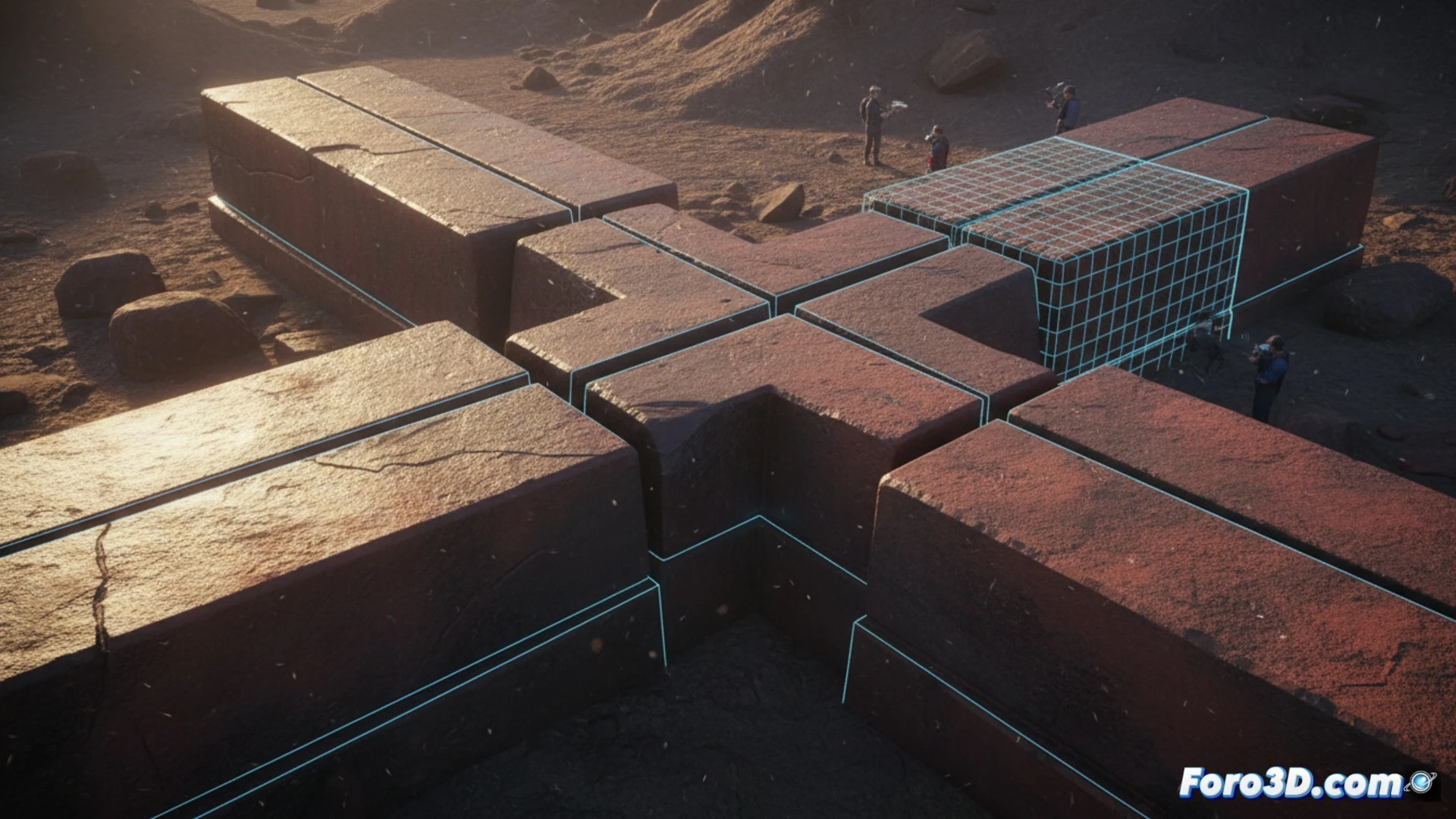
Photogrammetry and LiDAR: Unveiling the Impossible Geometry 🏛️
LiDAR scanning and high-resolution photogrammetry have enabled the generation of 3D models of the blocks with millimeter precision. By analyzing these point clouds, researchers can measure the flatness of surfaces, the orthogonality of edges, and the uniformity of assembly channels. The results show tolerances of less than one millimeter in multi-ton blocks, a precision that today is only achieved with industrial machinery. These digital models also allow simulating the fitting of the pieces, demonstrating that the blocks were designed to assemble like a three-dimensional puzzle, without the need for mortar. The hypothesis of geopolymer molds or abrasion wear techniques using water and sand finds in this digital data a rigorous testing ground, although not yet conclusive.
Silicon Against Dogma: Rethinking Tiwanaku Technology 🔍
Digital archaeology not only documents but also challenges. By visualizing the accuracy of the cuts at Puma Punku in 3D, the virtual model becomes a tool to challenge linear narratives of technological evolution. How could a culture without hard metals or the wheel achieve such precision? The scanning does not offer definitive answers, but it forces the scientific community to consider alternative hypotheses, from the use of advanced measurement templates to controlled percussion wear techniques. Virtual reconstruction also allows for the digital preservation of this fragile heritage, ensuring that the mystery of Puma Punku can be studied by future generations of archaeologists, even if the original blocks deteriorate.
Is it possible that the ultra-precise cuts and perfect angles of the Puma Punku blocks were achieved using controlled erosion techniques or geopolymer molds, rather than stone or metal tools known in Andean archaeology?
(PS: If you dig at a site and find a USB drive, don't plug it in: it could be Roman malware.)