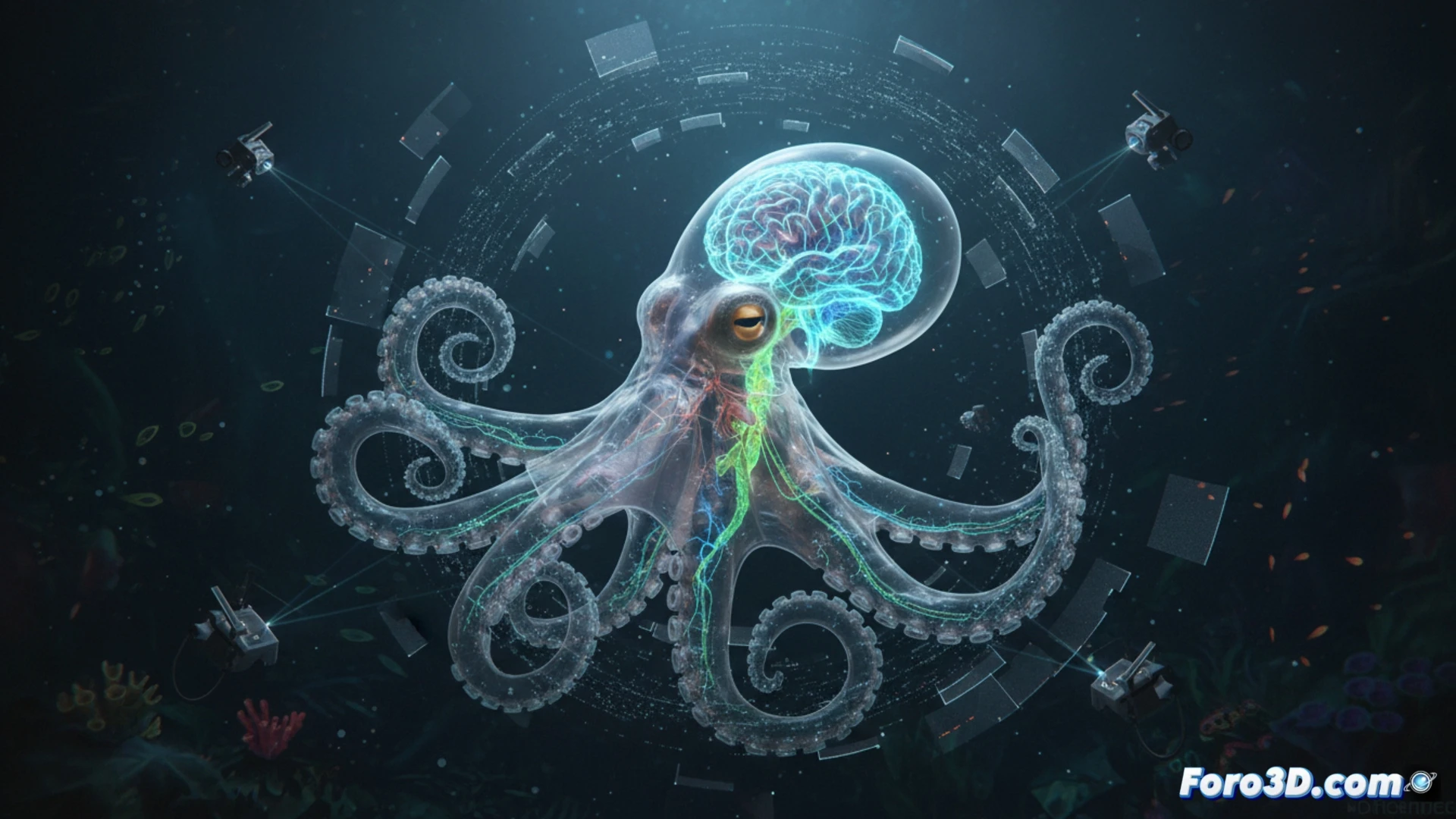
In 2024, a team of marine biologists achieved a milestone in scientific visualization: obtaining detailed images of the nervous system of the Atacama Glass Octopus (Vitreledonella sp.). This species, almost completely transparent, inhabits the depths of the Pacific Ocean. New explorations, using fluorescence microscopy and high-resolution computed tomography, have allowed the creation of 3D models of its brain and optic nerves without the need for invasive dissection.
Imaging techniques and anatomical modeling 🧠
The process began with chemical immobilization of the specimen to avoid motion artifacts. Then, a scan was applied using structured light and micro-CT (micro-computed tomography) with iodine contrast, a technique that highlights soft tissues. The resulting data were processed in segmentation software such as Amira and ImageJ, generating a polygonal mesh of the central nervous system. The octopus's natural transparency facilitated direct visualization of the optic lobes, the stellate ganglion, and the nerve connections to the arms. This interactive 3D model allows virtual rotation and sectioning of the cephalopod's brain, offering an unprecedented perspective for comparative neurobiology.
Implications for scientific visualization 🔬
This case demonstrates how the combination of advanced imaging techniques and 3D modeling can overcome the limitations of traditional dissection. The digital representation of the glass octopus not only serves academic research but is also integrated into virtual reality environments for outreach. By being able to isolate the nervous system of a transparent organism, scientists can study the evolution of intelligence in cephalopods and apply these methods to other gelatinous species, opening new pathways in biological data visualization.
What cleaning and optimization techniques for 3D meshes are required to preserve the transparency of nervous tissue in volumetric models of the glass octopus without losing anatomical detail
(PS: if your manta ray animation doesn't excite, you can always add documentary music from channel 2)