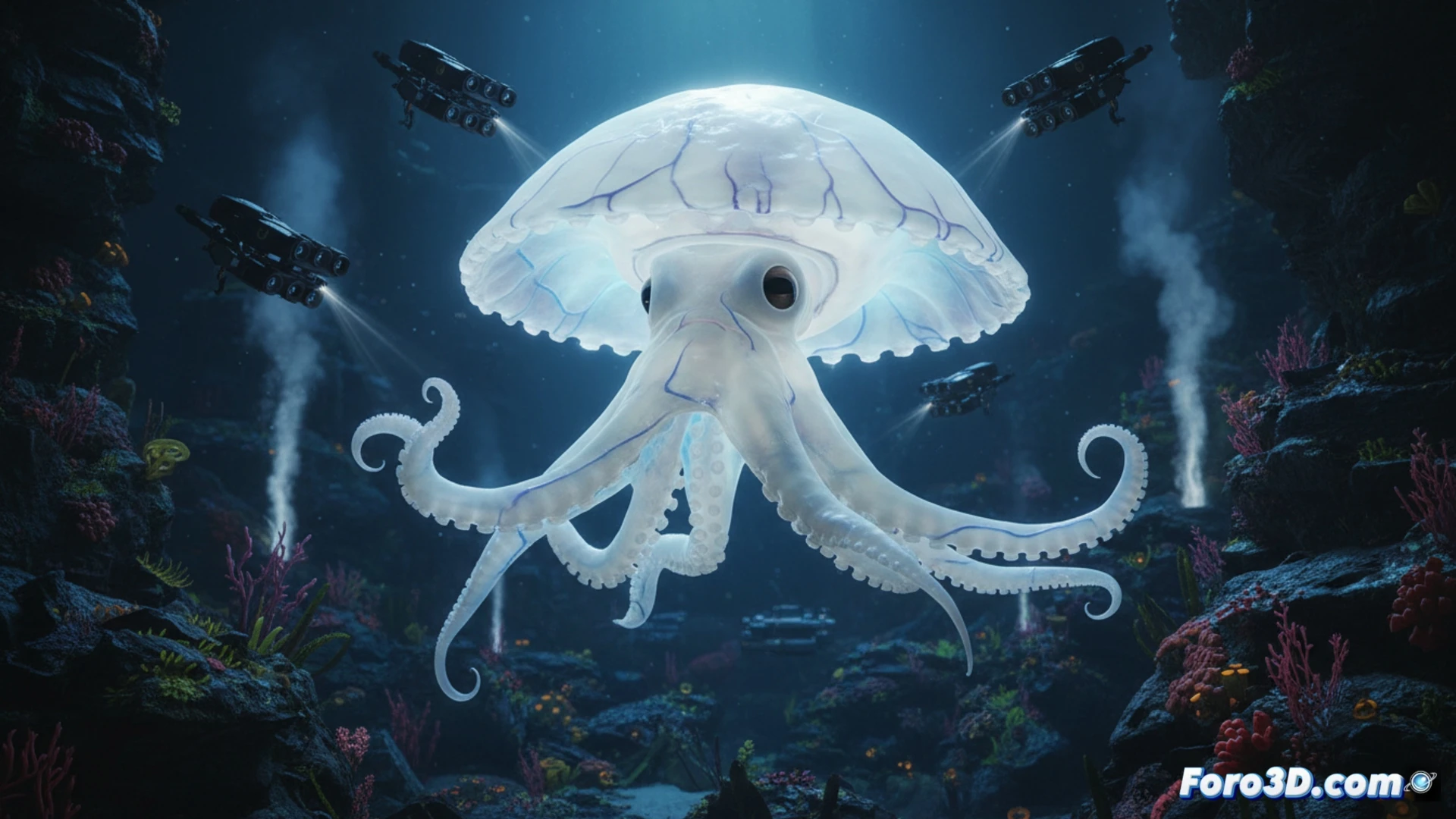
The sighting of the Casper Octopus in the submarine mountain ranges of Chile has surprised the oceanographic community. This ghostly-looking cephalopod was found at depths where this type of octopus was not expected, challenging previous biological models. For scientific visualization, this discovery represents a technical challenge: documenting a fragile creature in an extreme ecosystem without altering its habitat.
Submarine photogrammetry and modeling of abyssal habitats 🐙
3D technology offers non-invasive solutions for studying the Casper Octopus. Through submarine photogrammetry with ROVs (remotely operated vehicles), it is possible to capture multiple images of the specimen and reconstruct its spectral geometry with high-resolution textures. The next step is to integrate this model into a virtual environment of the Chilean mountain ranges, replicating the pressure, temperature, and abyssal twilight. This digital twin allows biologists and science communicators to analyze the octopus's anatomy, from its translucent mantle to its suckers, without needing to remove it from its ecosystem.
The paradox of documenting the invisible 👻
The Casper Octopus forces us to rethink the limits of scientific visualization. Its provisional name evokes the spectral, that which is barely visible. By creating an interactive 3D model of this species, we not only preserve a unique biological discovery but also demonstrate that technology can be a conservation tool. In a world where the exploration of ocean trenches advances, the art of 3D modeling becomes the eye that does not interfere, capturing the essence of the unknown so that we can all study it.
How can the 3D reconstruction of the Casper Octopus be optimized from low-resolution images obtained under extreme lighting conditions in the abyssal depths?
(PS: if your manta ray animation doesn't excite, you can always add some documentary music from channel 2)