A murder with no trace of a bullet is a scenario that challenges modern forensic investigation. In a recent case, the only evidence was an irregular cavity in a ballistic gel, with no recoverable projectile. The hypothesis pointed to an ice projectile that melted upon impact. To verify this, a comprehensive forensic pipeline was implemented, combining high-precision 3D scanning, medical segmentation, and numerical simulation, demonstrating that the shape of the wound can hold the key to reconstructing the murder weapon. 🔍
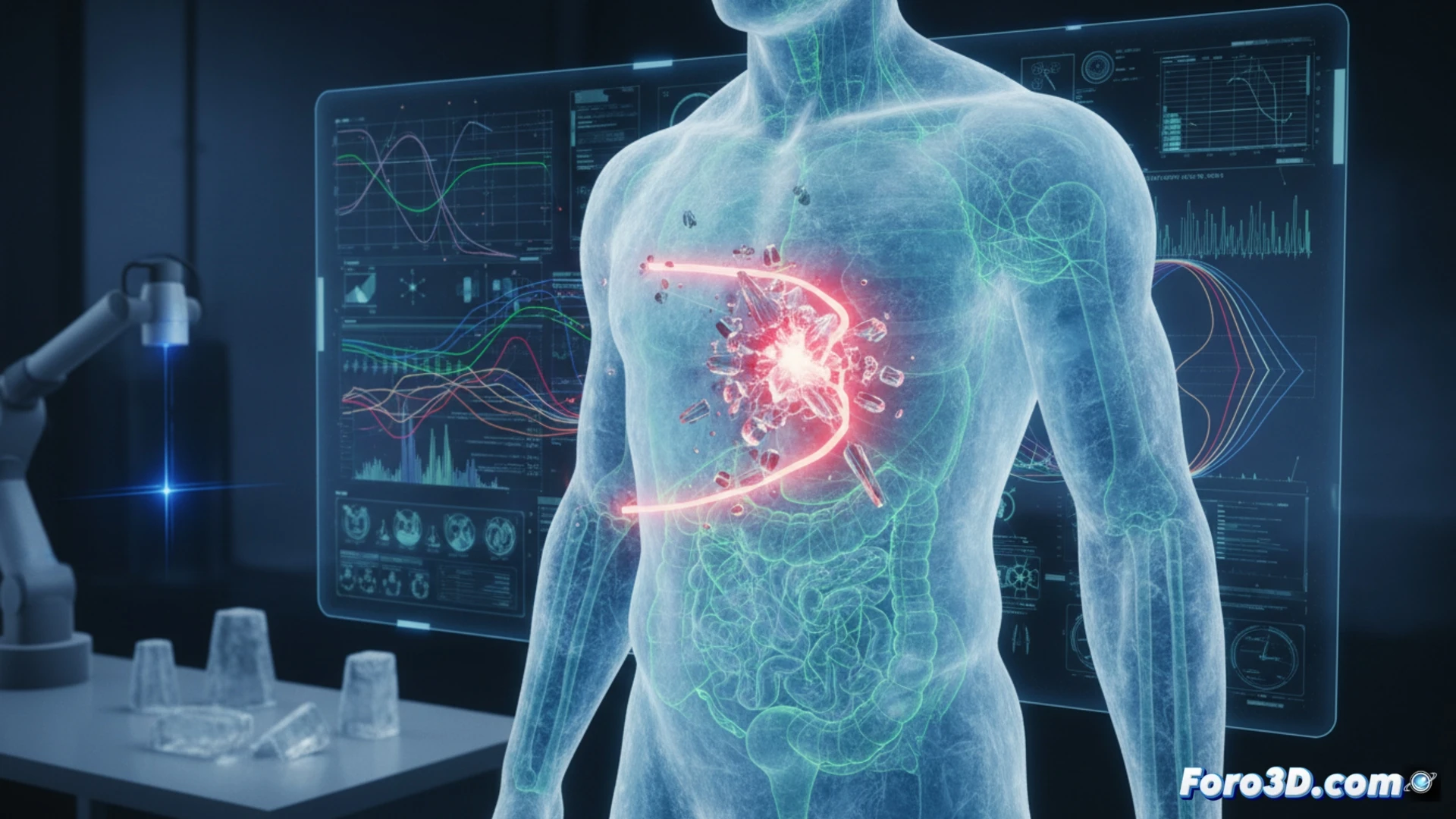
Forensic Pipeline: Scanning, Segmentation, and Simulation 🧊
The process began with scanning the impact cavity using an Artec Micro scanner, capable of capturing complex geometries with precision down to 10 microns. The resulting point cloud was processed in 3D Slicer to segment the wound channel, isolating it from the surrounding gel and generating a clean mesh model. This volumetric model was exported to LS-DYNA, where an ice material with known thermodynamic properties was defined. The terminal ballistic simulation recreated the impact, and a heat transfer module modeled the progressive melting of the projectile. The simulation results were compared with the scanned morphology, adjusting parameters such as impact velocity and initial ice temperature until a correlation exceeding 95% in the final cavity volume was achieved. Finally, Maya was used for visualization and animation of the melting process, presenting the finding as graphical evidence.
Implications for 3D Criminalistics ⚖️
This experiment demonstrates that forensic ballistics can go beyond the recovery of metallic projectiles. The integration of microgeometric scanning and multiphysics simulation allows answering key questions: What shape was the ice? At what speed was it traveling? How long did it take to melt? The presented pipeline not only solves the case but establishes a reproducible protocol for crimes where evidence vanishes. The key lies in the synergy between capture hardware and analysis software, uniting disciplines that rarely converse in the same workflow.
Would you use a laser scanner or photogrammetry to document this case?