The recent news about a defective hip prosthesis reopens the debate on the risks of standardized mass production. A poorly fitted implant not only causes chronic pain but also forces complex revision surgeries. Faced with this scenario, 3D printing and customized scanning emerge as the most solid technical solution to guarantee the absolute precision that human anatomy demands.
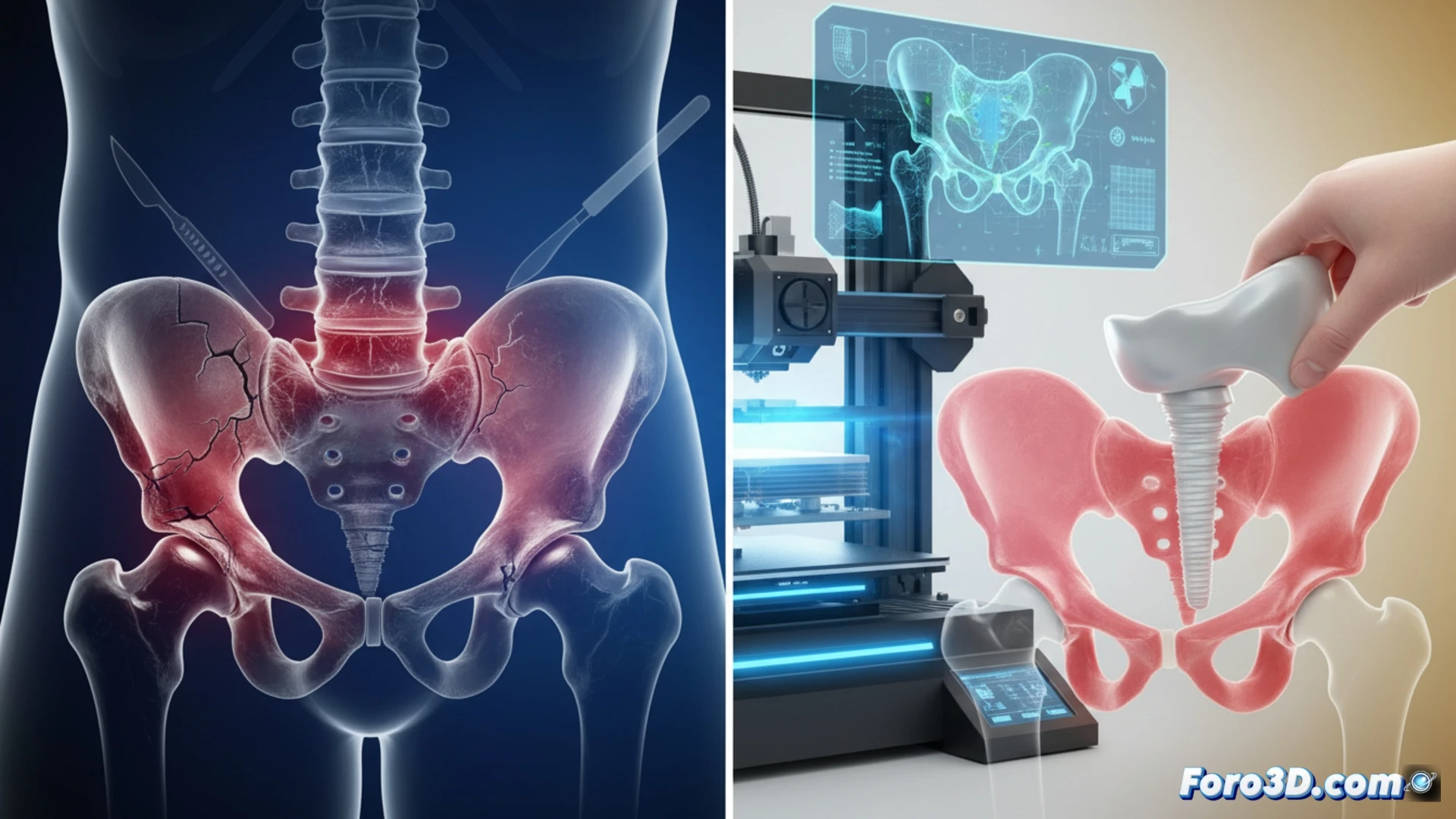
Parametric design and digital twin: the shield against error 🛡️
The process begins with a high-resolution 3D scan of the patient's pelvis and femur. With this data, a parametric CAD model is generated that allows adjusting the stem angle, anteversion, and cup depth in milliseconds. Before printing a single layer of titanium or PEEK, a biomechanical simulation is executed using finite elements. The implant's digital twin is subjected to loads equivalent to gait and deep flexion. If the software detects anomalous stress points or micromotion, the design is modified instantly, avoiding manufacturing a piece that would fail in the operating room.
Lessons from failure: quality that does not tolerate batches 🔍
Traditional methods produce thousands of identical copies of an implant, assuming all bone cavities are similar. The reality is that each patient has a unique geometry. A failure like the one reported in the news would have been avoided with individualized quality control. Additive manufacturing allows printing each prosthesis as a unique piece, verified against the original scan. At Foro3D we know that true safety lies not in production volume, but in the digital validation of every millimeter before pressing the print button.
What is the main blind spot in standardized hip prosthesis manufacturing that 3D printing can eliminate to prevent failures like the recent one?
(PS: 3D prostheses are so customized they even have a fingerprint.)