Riot Games has revealed Project T, an extraction shooter set in the Valorant universe that promises to revolutionize the visual aspect of the genre. Developed in Unreal Engine 5, the title bets on a hybrid style that merges photorealistic graphics with stylized touches, a technical challenge requiring a very specific production pipeline. We analyze how Maya, ZBrush, and UE5 tools work together to bring this artistic vision to life.
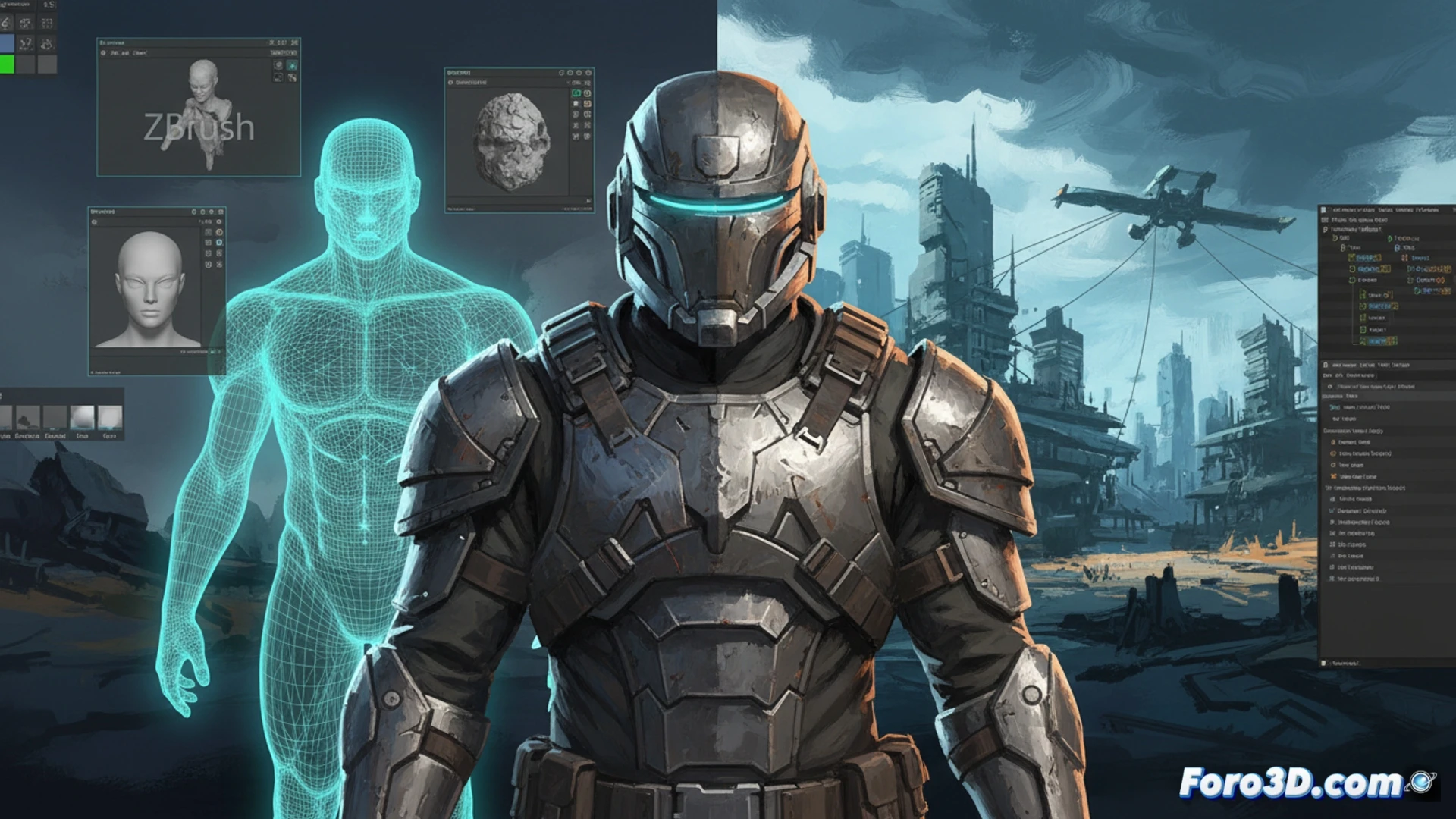
Modeling and optimization pipeline for real-time extraction 🎮
The workflow starts in Maya for blocking and retopology of characters and environments, ensuring a clean polygonal base. ZBrush comes into play for high-frequency details, sculpting wear textures and folds on Valorant agents that require a more painterly finish. The key lies in optimization for extraction gameplay: high-quality normal and occlusion maps are used to maintain detail without sacrificing performance. Unreal Engine 5 receives these assets and leverages its Lumen system for dynamic global illumination, while Nanite manages high-density geometry in complex environments. This balance allows real-time shots and interactions to maintain solid fluidity without losing the stylized visual essence of the IP.
The challenge of mixing realism with brand identity 🎨
The biggest challenge of Project T is not just technical, but artistic direction: integrating UE5's realism with Valorant's vibrant and clean visual identity. Riot achieves this through a saturated color palette on characters contrasted with rougher, more textured environments. The engine's rendering tools, combined with lighting passes in Maya, allow for precise control over materials. The result is an extraction shooter that feels tactile and cinematic, demonstrating that the fusion between realism and stylization is viable when the pipeline is well-tuned from initial modeling to final post-processing.
How does Riot Games' artistic pipeline in Project T achieve the efficient integration of Maya and ZBrush with Unreal Engine 5 to maintain the visual coherence of the Valorant universe in an extraction shooter?
(PS: 90% of development time is polishing, the other 90% is fixing bugs)