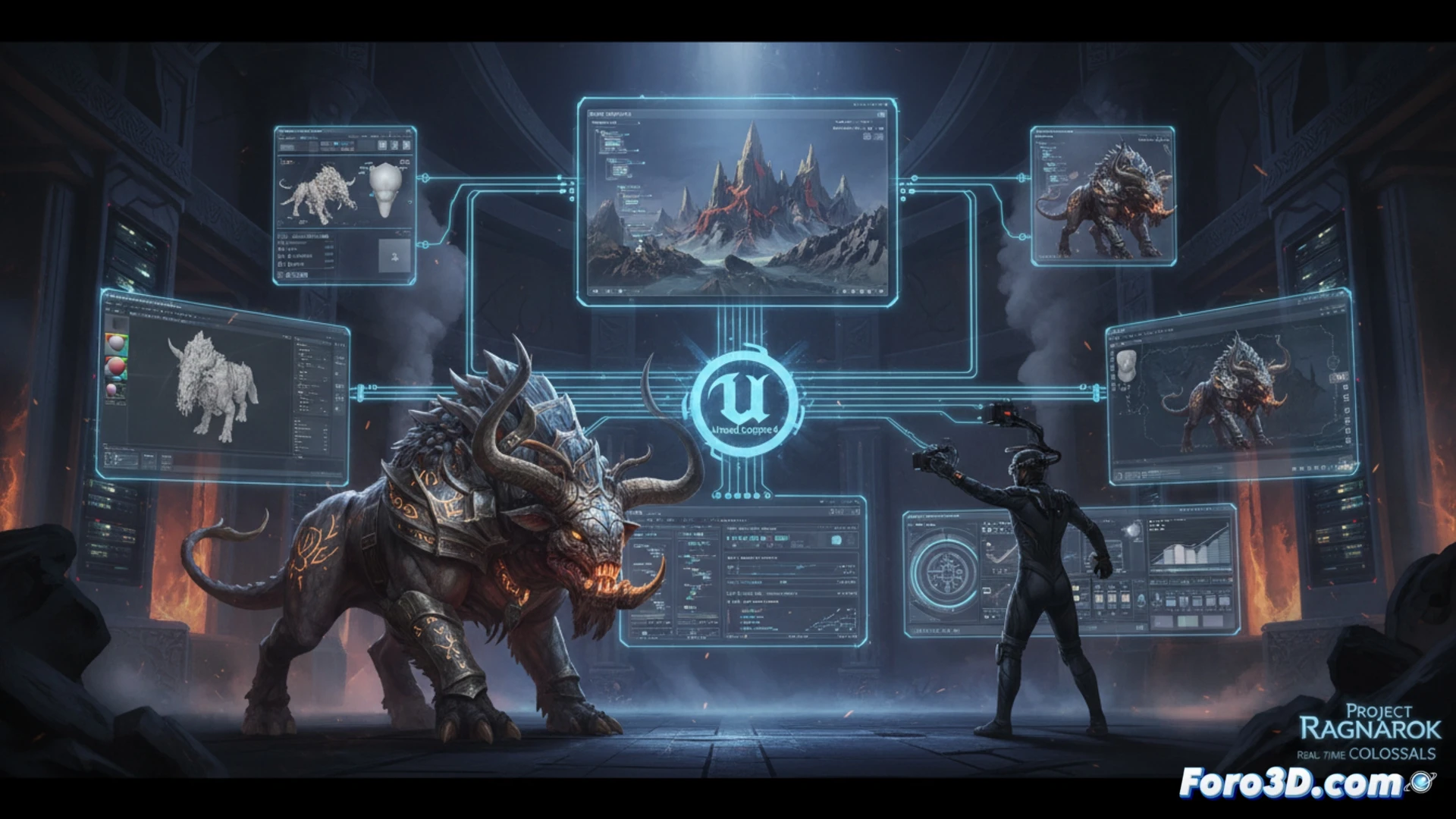
NetEase Games has revealed new details about Project: Ragnarok, an ambitious open-world title that uses Unreal Engine 4 to recreate Norse mythology. The project stands out for its integration of three key tools in the pipeline: Maya for modeling giant creatures, Houdini for procedural generation of complex environments, and an advanced proprietary motion capture system. This article analyzes how these technologies converge to bring dynamic climbing mechanics and colossal beasts to life, addressing real-time optimization challenges. 🎮
Maya, Houdini, and Mocap: NetEase's Production Flow 🛠️
The modeling of mythological creatures is done in Maya, where artists define the topology of beasts like giant wolves and sea serpents, prioritizing correct deformation for combat animations. For environments, Houdini generates procedural terrains with cliffs and Viking ruins, allowing designers to iterate on the scalability of dynamic climbing zones. NetEase's motion capture is applied to both characters and beasts, recording realistic locomotion patterns that are then retargeted to the creatures' skeletons in Unreal. The main challenge is maintaining the visual fidelity of Maya and Houdini assets without sacrificing 60 FPS on consoles, forcing the team to implement aggressive LODs and occlusion culling systems.
Dynamic Climbing and Optimization of Complex Levels 🧗
The dynamic climbing mechanic requires the player to interact with vertical surfaces without predefined restrictions. To achieve this, NetEase's team tags each polygon in Maya as grabbable or slippery, while Houdini generates procedural anchor points at cook time. In Unreal Engine 4, this translates into a spline-based collision detection system that evaluates the slope angle and material texture. Optimization here is critical: in environments with hundreds of ledges, the engine must prioritize physics calculations only in visible areas, using occlusion volumes generated from Houdini to avoid draw call spikes during vertical scaling.
As a developer, which specific aspects of NetEase's pipeline in Unreal Engine 4 for Project Ragnarok do you consider most innovative in managing a large-scale open world, and how do they optimize performance without sacrificing visual detail?
(PS: 90% of development time is polishing, the other 90% is fixing bugs)