The Npixel studio and Chrono Studio have presented Project: O, an MMORPG that challenges genre conventions by integrating time manipulation as a core gameplay mechanic. Developed in Unreal Engine 5, the title promises environments that rewind in real-time, altering the state of objects and scenarios without pausing the action. This mechanic, more typical of puzzle or platform games, is transferred to a persistent multiplayer world, posing unique technical challenges in synchronization and performance.
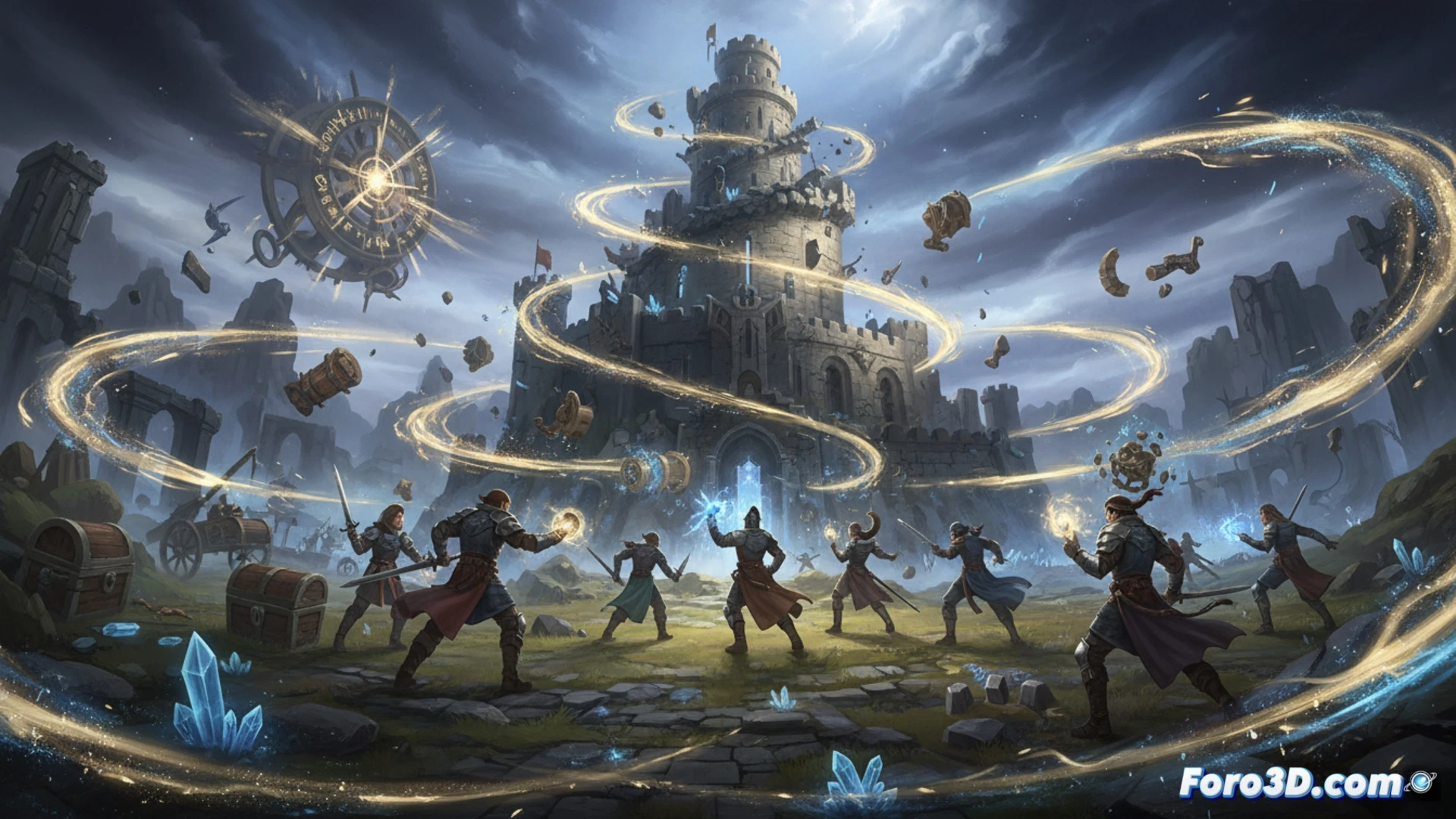
Workflow between Maya, ZBrush, and Niagara for Temporal Effects 🎮
The implementation of these effects relies on a hybrid modeling and VFX pipeline. High-poly assets are sculpted in ZBrush and retopologized in Maya to ensure optimal real-time performance. The real magic happens in Niagara, UE5's particle system. For the rewind, state buffers of particles and dynamic meshes are stored on the GPU. When the player activates the temporal ability, Niagara reinterprets that data in reverse order, recreating the animation of destruction or object movement as if time were going backward. This process requires careful management of video memory and a data pooling system to avoid bottlenecks in multiplayer scenes with dozens of characters.
Optimization and the Cost of Temporal Persistence ⚙️
The biggest challenge for developers is the persistence of temporal data in an MMORPG. Unlike a single-player game, the state memory of each object affected by the rewind must be synchronized with the server so that all players perceive the same timeline. This requires a data compression system in Niagara and a reduction in the scope of effects in areas with high player density. Project: O demonstrates that UE5's Lumen and Nanite engines can support these loads, but the true innovation lies in how Chrono Studio has designed a mechanic that is not only visual but also functional for cooperative gameplay.
How does the implementation of temporal rewind in Unreal Engine 5 affect the synchronization and persistence of the world state in an MMORPG like Project O, considering network latency and interaction between multiple players?
(PS: optimizing for mobile is like trying to fit an elephant into a Mini Cooper)