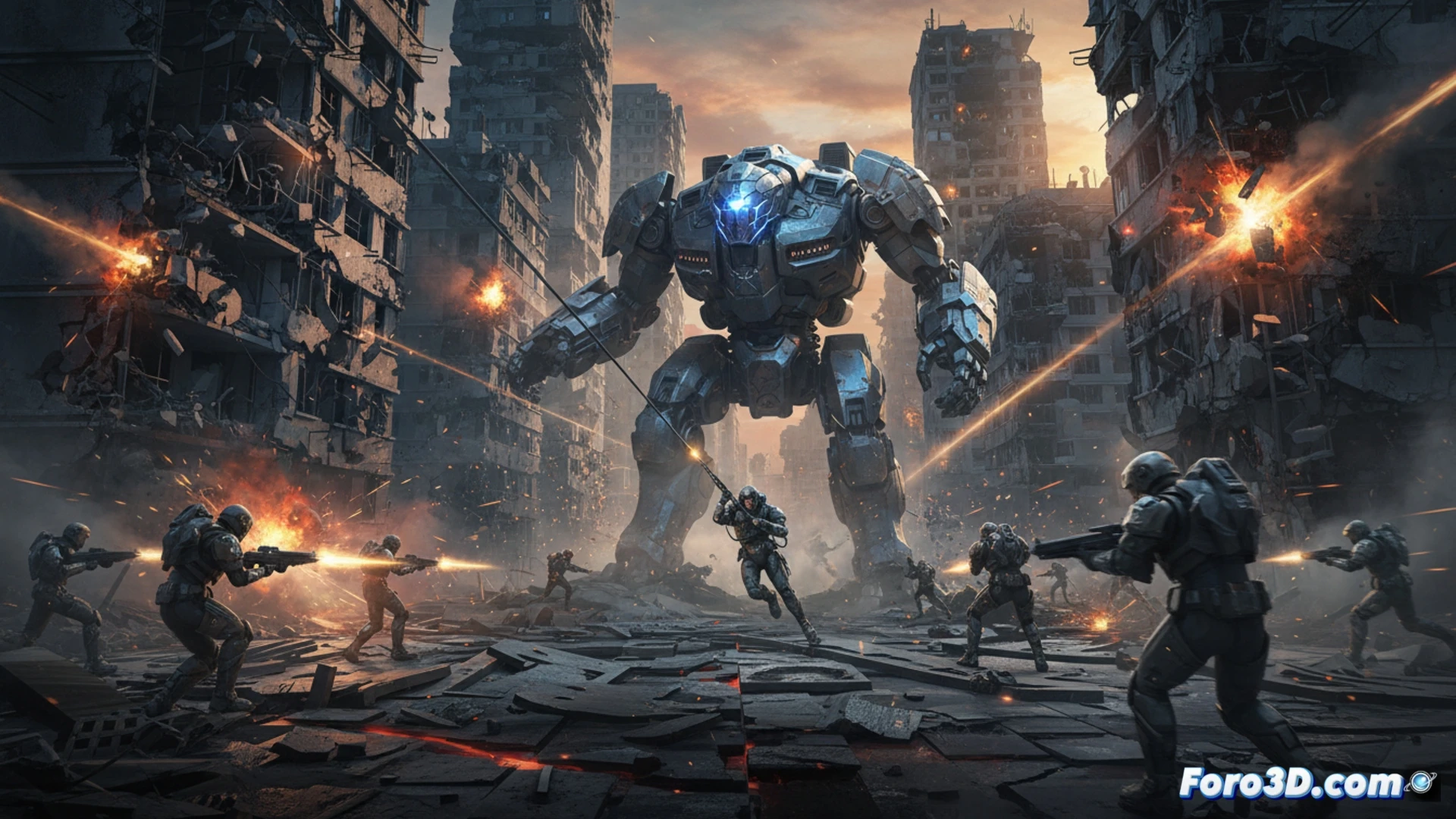
The Korean industry marks another technical milestone with Project LLL, NCSOFT's new MMO shooter that fully exploits the capabilities of Unreal Engine 5. The title promises not only massive battles, but an ecosystem where each material reacts uniquely to impact and lighting. The team has designed a workflow connecting 3ds Max for high-precision modeling, MotionBuilder for motion capture, and After Effects for the interface, creating a production loop that prioritizes physical immersion.
Asset Pipeline and Real-Time Physics Optimization 🎮
From a technical pipeline perspective, NCSOFT uses 3ds Max to sculpt assets with high-density geometry that supports dynamic deformation. These models are exported to Unreal Engine 5, where the Chaos Physics system manages real-time destruction. The main challenge lies in optimizing collisions for an MMO environment with dozens of players. For animation, MotionBuilder handles processing motion captures, ensuring smooth transitions between combat states and reactions to the environment. The interface, designed in After Effects, is integrated as widgets in UE5, minimizing graphical overhead through atlas textures and low-frequency animations.
Technical Lessons for the Indie Developer 🔧
Although Project LLL is a triple-A title, its approach offers keys for any studio. Integrating Chaos Physics for destruction does not require an external physics engine, but rather a correct hierarchy of collision meshes in 3ds Max. To replicate reactive materials, using damage masks in UE5 shaders allows a single material to show scratches and breaks without changing textures. The main lesson is that pre-production in 3ds Max and motion capture in MotionBuilder drastically reduce iteration time in the engine, a principle applicable even to small projects.
As a developer, which technical aspects of Project LLL's procedural destruction system in Unreal Engine 5 do you consider most relevant for achieving the balance between physical realism and performance in an MMO?
(PS: 90% of development time is polishing, the other 90% is fixing bugs)