The announcement of Project: J, the collaboration between NetEase and Square Enix, not only promises a high-caliber RPG for mobile devices but also reveals a very specific hybrid technical workflow. The use of Unreal Engine 4 (UE4) alongside tools like Maya, Photoshop, and Spine 2D poses an interesting challenge: how to integrate high-quality stylized 2D art within a 3D engine, optimizing everything for the limited power of a smartphone.
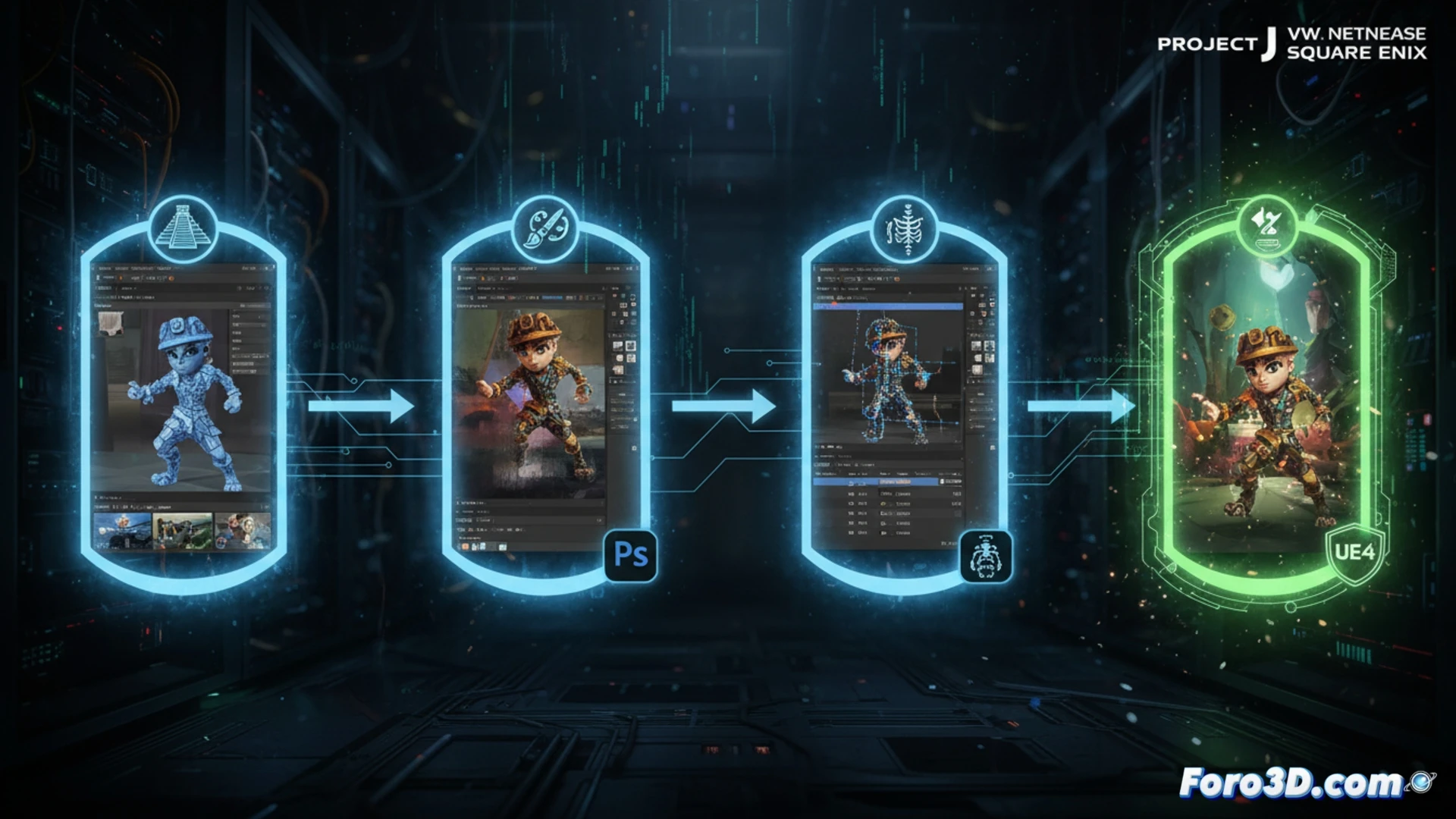
Asset optimization: From 3D modeling to real-time 2D animation 🎮
The technical pipeline of Project: J likely begins in Maya for creating the base geometry and character rigs. However, the visual finish does not aim for realism but rather the imitation of a 2D illustration. This is where Photoshop comes in, painting textures with flat shadows and highlights, eliminating the need for complex dynamic lighting in the engine. The real trick lies in Spine 2D, used for deformation animation and effects. Instead of animating heavy 3D bones, flat meshes are exported from Maya to Spine, where they are animated by vertices. This drastically reduces the rendering cost in UE4, allowing smooth animations with the aesthetic of an animated sprite.
The illusion of 2D: A rendering challenge for mobile 📱
The biggest technical challenge of Project: J is fooling the human eye. Unreal Engine 4 is designed for 3D lighting, but Square Enix's art demands a flat 2D look. The technical solution likely involves using custom shaders in UE4 that ignore directional light and apply extreme cel-shading or toon shading. Textures created in Photoshop act as pre-calculated color and occlusion maps, while Spine 2D manages the animation of body parts as if they were 2D puppets. This approach allows the game to look like a moving anime without sacrificing fluidity on mobile hardware.
What was the biggest technical challenge when integrating Spine 2D animations with 3D assets from Maya and textures from Photoshop within the Unreal Engine 4 pipeline for Project: J?
(PS: optimizing for mobile is like trying to fit an elephant into a Mini Cooper)