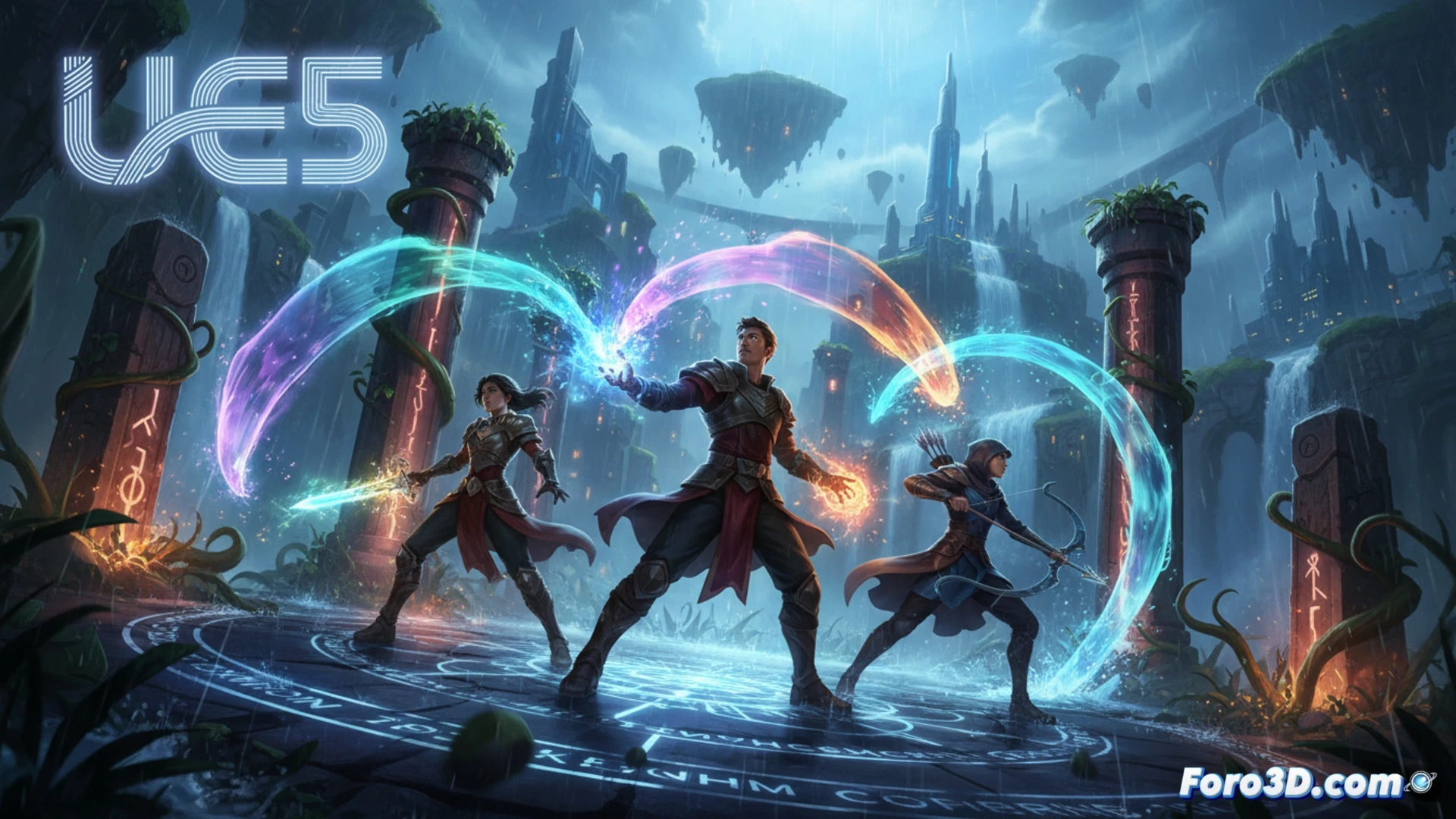
Riot Games' recent announcement of Project: F, a cooperative ARPG set in Runeterra, has sparked interest in the technical community. Beyond its gameplay proposal, the title represents a significant development challenge as it seeks to visually expand an already established universe. The use of Unreal Engine 4 and its transition to UE5 is key to achieving volumetric magic effects and environments that dynamically react to player abilities.
Asset pipeline and volumetric magic in UE5 🎮
Project: F's production pipeline relies on classic tools like Maya for character and structure creation, and Photoshop for crafting textures and material masks. However, the true technical challenge lies in implementing volumetric spell effects. To make a beam of light or a poison cloud feel organic in a cooperative environment, the team must optimize the use of particle shaders and Niagara systems. The key is generating low-resolution VDBs (digital volumes) that blend with the environment without saturating the GPU, allowing up to four players to cast abilities simultaneously without frame loss. Level design, meanwhile, uses Unreal's Landscape system and Blueprints to create zones that deform or are destroyed by magic, adding a layer of interactivity that reinforces immersion in the world of Runeterra.
Optimization for cooperation and visual identity ⚙️
The biggest technical challenge of Project: F is not just the graphics, but ensuring the cooperative experience remains smooth. Riot must balance the visual fidelity of magical effects with network performance. The use of dynamic LODs and particle prioritization based on player proximity are likely solutions to avoid overload. Ultimately, the project's success will depend on how the team manages to translate League of Legends' visual identity to a more complex engine, maintaining combat readability without sacrificing the technical spectacle that Unreal Engine 5 promises.
Considering the use of Unreal Engine for a massive cooperative ARPG like Project: F, what was the biggest technical challenge Riot Games faced in adapting the engine to handle the persistence of the Runeterra world and the synchronization of abilities among multiple players in real-time?
(PS: shaders are like mayonnaise: if they break, you have to start all over again)