The Project C, developed by NetEase in collaboration with Riot Games, represents a monumental technical challenge: transferring the competitive experience of Valorant to mobile devices without sacrificing visual clarity. Using a customized version of Unreal Engine 4, the team faced the task of reducing the graphical load while maintaining minimal latency and perfect visibility of agents and abilities. The key was not just scaling textures, but rewriting the rendering pipeline to prioritize gameplay readability over superfluous visual effects.
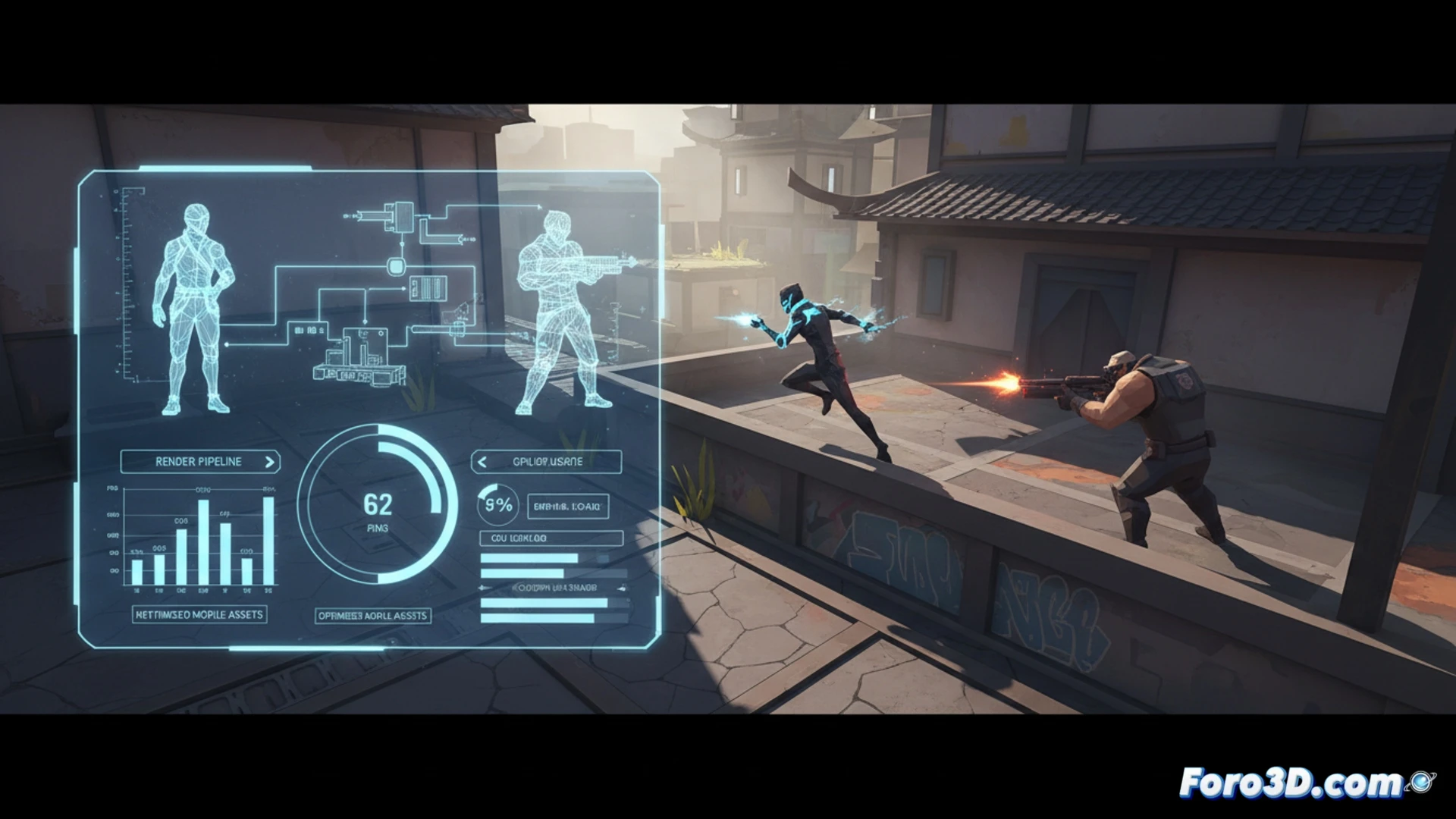
Rendering optimization and asset scaling in mobile UE4 🎮
The base engine of Valorant on PC uses dynamic shadows and a lighting system that demands a dedicated GPU. For the mobile version, NetEase implemented an aggressive LOD (Level of Detail) system that reduces the polygonal complexity of maps by more than half on mid-range devices, keeping only the critical outlines for enemy identification. Additionally, dynamic resolution scaling (DRS) was introduced, lowering the internal resolution to 50% during high-action moments but instantly increasing it when the player aims down sights. Tencent's profiling tools, integrated into the UE4 editor, allowed detecting VRAM memory bottlenecks and adjusting texture streaming to avoid micro-stutters on smartphones with 4GB of RAM.
Lessons on competitive clarity on limited hardware 🔍
Project C's greatest success was understanding that in a tactical shooter, graphical fidelity is secondary to performance predictability. NetEase opted for flat shading on weapons and characters, eliminating specular reflections that could camouflage players. They also redesigned ability effects to occupy fewer pixels on screen, using semi-transparent particles instead of complex volumes. This philosophy demonstrates that for competitive mobile game development, optimization is not a luxury: it is the foundation of design, and any deviation toward unnecessary realism harms the core gameplay experience.
How did NetEase manage to maintain the aim precision and tactile response of Valorant on mobile devices despite the latency and touch control limitations in Unreal Engine 4?
(PS: optimizing for mobile is like trying to fit an elephant into a Mini Cooper)