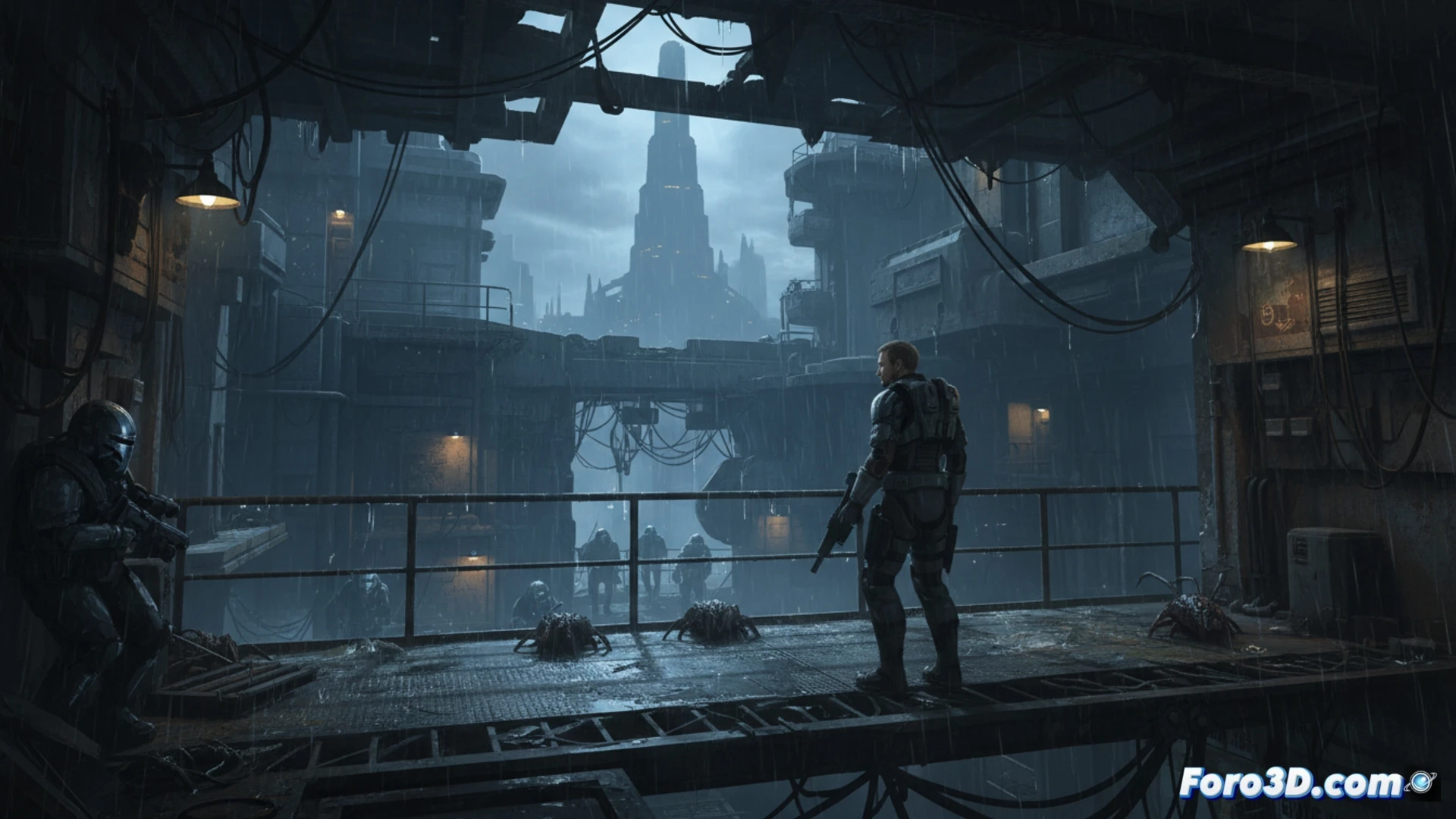
The fan team behind Project Borealis has set itself a titanic challenge: transferring the visual essence of Half-Life 2 to the Unreal Engine 5 engine. Using Blender for organic modeling and 4K textures, the group seeks to capture the oppressive atmosphere of the original without falling into generic photorealism. The key lies in a technical balance between Lumen's dynamic lighting and respect for the desaturated color palette that defined Valve's work.
Blueprints and Artistic Recreation in UE5 🎨
To achieve stylistic fidelity, the team has turned to Unreal Engine 5's Blueprints, avoiding traditional C++ programming. This allows for rapid iteration on materials and particle systems, adjusting the reflectance of metallic surfaces or fog density without compiling code. In Blender, iconic assets such as the Combine or vehicles are rebuilt, applying flat shading with hard edges that mimics the Source Engine's vertex lighting, but with 4K normal maps to add subtle detail. The biggest technical challenge has been synchronizing the original facial animations with UE5's Control Rig system, since the source data cannot be exported directly without mediation from custom Python scripts.
The Value of Open Source in Unofficial Projects 🛠️
Project Borealis demonstrates how free tools like Blender and Audacity allow small teams to compete in quality with AAA studios. However, the absence of a corporate pipeline forces developers to manually document each asset to avoid visual inconsistencies. The community has applauded the decision to maintain the original artistic style rather than fully modernizing it, which raises a reflection: sometimes, modern technology serves better to preserve an artistic vision than to surpass it.
How does the use of Blender in Project Borealis's workflow affect the visual fidelity of Half-Life 2 when transferring its assets to Unreal Engine 5, considering the differences in lighting and geometry between both engines?
(PS: 90% of development time is polishing, the other 90% is fixing bugs)