A team of scientists has discovered traces of the isotope iron-60 in deep Antarctic ice, dating back between 40,000 and 81,000 years. This isotope, which only forms in supernova explosions, was found in 295 kilograms of ice from the European Project for Ice Coring in Antarctica (EPICA). Its half-life of 2.6 million years confirms that it does not originate from Earth's formation, but from an extraterrestrial shower that still reaches us.
3D Modeling of the Solar System's Trajectory through the Local Interstellar Cloud 🌌
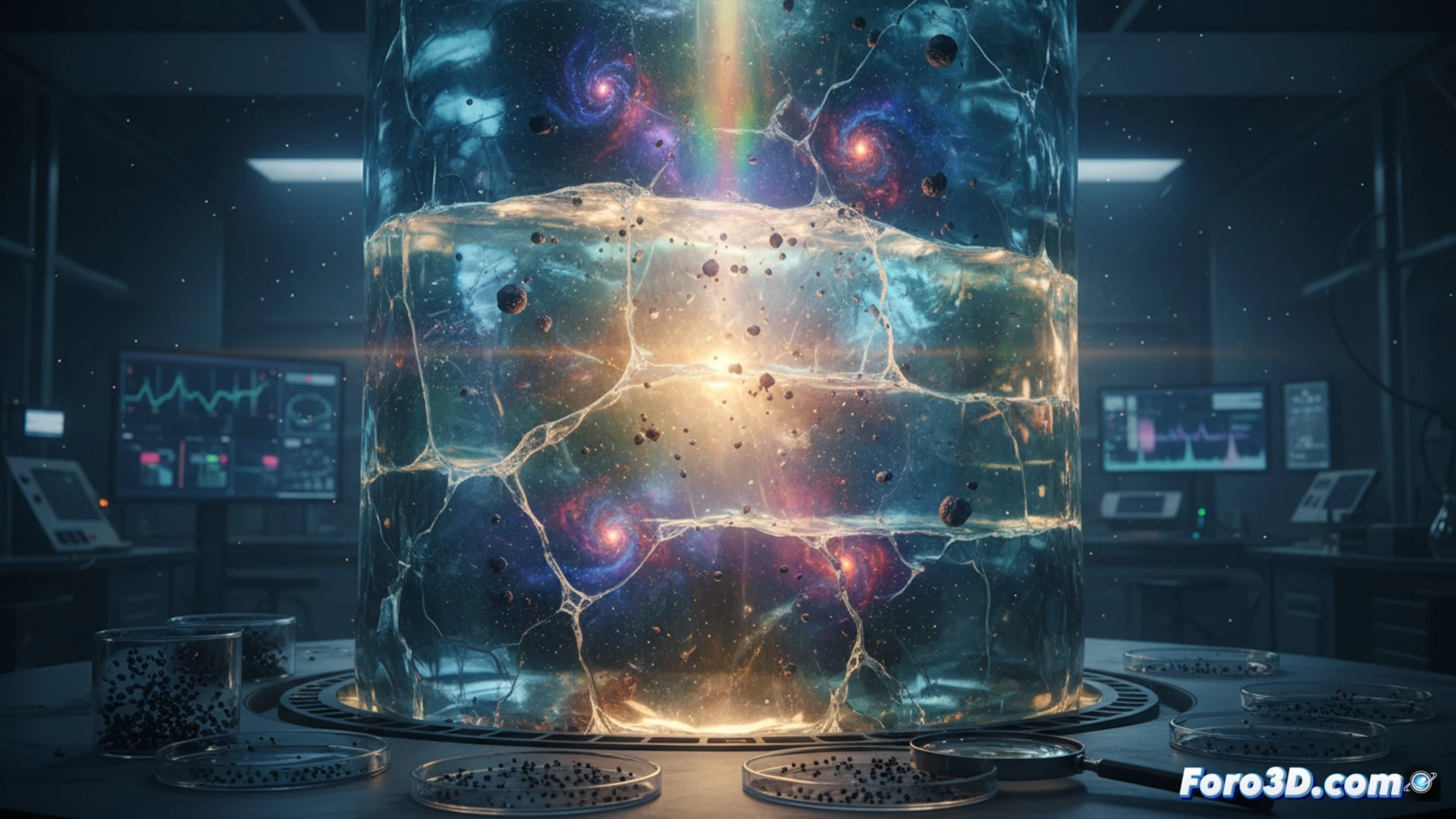
To visualize this phenomenon, we propose an interactive 3D infographic representing the Solar System's drift through the Local Interstellar Cloud, a region of gas, dust, and plasma generated by supernova activity. The model should include an animated timeline spanning from 40,000 to 81,000 years ago, showing how the cloud's varying density affects particle concentration. On a volume of Antarctic ice rendered with transparency, we will embed radioactive iron-60 particles emitting a faint but detectable glow, simulating the weak cosmic shower. Study data indicate that the current concentration is higher than in the past, so the animation should reflect a gradual increase in particle density as we approach the present.
The Paradox of Stardust: A Less Dense Past, a More Active Present ✨
The discovery reveals a fascinating paradox: although the Solar System has been immersed in this interstellar cloud for at least 80,000 years, the amount of iron-60 trapped in ancient ice is less than in recent snow. This suggests that the space region we traversed in the past was less dense, as if we had sailed through the outskirts of a cosmic storm. The 3D infographic should highlight this visual contrast, using heat maps along the orbital trajectory to emphasize how the interstellar environment changes over time, offering a unique perspective on the evolution of our galactic neighborhood.
How the dispersion of the iron-60 isotope in Antarctic ice is modeled and visualized in 3D to reconstruct the history of nearby supernovae over the last 80,000 years
(PS: if your manta ray animation doesn't excite, you can always add documentary music from channel 2)