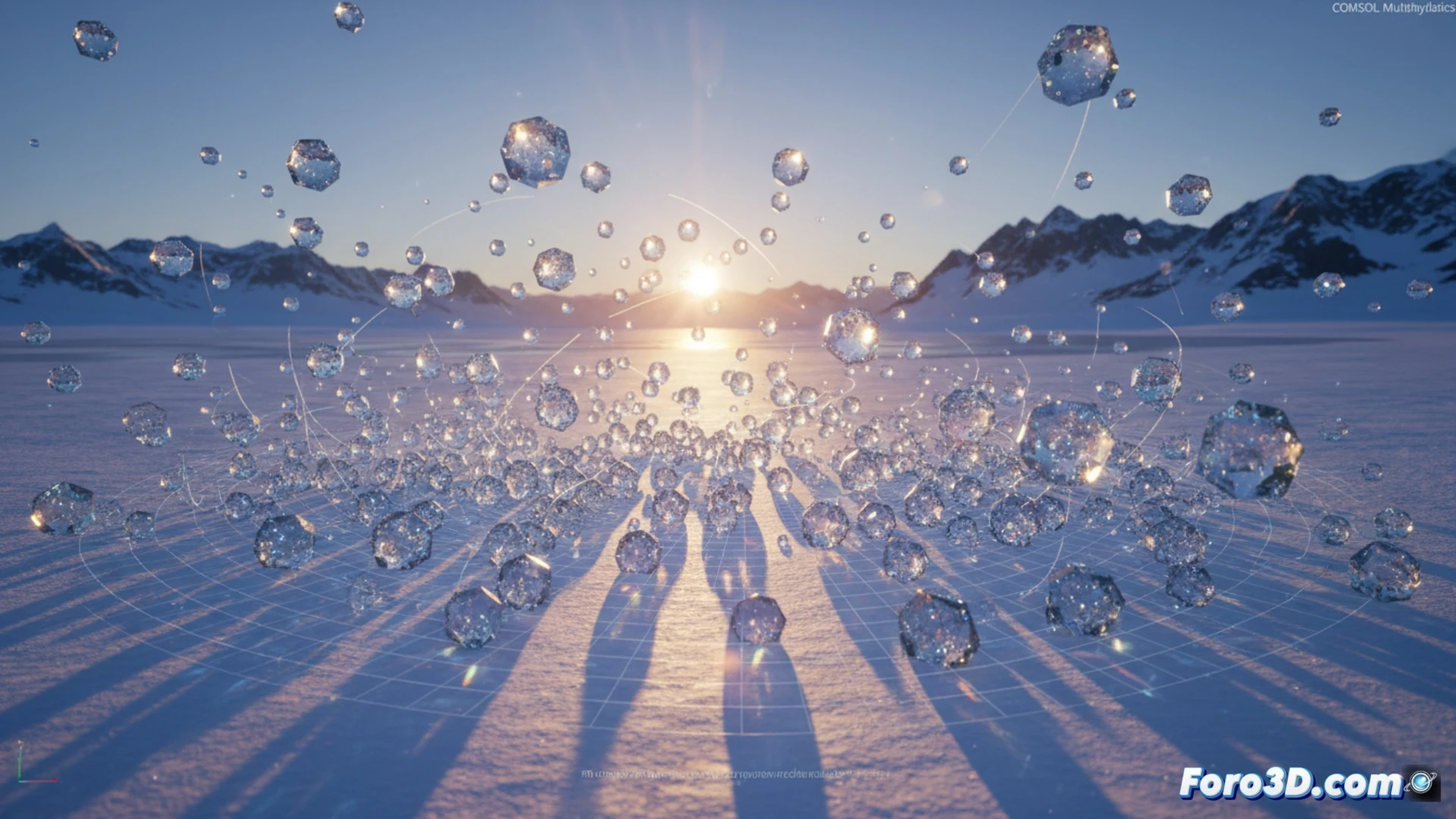
Diamond dust is not a gemstone, but a fascinating meteorological phenomenon that occurs when tiny ice crystals form near the ground in conditions of extreme cold and clear skies. These crystals, with a hexagonal structure, float in the air and refract sunlight, generating sparkles that resemble suspended diamonds. The key to their formation lies in homogeneous nucleation, a thermodynamic process where water molecules spontaneously organize into a crystalline lattice.
Molecular Nucleation and Multiphysics Simulation with COMSOL 🌡️
To understand the formation of diamond dust at the molecular level, tools like COMSOL Multiphysics in its Bio-electromagnetism module allow modeling the heat exchange and intermolecular forces that govern nucleation. At sub-zero temperatures, water molecules lose kinetic energy and cluster together. COMSOL simulates this process by solving heat transfer and fluid dynamics equations, predicting how water vapor condenses directly into ice without passing through a liquid state. This type of analysis is crucial for precision meteorology and the study of ice formation on surfaces.
3D Visualization and Applications in Materials Science 💎
Once modeled, the simulation data is exported to VGSTUDIO MAX to visualize the three-dimensional geometry of the crystals. This software allows rendering the hexagonal structure and simulating light refraction, recreating the characteristic sparkle of diamond dust. Additionally, Materialise Mimics can segment and analyze crystal growth patterns from artificial snow tomographies. This methodology has direct applications in creating anti-ice materials and predicting visibility at airports during cold waves.
How can the complex hexagonal and prismatic formations of diamond dust ice crystals be accurately modeled and visualized in a 3D engine to simulate their interaction with light and generate realistic sparkles?
(PS: if your manta ray animation doesn't excite, you can always add documentary music from channel 2)