Outer space is not a perfect vacuum. Between planets and stars, a cloud of microscopic particles known as cosmic dust floats. For the optical equipment of telescopes and satellites, these specks are a silent but devastating threat. Traveling at hypersonic speeds, each impact erodes lenses and sensors, degrading the quality of observations and shortening the lifespan of costly instruments. This article analyzes the 3D modeling of this destructive phenomenon. 🚀
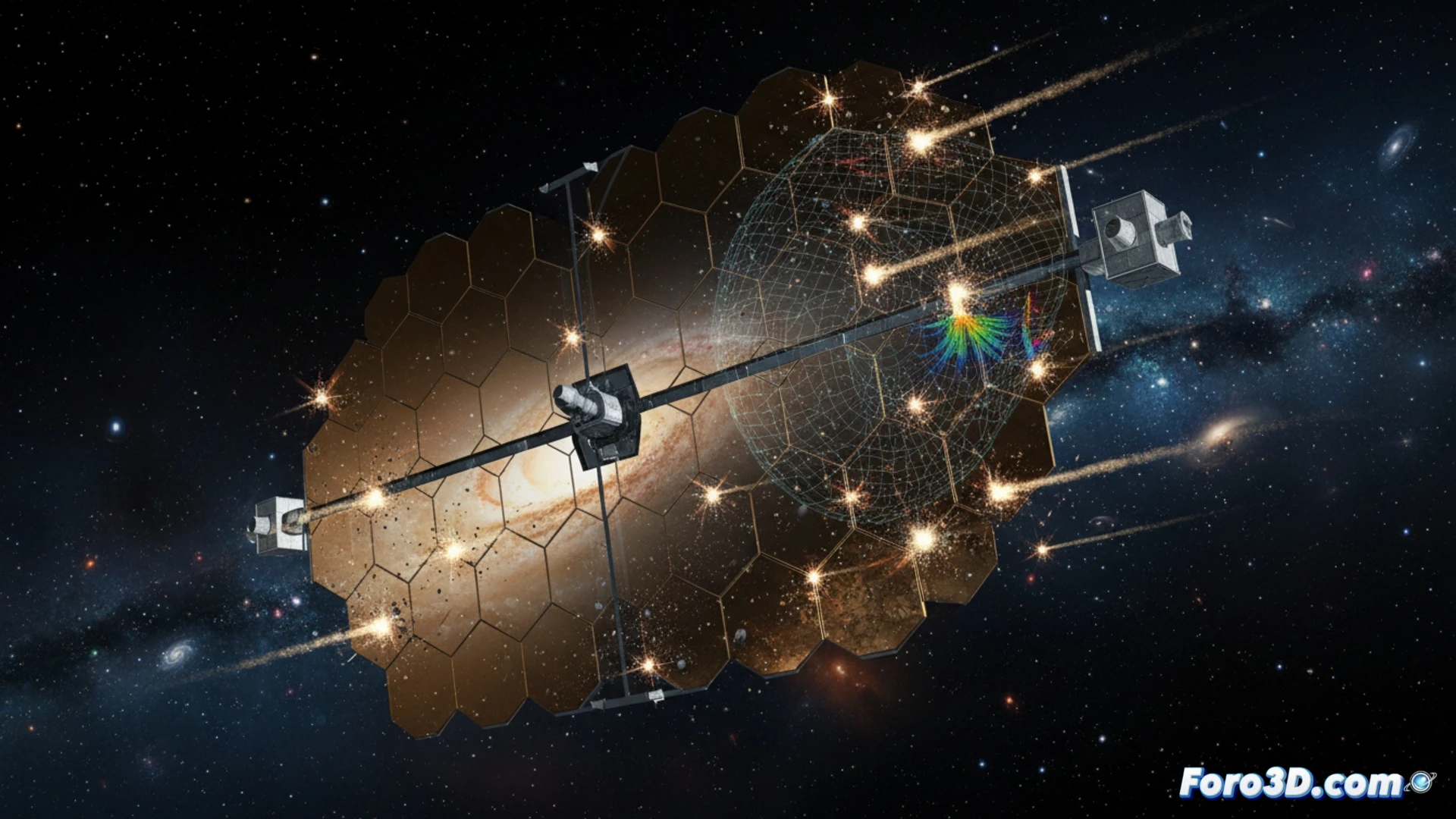
Simulation of Impacts and Surface Degradation 🌠
To understand the damage, engineers turn to 3D simulations of computational fluid dynamics and finite elements. Particles of silica or ice between 1 and 100 microns impacting at over 10 km/s on borosilicate glass surfaces or anti-reflective coatings are modeled. The simulations reveal microscopic craters, microfractures, and material ablation. In the case of the Hubble telescope, over 5,000 impacts were documented on its primary mirror, while the James Webb, with its multi-layer thermal shield, uses kevlar and aluminum shielding to deflect or vaporize dust before it touches the sensitive optics.
Lessons for 3D Catastrophe Modeling 💥
The study of cosmic dust offers a perfect laboratory for disaster modeling. The progression of damage is not immediate, but cumulative, similar to wind erosion on Earth. Visualizing in 3D how an optical surface goes from perfect to a mosaic of pitting allows predicting failures and designing mitigation strategies, such as protective blankets or plasma sweeps. Mastering these simulations not only protects telescopes but also trains modelers to face any phenomenon of progressive degradation in extreme environments.
As a space materials engineer, how can we design a self-regenerating electromagnetic cleaning system to mitigate the impact of cosmic dust on telescope optics during long-duration missions?
(PS: Simulating catastrophes is fun until the computer crashes and you are the catastrophe.)