GameMill Entertainment has released The Karate Kid: Street Rumble, a beat 'em up that pays homage to the classic 80s trilogy. Developed in Unity, the game foregoes photorealism to embrace 16-bit pixel art that evokes the golden age of arcades. The choice of Aseprite as a spriting tool is no coincidence: it allows for precise control over the color palette and frame-by-frame animation, key elements to capture the essence of the original films.
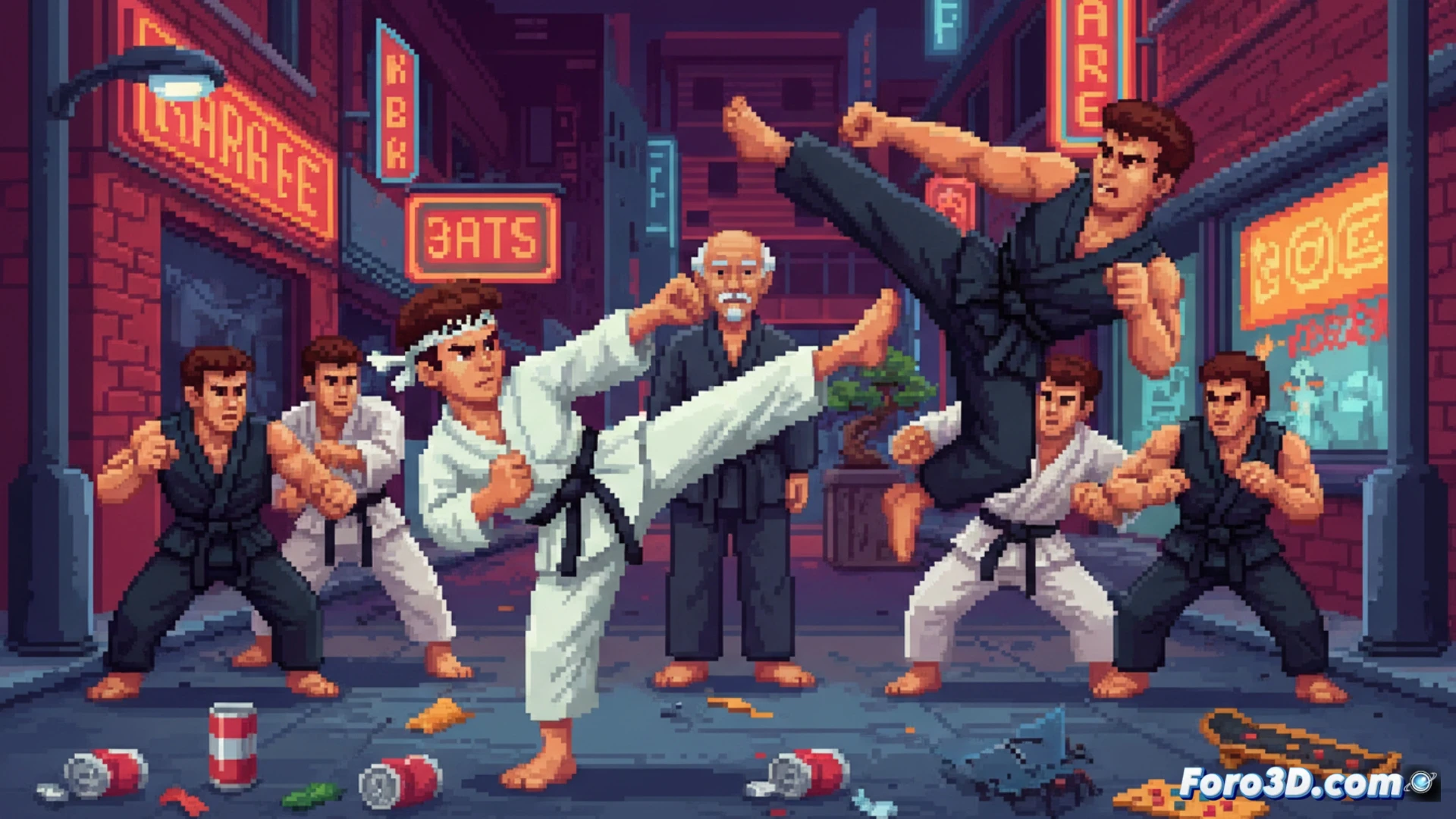
Fluid animation techniques in a 3D engine for a 2D beat 'em up 🎮
One of the biggest technical challenges when recreating a retro beat 'em up in Unity is achieving animations that feel organic without sacrificing the pixel aesthetic. The team has used Aseprite to generate animation cycles with a reduced frame rate (12-15 fps), characteristic of the genre. Later, in Unity, these sprites are imported as optimized sprite sheets. The key lies in using the Sprite Renderer tool and setting Compression to None to avoid blurring artifacts. Additionally, for transitions between attacks and movements, coroutines are implemented that interpolate the sprite's position in 2D space, avoiding the use of 3D animations that would break the retro illusion. Indie developers should remember to disable Anti-aliasing on the main camera and use the Point (no filter) filter in Texture Import Settings to maintain the sharp, crisp edges of pixel art.
Nostalgia as a design and optimization driver 🕹️
Beyond the technique, Street Rumble demonstrates that nostalgia is not merely an ornament, but a design guide. Each scenario, from Miyagi's dojo to the All Valley tournament, is built with a limited color palette (maximum 256 colors per screen) to replicate the hardware limitations of the era. For independent developers, the lesson is clear: you don't need a cutting-edge graphics engine to create an appealing title. Optimization in Unity through the use of Tilemaps and texture compression in PNG format allows the game to run smoothly even on modest hardware, expanding the target audience and reducing production costs. Visual authenticity, when supported by the right tools, remains a powerful commercial hook.
Given the growing trend of 2D beat 'em up revivals, like The Karate Kid: Street Rumble, which technical aspects and limitations of Unity do you consider most decisive for faithfully emulating the pixel art aesthetic and gameplay of classic 80s titles without falling into a mere nostalgic simulation?
(PS: a game developer is someone who spends 1000 hours making a game that people complete in 2)