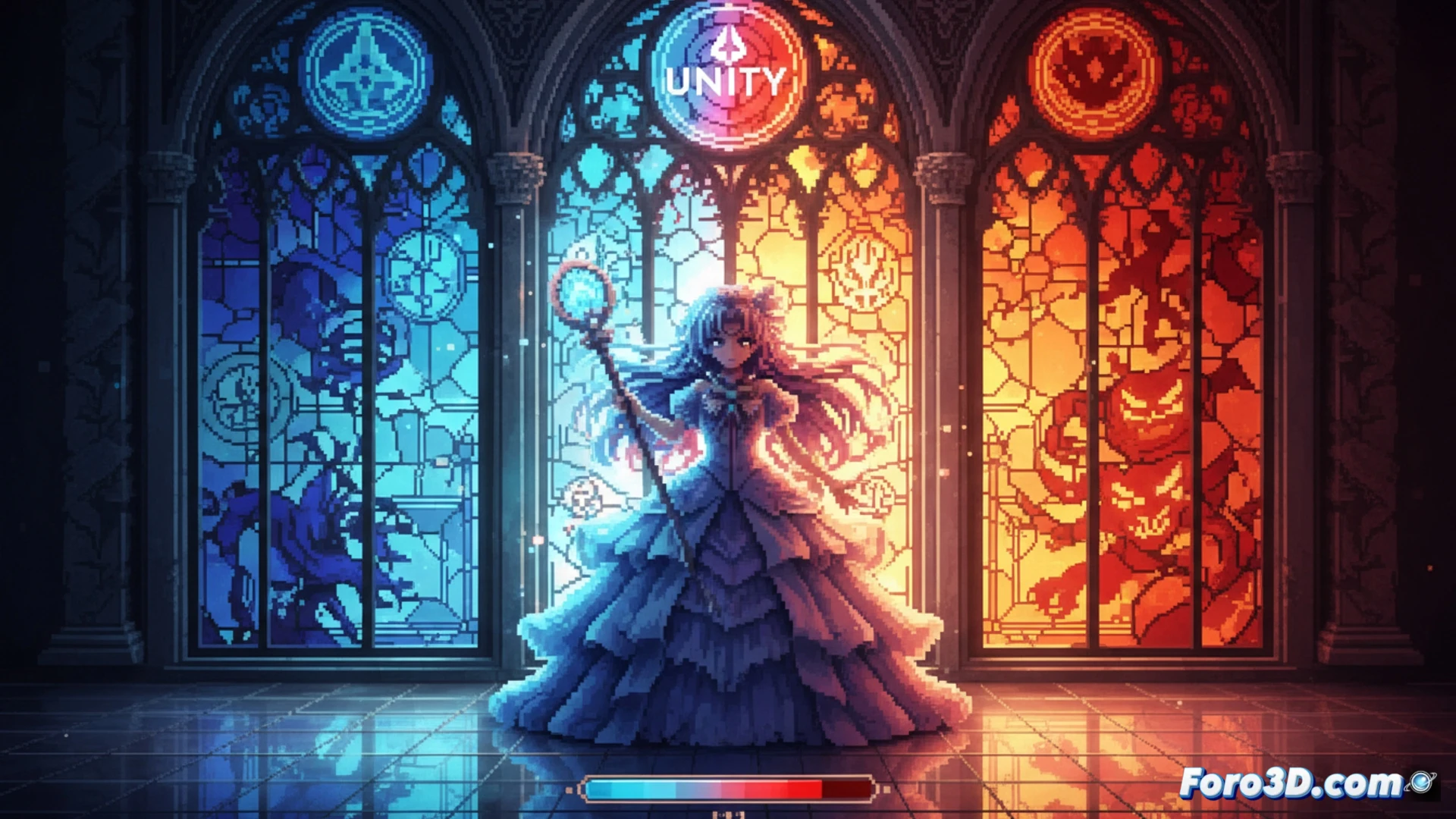
The development of 9 Years of Shadows demonstrates how Unity can be the ideal engine for pixel art projects with visual ambition. The studio has achieved a 90s magical girl aesthetic using a progressive color palette that changes according to the character's health. This technical decision is not merely decorative: it directly affects the legibility of the scenery and the visual narrative.
Workflow with Aseprite and Photoshop in Unity 🎨
The artistic pipeline of 9 Years of Shadows combines Aseprite for sprite animation and Photoshop for composing stained-glass-style backgrounds. Aseprite allows precise control over the limited palette and animation cycles, while Photoshop facilitates the creation of translucent textures that simulate glass. In Unity, these assets are integrated using particle systems and custom shaders that apply chromatic progression in real-time. The result is a world that fades from color to grayscale as the character loses health, a technical solution that reinforces gameplay without the need for dialogue.
How Technique Defines Visual Narrative ✨
The choice of Unity for this project was no coincidence. Its flexibility with 2D shaders allows pixel art to behave like a dynamic stained glass window, with light filtering through transparent layers. This 90s magical girl aesthetic would not be possible without the combination of Aseprite for frame-by-frame detail and Photoshop for static backgrounds. 9 Years of Shadows demonstrates that pixel art is not a limitation, but a canvas where technology amplifies emotion and narrative.
How does Unity manage dynamic lighting and particle effects on stained-glass pixel art sprites without compromising the retro aesthetic or performance in 9 Years of Shadows
(PS: 90% of development time is polishing, the other 90% is fixing bugs)