The launch of Metal Slug Tactics not only marks a genre shift for the franchise, but also a fascinating technical challenge for the developers. Translating the series' iconic pixel art to a tactical isometric perspective in Unity required maintaining the fluidity and handcrafted detail of the original sprites while adapting them to a movement grid and a fixed 3D camera. The result is a lesson in how to combine traditional 2D animation techniques with modern lighting effects to preserve the visual essence without sacrificing gameplay.
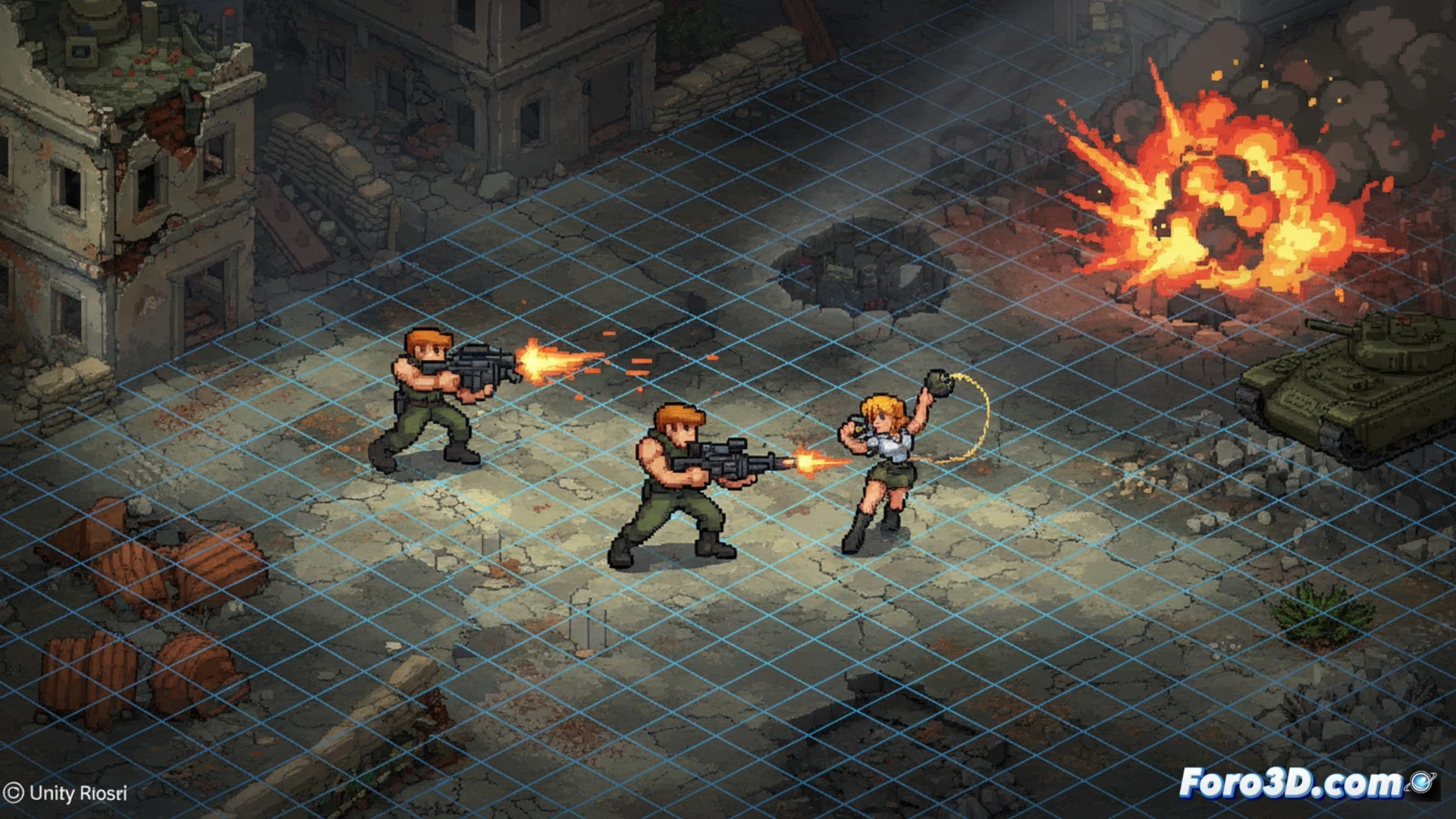
Workflow between Photoshop and Unity for isometric sprites 🎮
To achieve this style, the team turned to Photoshop as the main sprite creation tool, maintaining the limited palette and exaggerated animations that characterize the series. However, the leap to isometry meant redrawing each sprite from scratch to fit a 2:1 perspective on the grid. In Unity, these sprites were imported as 2D animation sheets but combined with dynamic lighting systems (point, directional, and ambient) to add depth to the scene. The technical trick was using custom shaders that respected the hard edges of pixel art while applying soft shadows, preventing the characters from looking like stickers on the background. Additionally, particles and post-processing effects (such as bloom and vignette) were implemented to emulate the explosiveness of the original titles, but optimized so that performance on consoles and PCs would not suffer.
Preserving the visual essence in a new genre 🎯
The greatest technical achievement of Metal Slug Tactics is that it doesn't feel like a generic tactical game with a Metal Slug skin. The sprite animations, although now viewed from above, retain the same number of frames and the same exaggeration in character movements, from running to explosions. This was achieved through advanced 2D rigging in Unity that allows smooth interpolations without losing the pixelated aesthetic. For developers interested in this approach, the case demonstrates that the key is not in the resolution, but in the coherence of the visual language: if the sprites move at 12 fps, the lights and shadows must follow that same rhythm to avoid breaking the illusion.
How does Metal Slug Tactics achieve the feeling of depth and smooth movement in its isometric pixel art scenarios without compromising performance in Unity?
(PS: shaders are like mayonnaise: if they break, you start all over again)