In southeastern Tenerife, six stepped structures of volcanic stone challenge the official chronology. The Pyramids of Güímar, whose origin is debated between agricultural terraces, a Masonic ritual, or remnants of a pre-Columbian civilization, have undergone a rigorous digital documentation process. Digital archaeology has burst into this debate to offer objective data through massive geometry capture technologies.
Photogrammetry and astronomical alignments in 3D models 🏛️
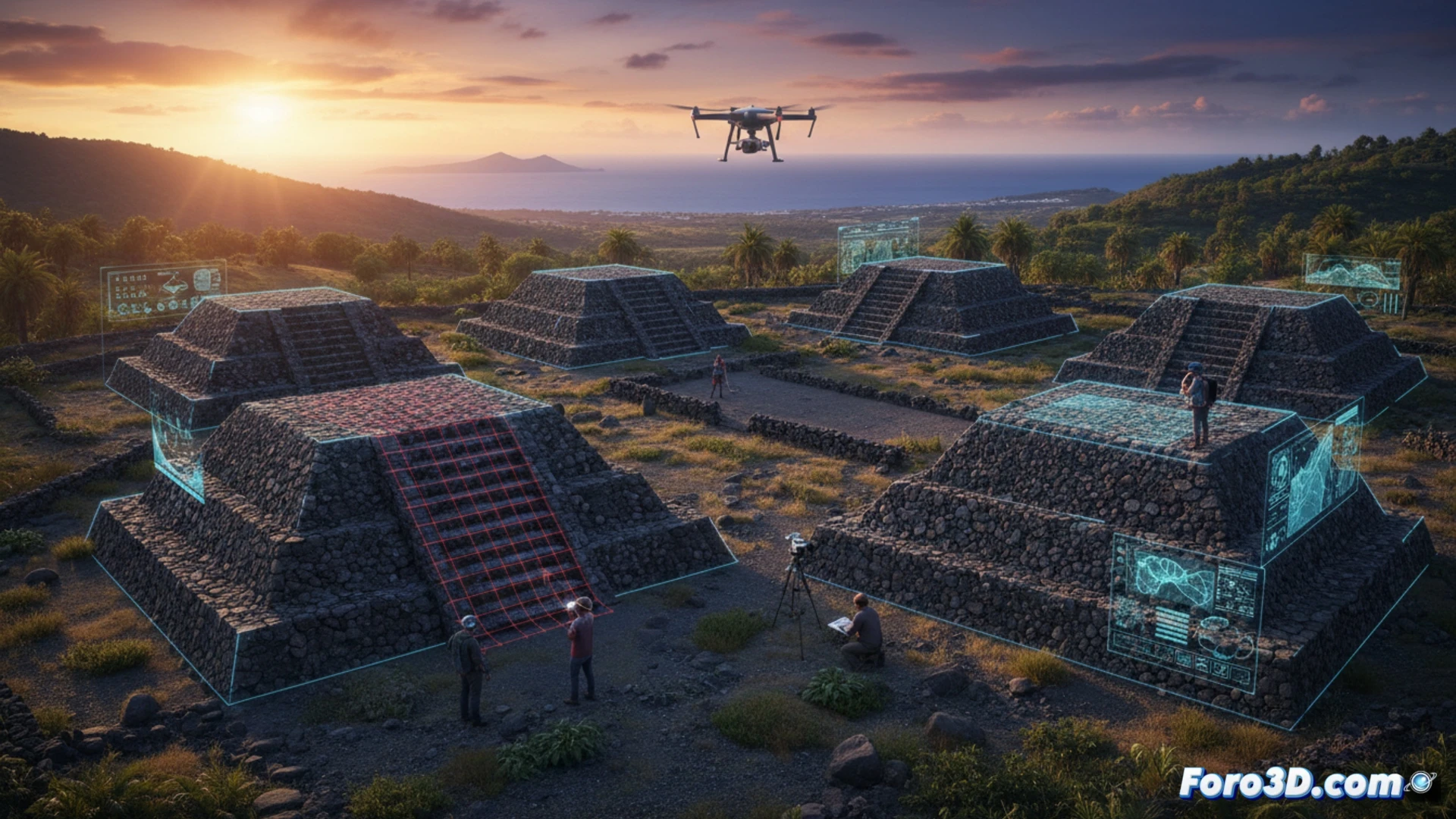
The research team has used drones equipped with LiDAR sensors and high-resolution photogrammetry to generate precise point clouds of the structures. These digital models allow analyzing the orientation of the stairways and walls with millimeter accuracy. The data reveals that the pyramids are not only aligned with the summer solstice but also display geometric patterns that could correlate with specific constellations. The digital comparison between the different hypotheses (agricultural, symbolic, or ceremonial) is now carried out on a virtual twin that allows rotating, sectioning, and measuring every angle without altering the physical heritage.
Beyond the stone: The digitized debate 🔍
The true value of this virtual recreation lies not in validating one theory over another, but in democratizing access to scientific analysis. Now any researcher can download the model and check whether the alignments match those of the Egyptian pyramids or whether the layout corresponds to a stepped farming system. 3D technology does not solve the mystery, but it turns the debate into an exact science where data, not beliefs, draw the lines for future archaeological study.
What revelations about the construction techniques and dating of the Pyramids of Güímar has 3D scanning provided that could not have been obtained with traditional archaeological methods?
(PS: and remember: if you can't find a bone, you can always model it yourself)