Red Barrels has taken cooperative horror to a new level with The Outlast Trials, a title that maximizes the capabilities of Unreal Engine 4. The game not only frightens but also demonstrates deep technical mastery in the manipulation of light and organic matter. For independent developers, analyzing this pipeline reveals how to combine sculpting software and motion capture with a modern graphics engine to achieve visceral realism without needing an AAA budget.
Nighttime lighting and volumetric blood in UE4 🕯️
The heart of realism in The Outlast Trials lies in two key technical systems. First, the night vision lighting is not a simple green filter; it is a dynamic system that uses noise textures and selective bloom to simulate the optical distortion of a real camera. Second, the volumetric blood effects are achieved through particles that react to the engine's dynamic lighting, combined with decals that deform the ground geometry. To replicate this, a developer must master materials with advanced blend modes and UE4's Niagara system for persistent particles, adjusting the blood density to affect player visibility.
The art of organic deformation 🧬
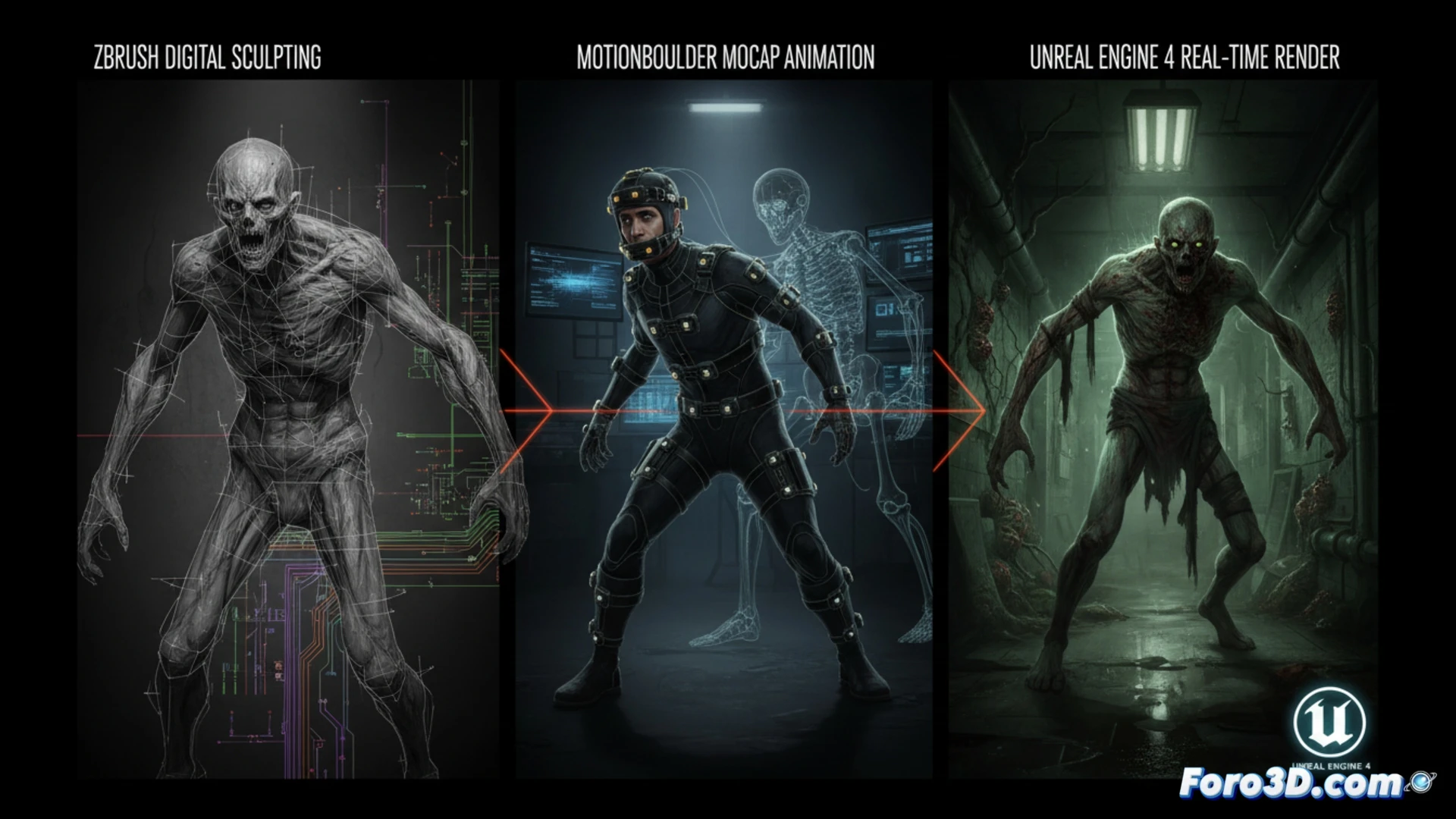
The design of the deformed enemies is a case study in ZBrush. Artists use DynaMesh to sculpt grotesque body masses without topology restrictions, applying skin and scar alphas to texture the horror. Subsequently, motion capture in MotionBuilder not only animates the walk but introduces micro-vibrations and tremors in the bones, synchronizing the skeleton's movement with the flesh deformation. The final trick lies in the export: using a control rig with blendshapes so that the terrifying animation does not destroy the high-density polygons.
How would you approach lighting at this level? 💡