Shadow Warrior 3 represents a fascinating case study in the convergence of concept art and technical optimization. The game uses Unreal Engine 4 as its backbone to manage destructible environments and massive particles, while Autodesk Maya handles first-person execution animations. ZBrush, in turn, sculpts demonic enemies with a level of detail that supports close-up camera angles without sacrificing performance.
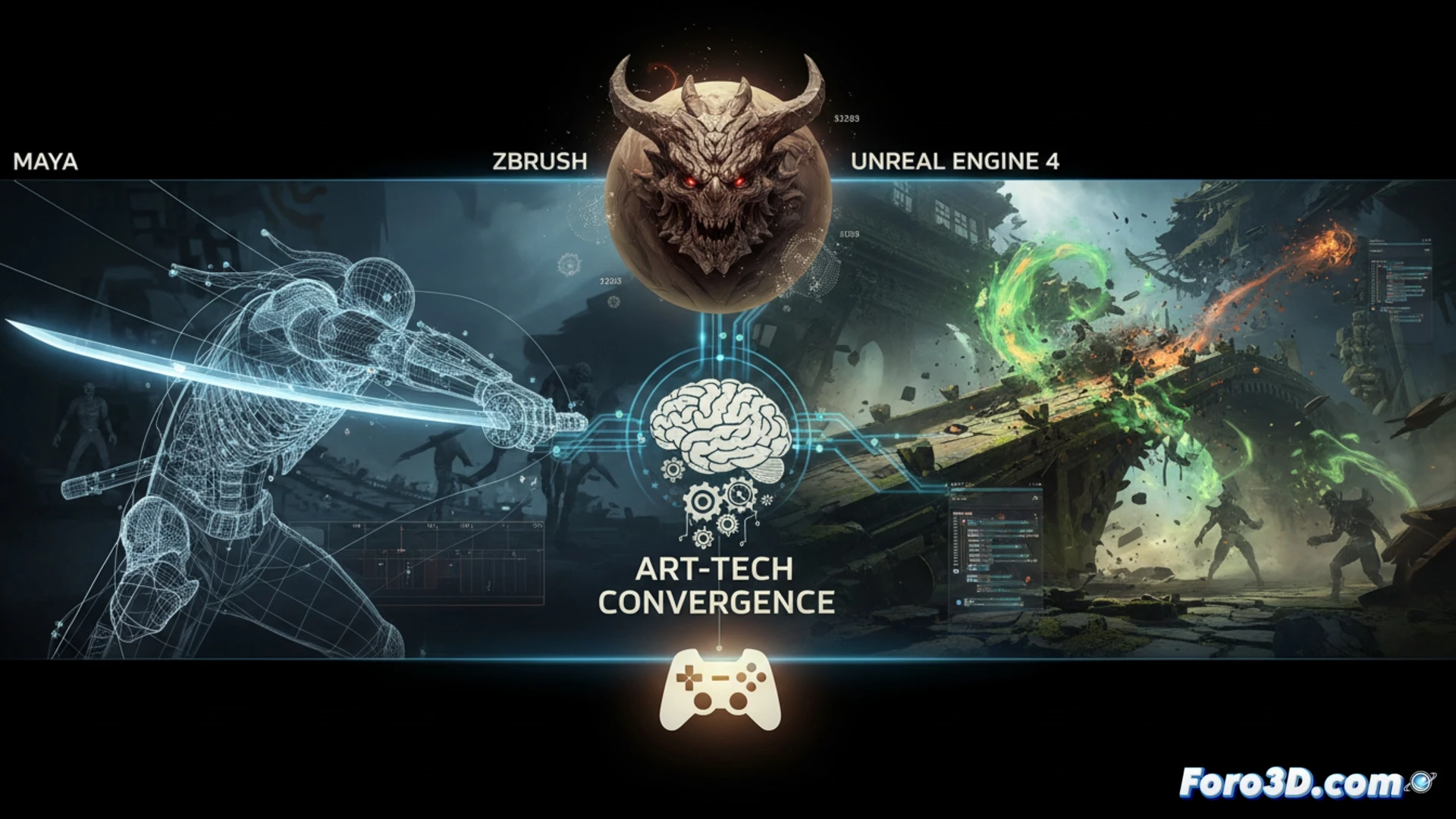
Demonic enemy pipeline and procedural blood 🩸
The workflow begins in ZBrush, where modelers sculpt creatures with high-density geometry. Then, they are retopologized in Maya to generate optimized meshes that work in real-time. Procedural blood is implemented using dynamic materials in Unreal Engine 4: mask textures are assigned that react to impacts, generating stains that expand without the need for pre-rendered assets. For massive particles, developers use the Niagara system, which allows controlling tens of thousands of fragments with low overhead. A key tip for indies: limit the number of particles per impact to 500 and use aggressive LODs for demonic enemies.
Technical lessons for indie developers 💡
The main lesson from Shadow Warrior 3 is that frenetic action does not require cutting-edge hardware if the pipeline is optimized. Indies can replicate saturated neon colors using post-process volumes in Unreal Engine 4 with controlled bloom and saturation. For first-person executions, Maya allows animating cameras separate from the character's body, achieving smooth transitions. Remember that visual success lies in the coherence between concept art and the engine's technical limitations.
How would you approach lighting in this level?