The development of Outer Wilds represents a fascinating case study on how a small team managed to simulate a complete solar system with real-time physics. Using Unity as the base engine, the developers combined Autodesk Maya for modeling planets and ships, Substance Painter for texturing with a stylized artistic style, and Photoshop for designing the ship's log interface. This article analyzes the technical pipeline behind this indie masterpiece. 🚀
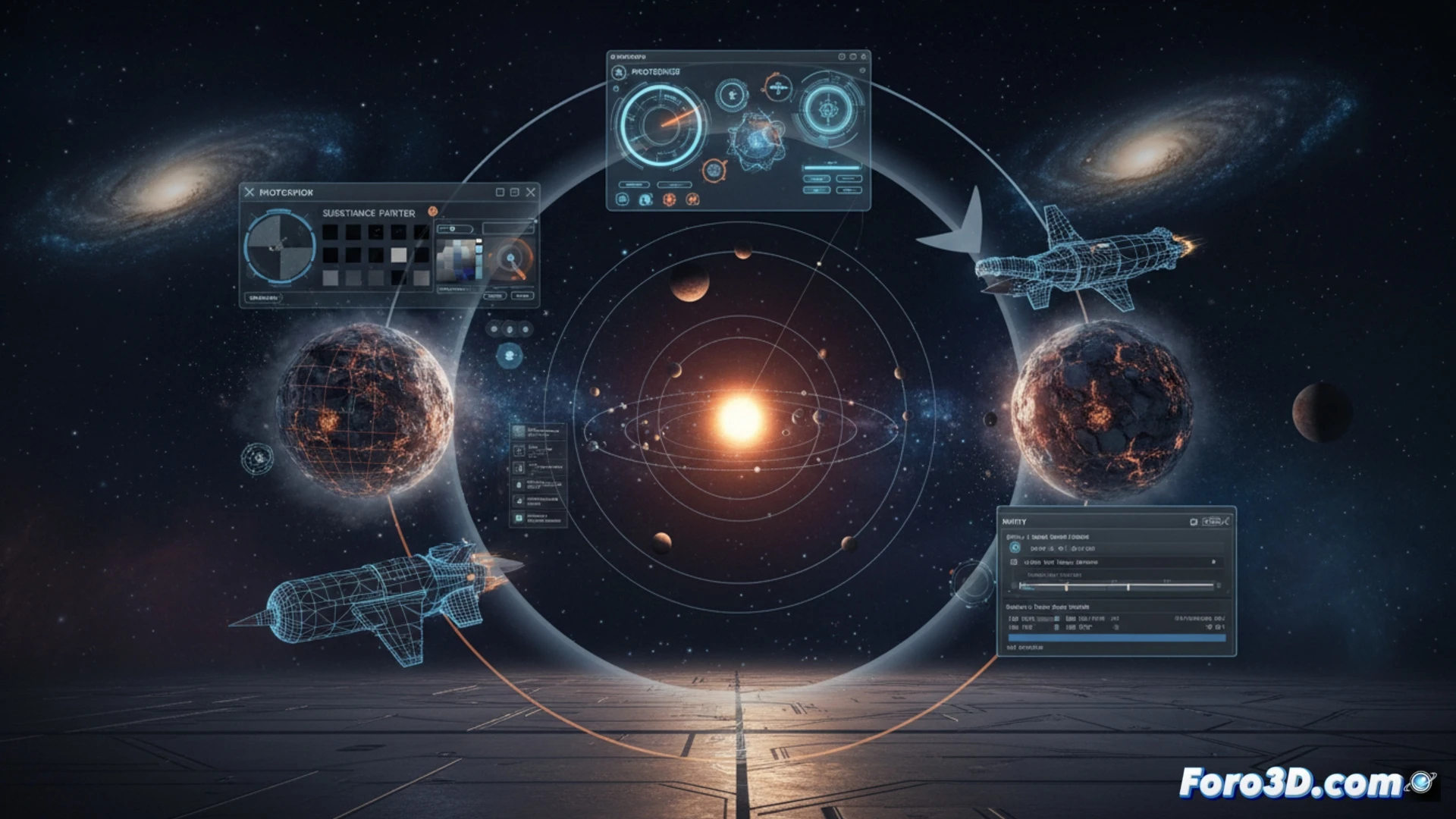
Asset optimization for large-scale gravitational simulation 🌌
The biggest technical challenge was creating celestial bodies that looked detailed without sacrificing physics performance. In Maya, artists modeled planets with simplified geometry but with high-resolution normal maps generated in Substance Painter, allowing Unity to calculate collisions and orbits without overloading the CPU. The textures, hand-painted in Substance, applied color variations and wear that translated into lightweight shaders. For the ship, dynamic LOD (level of detail) was used: at a distance, the model was reduced to a basic silhouette, while up close, cockpit and panel details were loaded. This strategy allowed the game to maintain 60 fps even with multiple planets visible from the surface.
The ship's log as an art-tech integration 📓
The log interface, designed in Photoshop, is not just a visual element; it is a living data system. Each text and drawing is rendered as a procedural texture in Unity, directly connected to the physics engine. When the player discovers a new planet, the log updates its connection map in real-time, reflecting the orbits calculated by the engine. This workflow demonstrates how 2D art can integrate with 3D simulation: flat Photoshop assets are assigned to 3D objects within the game world, creating an immersive experience where the interface is part of the environment. A clear example that, in indie games, technical optimization and artistic direction must go hand in hand.
What specific challenges did the Outer Wilds team face when integrating Maya and Substance assets into the Unity pipeline to achieve the simulation of a complete solar system without sacrificing real-time performance?
(PS: optimizing for mobile is like trying to fit an elephant into a Mini Cooper)