Marvel's Midnight Suns is not just a strategy game; it's a technical showcase of how to combine high-fidelity modeling with tactical performance. The Firaxis team used Unreal Engine 4 as a foundation, but the real secret lies in the workflow between Autodesk Maya for skill cinematics and ZBrush for costume and armor detail. We analyze how they achieved that unique, magical lighting per superhero without sacrificing turn-based gameplay.
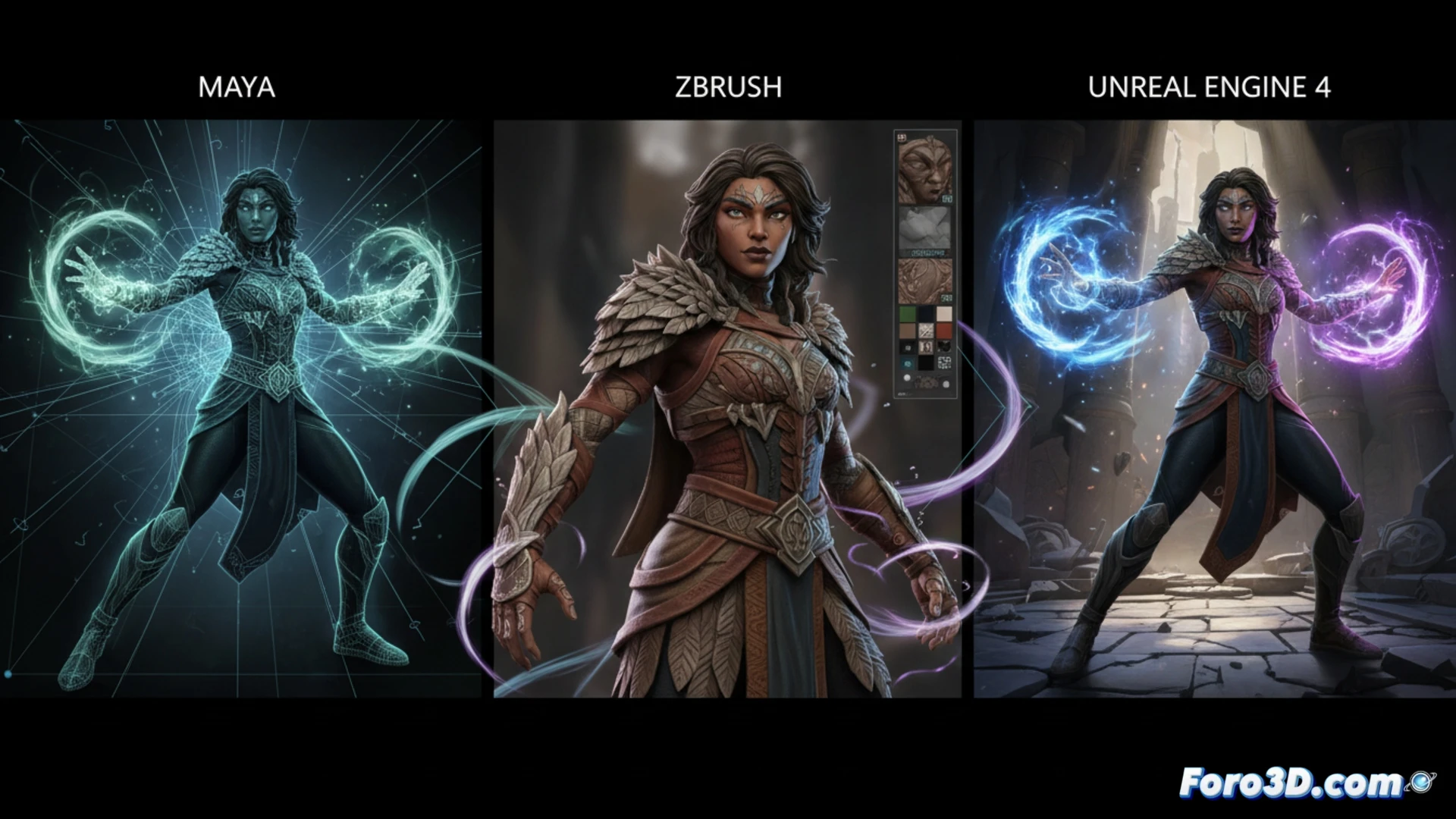
From Sculptor to Real-Time: The ZBrush-Maya-Unreal Flow 🎨
The pipeline began in ZBrush, where artists sculpted every armor plate and fabric fold with millions of polygons. For characters like Ghost Rider or Magik, the detail of the flames and demonic armor required normal maps and ambient occlusion extracted directly from the high-poly model. Subsequently, these assets were retopologized and sent to Maya. Here, animators created the cinematics for special abilities, such as Magik's Limbo portal, using particle systems and advanced rigging. The key was optimization: the final models in Unreal Engine 4 retained the detailed silhouette from ZBrush, but with a polygon count adjusted so the tactical camera could move smoothly between cards and the battlefield.
Magical Lighting as a Game Mechanic 💡
The most interesting aspect of the technical approach is how the specific lighting per superhero is not just aesthetic, but functional. In Unreal Engine 4, each character has a dynamic light source associated with their magical aura (Ghost Rider's fire, Nico Minoru's darkness). This was achieved using materials with emissives controlled by blueprints, which activate during combat phases. The result is a game where technical art and gameplay merge: the high fidelity of ZBrush and Maya is not an ornament, but a tool for the player to instantly identify each hero's power on the tactical board.
How the team at Firaxis managed to optimize the pipeline between Maya, ZBrush, and Unreal Engine 4 to ensure that the high-fidelity models of heroes and environments maintained stable performance on this generation's consoles without sacrificing detail in cinematics or turn-based combat
(PS: 90% of development time is polishing, the other 90% is fixing bugs)