The development of Bramble: The Mountain King represents a fascinating case study within the niche of narrative horror video games. This technical article breaks down the pipeline used by the development team, combining Unreal Engine 4 with digital sculpting tools and procedural simulation. We will analyze how the use of ZBrush, Substance Painter, and Houdini allowed for the construction of a world based on Nordic folklore, optimizing each asset to maintain stable real-time performance without sacrificing the dark realism characteristic of the title.
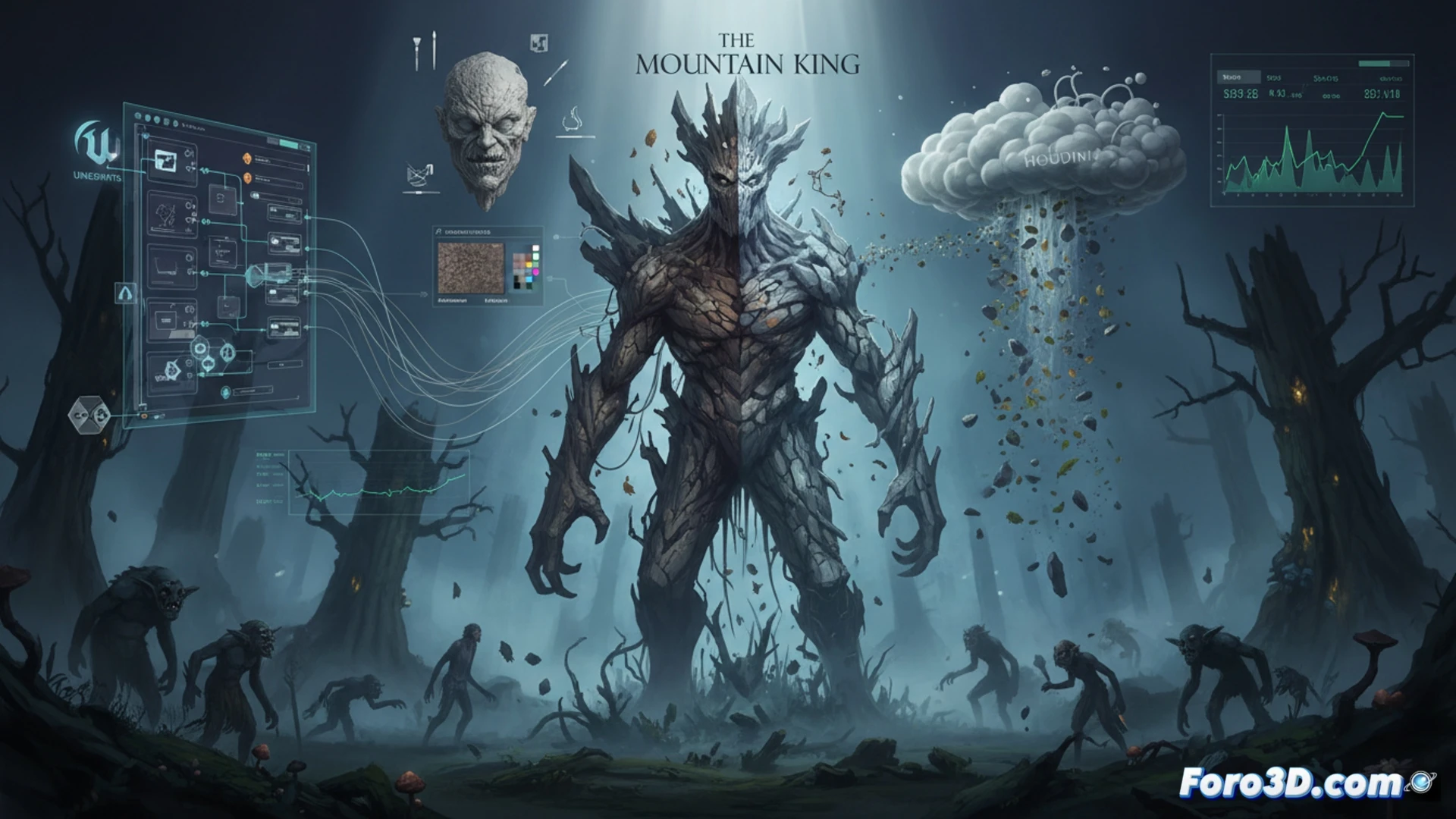
Asset pipeline and real-time fluid simulation 🎮
The process begins in ZBrush, where mythological creatures are sculpted with a high level of detail. The key is capturing the organic texture of rotten wood and troll skin, central elements of Nordic folklore. Subsequently, Substance Painter is used to generate texture maps (diffuse, normal, and roughness) that support dynamic ambient lighting within Unreal Engine 4. For particle effects, such as viscous blood or swamp water, Houdini performs high-fidelity fluid simulations. The technical challenge was converting these simulations into efficient particle systems, avoiding excessive memory usage by baking flipbook textures. The ambient lighting was designed with hard shadows and volumetric fog to recreate the oppressive feeling of Nordic forests.
Tips for optimizing creatures and dark environments 🛠️
To replicate this style, it is crucial to prioritize silhouette over microscopic detail. When sculpting in ZBrush, focus on shapes that will be visible under low light, such as claws or horns. In Substance Painter, use wear masks to simulate the constant humidity of the Nordic environment. Regarding lighting in Unreal Engine 4, avoid multiple point lights; use a single directional light with a blue-gray tone and complement it with subtle emissives for the creatures' eyes. Finally, for Houdini fluids, limit particles to 2000 per system and use the VDB module for collisions, thus ensuring a smooth experience on consoles and mid-range PCs.
How does the technical pipeline of Bramble: The Mountain King integrate Nordic folklore into Unreal Engine to enhance the horror narrative without relying on traditional jump scares?
(PS: 90% of development time is polishing, the other 90% is fixing bugs)