NCSOFT has presented Battle Crush, a title that bets on cross-play between platforms under a casual and colorful visual prism. The base engine is Unreal Engine 4, a choice that balances performance and graphical quality across disparate hardware. To achieve this aesthetic, the studio combines 3ds Max for modeling, Photoshop for texture creation, and internal network tools that synchronize character states in real time.
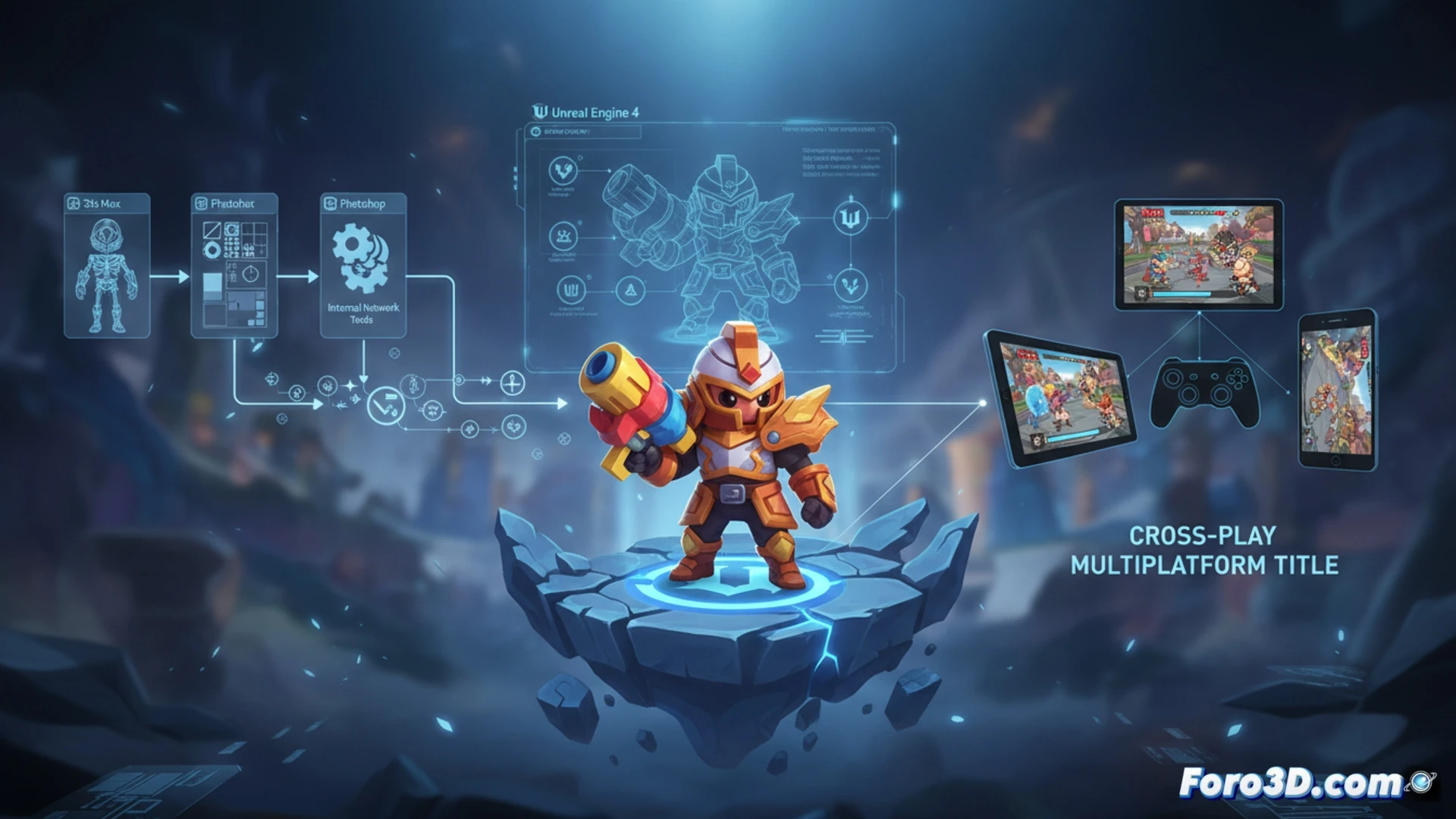
Modeling, Texturing, and Integration in Unreal Engine 4 🎨
The art pipeline begins in 3ds Max, where artists build characters and environments with low-density geometry, prioritizing clear silhouettes over unnecessary polygonal details. This facilitates export to Unreal Engine 4 without sacrificing the game's visual identity. Subsequently, diffuse textures and normal maps are generated in Photoshop to reinforce the cartoon finish, avoiding complex shadows that penalize performance on consoles or mobile devices. Integration into the engine is done through master materials that dynamically adjust the level of detail (LOD) based on the platform, ensuring the frames per second rate remains stable during multiplayer matches. NCSOFT's proprietary network tools manage the synchronization of animations and visual effects, minimizing latency without overloading the graphics processor.
Technical Decisions for Consistent Multiplatform Performance ⚙️
The biggest technical challenge of Battle Crush lies in unifying the visual experience across PC, consoles, and mobile devices. NCSOFT has opted for stylized shading (toon shading) that reduces dependence on dynamic lighting, replacing it with predefined color ranges in Photoshop. This frees up GPU resources and allows Unreal Engine 4 to run the game at 60 FPS even on modest hardware. The decision to use casual art is not just aesthetic, but an optimization strategy: low-poly models and compressed textures travel faster over the network, reducing the bandwidth needed for cross-play. Ultimately, the studio demonstrates that a well-tuned pipeline between 3ds Max, Photoshop, and the engine can overcome technical limitations without sacrificing an attractive visual identity.
How does the technical pipeline of Battle Crush in Unreal Engine 4 balance the multiplatform casual aesthetic without compromising performance on low-power devices?
(PS: a game developer is someone who spends 1000 hours making a game that people complete in 2)