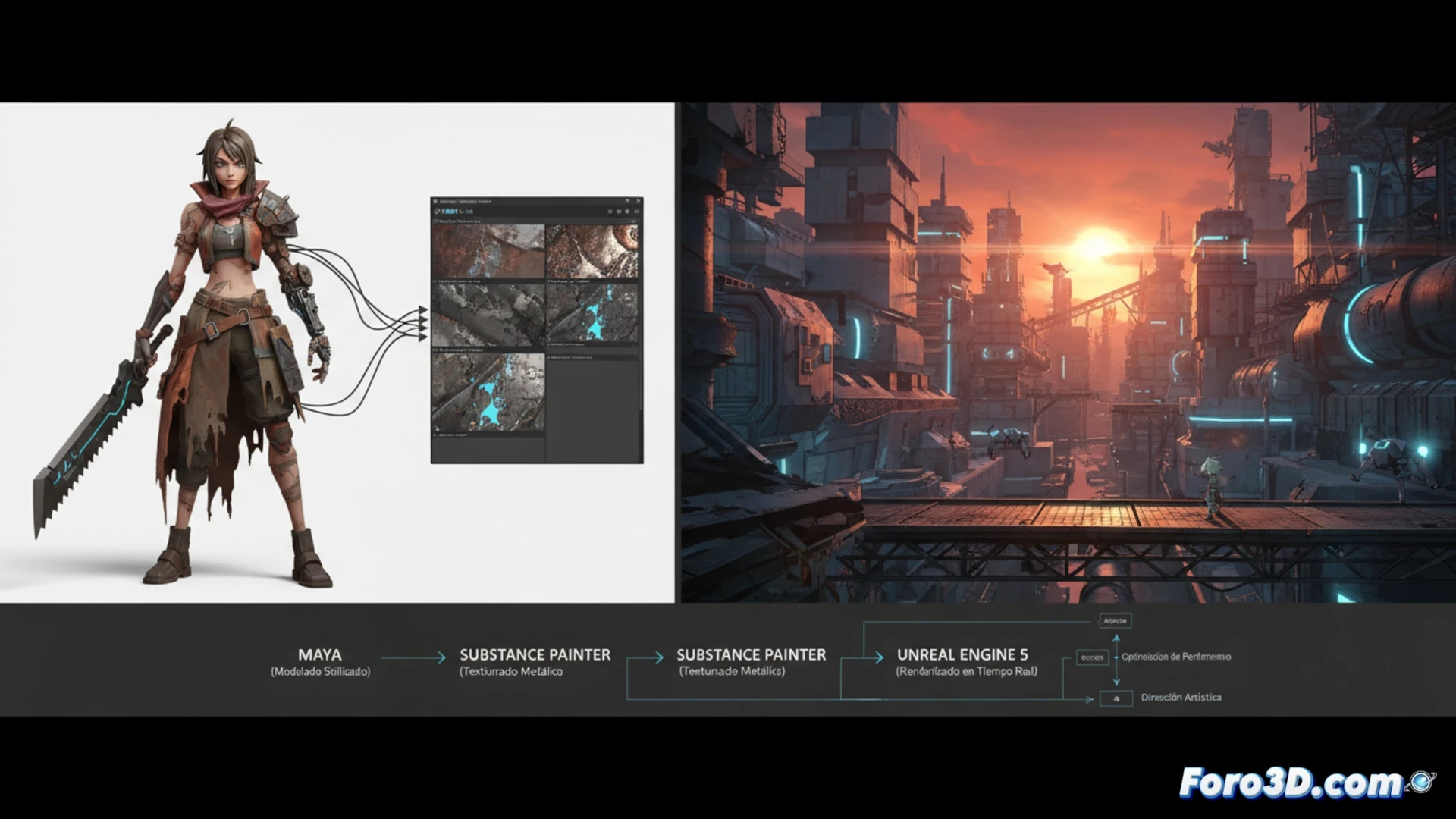
The AI LIMIT project merges the aesthetic of futuristic anime with the rawness of a post-apocalyptic world, using Unreal Engine 5 as its main engine. The technical key lies in combining Maya for stylized character modeling and Substance Painter for texturing metallic surfaces. This approach allows for a high level of detail in industrial environments, optimizing real-time performance without sacrificing artistic direction.
Modeling and texturing for real-time 🎨
In Maya, character modeling is based on clean geometry with topology optimized for deformations, prioritizing angular silhouettes typical of anime. For industrial environments, modular modeling techniques are used to facilitate asset reuse. In Substance Painter, metallic textures are built using layers of wear, rust, and scratches, combined with precise roughness and metallic maps. Integration in UE5 leverages the Nanite system to manage high polygon density, while Lumen handles global illumination, achieving realistic reflections on steel and scrap surfaces without the need for complex baking.
Reflection on the hybrid visual style 🤔
The biggest technical challenge of AI LIMIT is balancing the caricaturization of anime with the dirty, heavy atmosphere of the post-apocalypse. The solution lies in shading: toon shaders with stylized edges for characters, combined with realistic PBR materials for the environment. This duality not only defines the game's identity but also demonstrates how Unreal Engine 5 allows breaking barriers between artistic styles, offering a viable pipeline for independent studios looking to stand out visually without sacrificing performance.
How does AI LIMIT maintain the visual fluidity of anime cel-shading in Unreal Engine 5 while handling the dense lighting and particle effects typical of a post-apocalyptic setting without sacrificing performance?
(PS: optimizing for mobile is like trying to fit an elephant into a Mini Cooper)