At a depth of 3000 meters, a quantum fiber cable appears severed. The initial hypothesis points to a lost anchor, but the marks on the shielding suggest an industrial cutting tool. To solve the case, an ROV equipped with high-resolution cameras is deployed. The objective is clear: to digitally reconstruct the scene and determine whether it was an accident or deliberate sabotage.
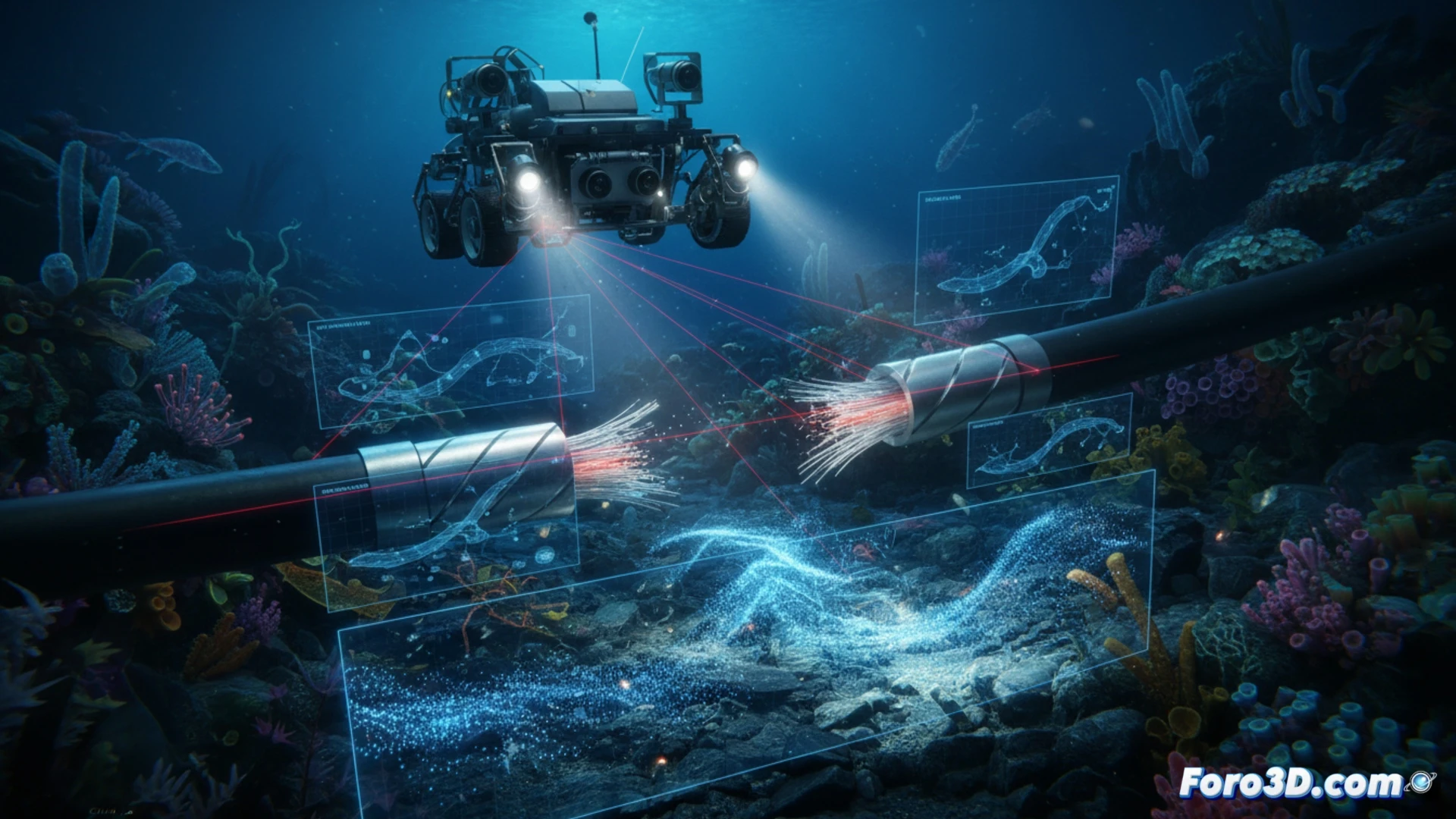
Capture, alignment, and mesh comparison on the seabed 🔍
The ROV performs a systematic scan of the affected area. The images are processed in Bentley ContextCapture, generating a detailed 3D model of the seabed and the damaged cable. This model is exported to CloudCompare for mesh comparison. The geometry of the intact cable (reference) and the severed cable are overlaid. The residual difference highlights the cut marks with millimeter precision. This analysis allows distinguishing the irregular pattern of an anchor drag from the clean, repetitive profile of a hydraulic saw.
Dynamic validation: from solid modeling to current simulation 🌊
With the marks identified, the damage is modeled in SolidWorks to replicate the exact geometry of the cut. This model is integrated into Unreal Engine 5, where underwater currents and sediment trajectories are simulated. The simulation confirms that an anchor would have left an irregular, continuous groove, while the observed clean cut is only compatible with an active tool. The forensic pipeline demonstrates that the quantum fiber was the victim of an intentional act.
What forensic simulation and underwater photogrammetry protocols are most effective for reconstructing the kinematics of a cut in quantum fiber at 3000 meters depth, differentiating between sabotage with quantum tools and the impact of a conventional anchor?
(PS: don't forget to calibrate the laser scanner before documenting the scene... or you might be modeling a ghost)